Following on from the analysis of Blue and Marsh Tit numbers, I have had a look at the same data for the Great Tit: another species that, along with Blue Tits, are supposed to be being advantaged by garden and supplementary feeding in the winter to the detriment of other species. How do the statistics stand up to scrutiny on that?
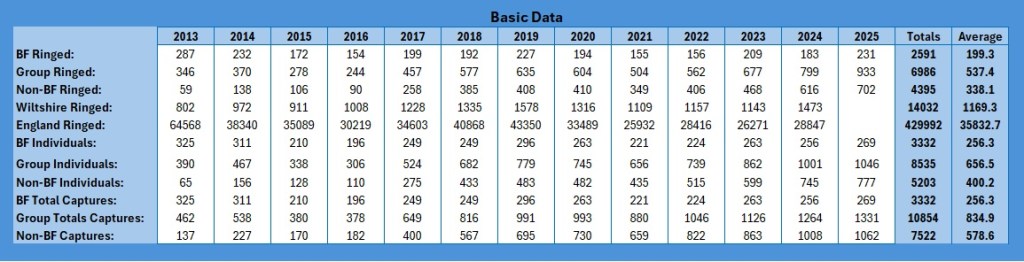
As with the Blue Tits, I only have data up to the end of 2024 for the entirety of England and Wiltshire, but have comparative data for my Braydon Forest sites against the entirety of the West Wilts Ringing Group. These are the basic figures:
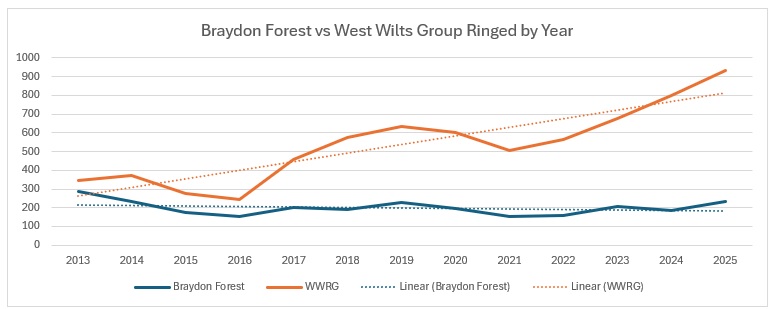
It is interesting to see how small a proportion of the Great Tit catch is found in the Braydon Forest:
The long term trend within the Braydon Forest is a long slow decline: ironically mirroring the trend in Blue Tits. The highs and lows within the Forest are quite smooth, but the growth in the rest of the Group’s activity is significantly different to what is happening there.
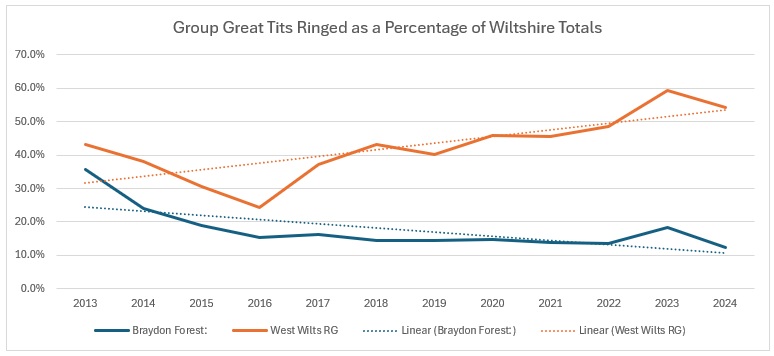
How do they stack up against the rest of Wiltshire:
Obviously, only going as far as 2024 does not reflect the rather large hike in the Group numbers in 2025, however, the downward trend in the Braydon Forest is even more pronounced.
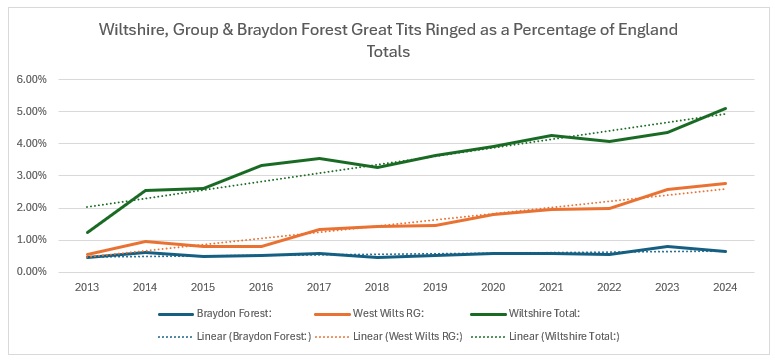
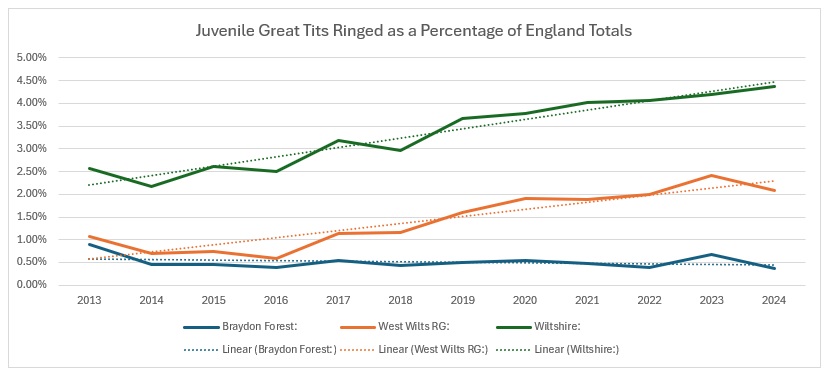
When we compare the Wiltshire trends across the whole of England, the Wiltshire and Group trends are showing a definite increase and the Braydon Forest is neutral.
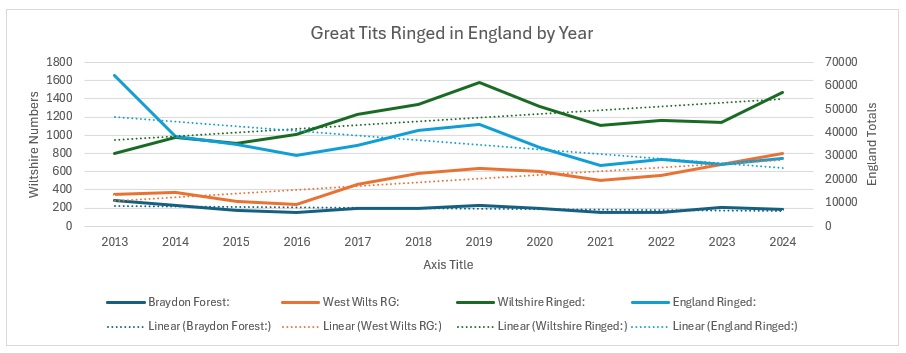
The explanation for that is shown if you graph the actual figures:
As you can see from this, there is a pronounced downward trend of the number ringed across England, even more so than in the Braydon Forest. So it seems that Wiltshire is actually bucking the national trend, with little help from my sites.
As with the other species, I cannot analyse individuals caught for the whole of Wiltshire and England, as that data is not readily available from the BTO (and I would not want to have to work my way through so much data, it is bad enough doing it for our group). I have looked to see if these overall trends are anything to do with juvenile recruitment. As with the Blue and Marsh Tit pieces, the juvenile analysis does not include pulli ringed as within our group only one of the team monitors titmouse nest boxes, and there are none for me to monitor in the Braydon Forest either. So juveniles ringed are beds ringed post-fledging.
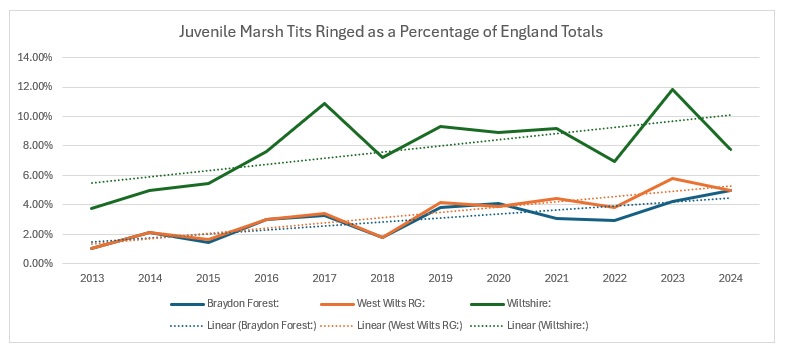
As you can see, the Braydon Forest averages just under one-sixth of the Wiltshire total, the Group as a whole just under half of the Wiltshire total, but when looked at the England total juvenile recruitment, as much as one can extrapolate from ringed birds, the Braydon Forest is producing, on average, 0.51% of the England total, the Group contribution is 1.44% and the whole Wiltshire contribution is just 3.34%.
Again, a slight reducing trend within the Braydon Forest, but significant increases with the rest of the group and Wiltshire as a whole.
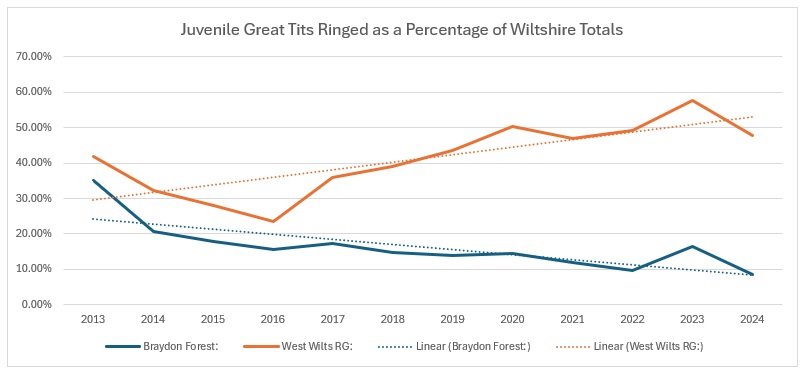
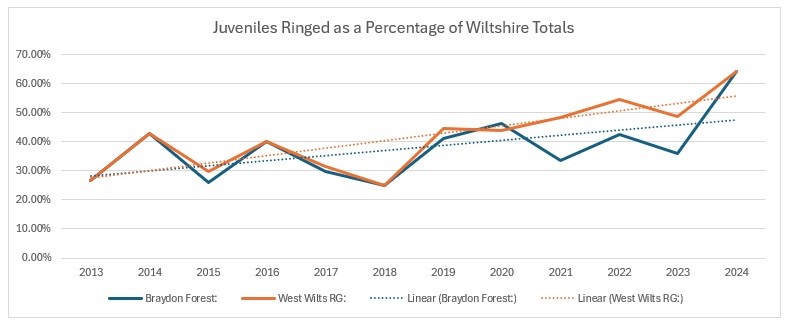
That reduction is more obvious when you look at the Braydon Forest against the Group and the rest of Wiltshire in graphical form.
There was a slight spike for the Braydon Forest in 2023, but it clearly had little impact on the overall trend.
So, the point of all of this: within the Braydon Forest Marsh Tits are definitely increasing, whereas Blue and Great Tit numbers within it are in decline. There are a number of factors but I think key is the absence of titmouse nest boxes.
We seem to have moved from the Ice Age into the monsoon season in very short order. After our excellent sessions at the Somerford Common sites of the 3rd and 10th of January, the next two sessions had to be cancelled because of the wet weather. Last Wednesday was particularly frustrating: we arrived on site but, although forecast to be at zero, warming through the morning, when we arrived on site it was -7oC and it failed to warm at all. For Saturday it forecast to be wet on three of the usual suspects (Met Office, Meteo and Weather.com) but dry on just one (xcweather). I told the team to have their phones on at 6:30 and I would check the actual weather, as the site is within 2km of my home, and confirm or cancel. I went outside at 6:20 and it was wet, cold and miserable, so I cancelled. Back to bed, woke up at 9:30: sunshine, no wind, lots of swearing!
With this week looking wet all week and beyond, Tuesday was the only available day with a chance of getting out. There were warnings about the wind, but we decided to risk it and see how it turned out. I decided to head to Red Lodge, as we have had some good catches there recently. On Friday I went out and topped up the feeders at every one of my ringing sites. When I arrived on site at 7:15 this morning, the feeders had been emptied, so I was hopeful of a good haul. I topped them up whilst waiting for the team to arrive. The team today comprised Laura, Miranda, Ellie and Pete.
We set the usual nets and tried an extra two, just in case. Suffice to say, we could have not bothered with them: they didn’t catch a single bird!
Given how completely the feeders in ride 3 were emptied in such a short time, I was surprised that it did not start catching until the nets had been open for over an hour. In fact, given that the last two sessions there had produced about 30 birds an hour, today it was a mere 10 birds per hour! It did mean that we didn’t have the hectic sessions that we have had recently. Also, it meant that we weren’t pecked to bits by Blue Tits, so that was one benefit. The downside was that there wasn’t much variety in a relatively small catch.
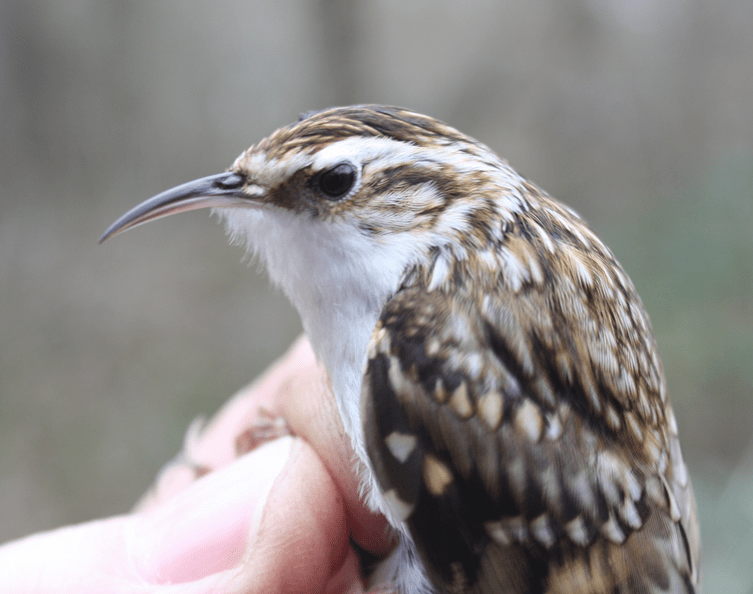
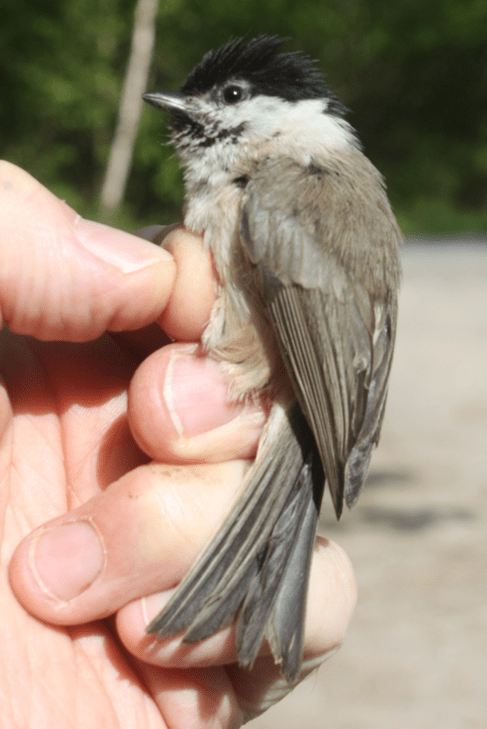
Not that it was all bad: we had our first Treecreeper of the year:
Treecreeper, Certhia familiaris
We caught and ringed another Marsh Tit: that is three caught in the three Braydon Forest sessions this year! We have also recaptured another nine individual Marsh Tits as well. A good start to the year in the Braydon Forest for this red-listed species.
The list for the morning was: Treecreeper 1; Blue Tit 16(6); Great Tit 3(5) Coal Tit 1(2); Marsh Tit 1(1); Redwing 1. Totals: 23 birds ringed from 9 species and 14 birds retrapped from 4 species, making 37 birds processed from 9 species.
So, not the most exciting catch. The Redwing means that the only woodland site left that needs one for this winter is Ravensroost and, weather permitting, we will be there on Saturday (the forecast does not fill me with confidence).
Unfortunately, at about 10:45 the wind got much stronger and consistently so, so we extracted the last birds and closed the nets. Once we had processed them we took down, packed away and left sit by just after 11:30.
It has been quite an astonishing year for two species of titmice within our ringing group. I intend to cover all four species. I started with Blue Tits but will now continue with my obsession, the Marsh Tit, Poecile palustris. The first thing that I noticed was that we were ringing far more individuals in the Braydon Forest sites than we had ever done before. So I had a look at the results for the rest of the group. They were rather surprising. A big thank you to Bridget Griffin at the BTO who gave me the preliminary 2025 figures for Marsh Tits ringed in Wiltshire and England as a whole.
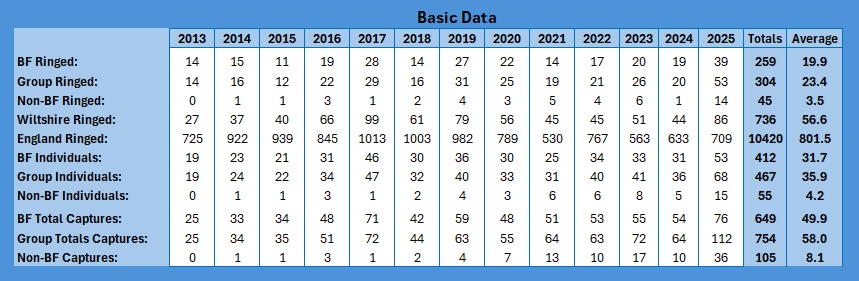
Let’s start with the basic figures: I cannot do individual numbers for Wiltshire and England, as the BTO don’t issue figures for retrapped birds, and certainly not individual ring number histories, unless the owners of the raw data agree to share it. They will release it for a specific academic study on a non-commercial basis, and I am not ready to do that (yet!).
As you can see, more were ringed in 2017 and 2019, but the England total was much higher and, in 2017, the Wiltshire total was higher. When you look at the catch as a proportion of the overall catches it looks like this:
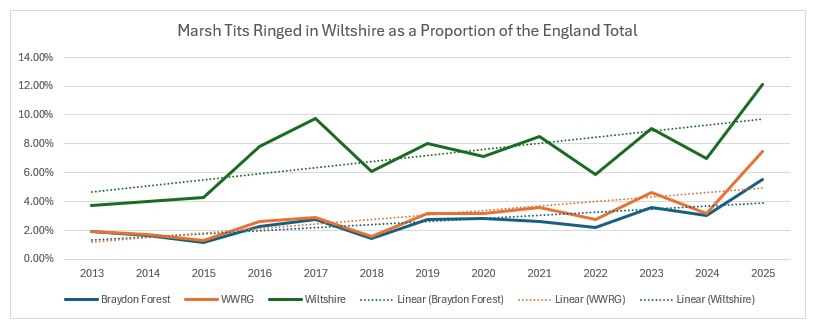
When you graph that, the trend becomes encouraging for the species in Wiltshire:
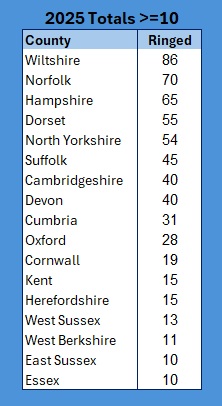
Interestingly, Wiltshire did have the highest number of Marsh Tits ringed in England this year. I have restricted the table to show counties that have caught and ringed more than 10 of them:
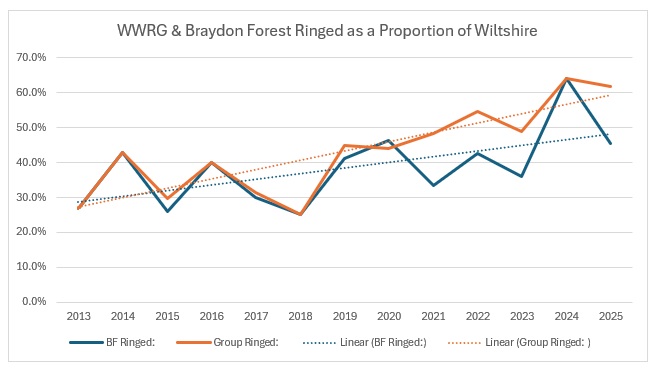
When you look at the West Wilts Ringing Group results and, within that, the Braydon Forest subset, you get the following:
As you can see, in the last two years the group has produced over 60% of the Marsh Tits ringed in Wiltshire. Of course, percentages can be misleading: according to that, despite ringing over twice as many as last year, it is a considerably lower proportion of the catch compared to 2024, although it is our best ever annual catch.
Still, the overall trends are going in the right direction.
Unfortunately, I don’t have the breakdown for 2025 between adults and juveniles for the rest of England or Wiltshire but the breakdowns up to and including 2024, plus 2025 for the West Wilts Group and the Braydon Forest are worthy of looking at. To be as accurate as possible, there are always a few birds that are impossible to age accurately. I have decided to include them in the adult figures and focus only on those that are definitely juveniles.
Looking at the figures graphed up to 2024 is quite illuminating:
As you can see, there is an upward trend across all three data sets and, given the results this year, with 67% of the Braydon Forest catch being juveniles and 47% of the group catch being juveniles, it is looking promising again.
When I compare the group’s activity against the total for Wiltshire it looks like this:
Things are looking hopeful for the Marsh Tit in Wiltshire and a large part of that is down to the catch in the Braydon Forest. As I have said before, the broadleaved woodland area of the Braydon Forest is 0.86% of the Wiltshire total and 0.028% of the England total. Given how Marsh Tit is the most sedentary of the Titmice that I encounter, it is appropriate to look at the size of the broadleaved woodlands in which we set our nets. That is 0.15% of the Wiltshire total and just 0.005% of the England total. To put that into perspective: the 5.5% of this year’s total of Marsh Tits ringed was ringed in 0.005% of the available broadleaved woodland in England!
As I have said in my previous analysis on Blue Tits, my theory is that the reason that Marsh Tits are stable in the Braydon Forest is because we have virtually no Titmouse nest boxes in the woodlands, and very few other boxes, except bat boxes. As a result our local Blue Tit population is stable but with a slight decline. Interestingly, given that the increase in Blue Tits is being blamed as a factor in the decline of Marsh Tits by some academics, the BTO Garden Birdwatch Scheme, of which I am a long term member, has registered long term stability in the reporting rate of Blue Tit numbers across England. In the last 10 years, up until the end of2025, there has been a small decline.
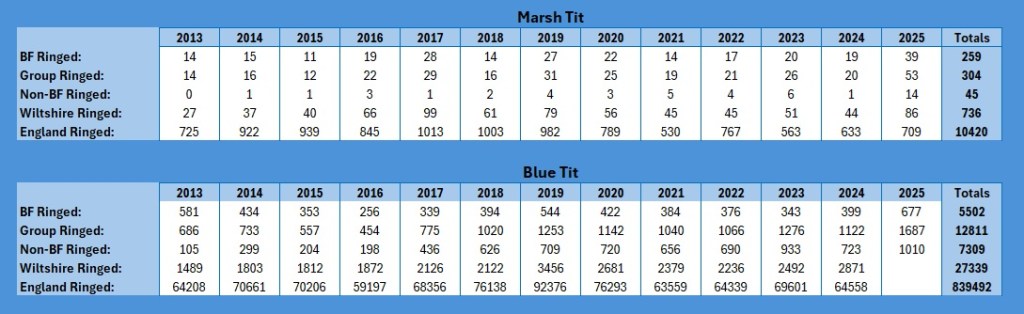
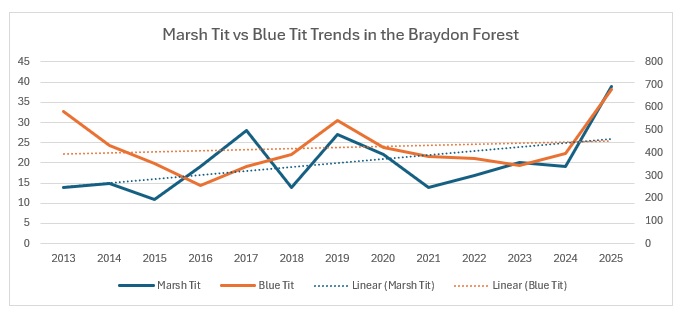
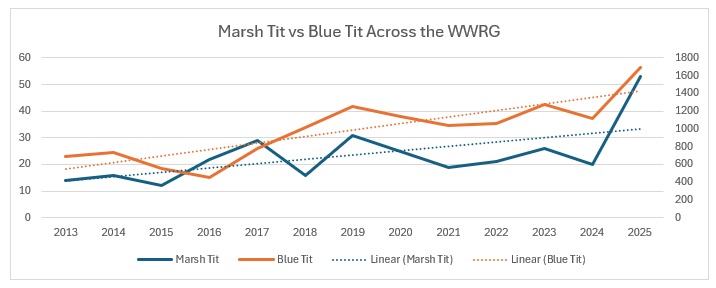
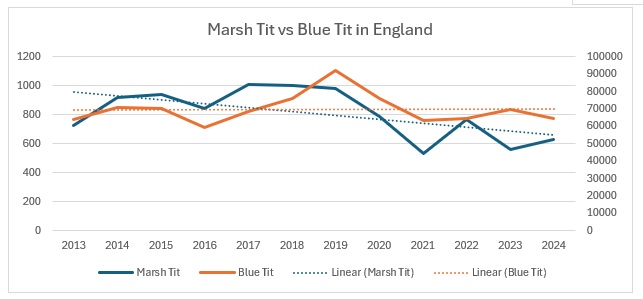
Anyway, as a footnote, here is a series of figures and graphs showing the ringing trends for Blue Tit vs Marsh Tit. The data for Blue Tits for Wiltshire and England only go as far as 2024, so those two graphs, and the trends, only go up to that year.
As you can tell, the trend of Marsh Tit growth in the Braydon Forest is positive, and has overtaken the trend in Blue Tits over the 12 years of my ringing team working there. The trend across the West Wilts Group shows that populations of both are increasing, but the Marsh Tits not as rapidly as the Blue Tits, but increasing.
Across Wiltshire the Blue Tit population is increasing, whilst the Marsh Tit population is stable. However, the trend for England shows that, whilst the Blue Tit numbers are stable, Marsh Tit numbers are falling, as we all know.
So, what is the difference between the Braydon Forest and elsewhere? I suggest the lack of nest boxes but am open to other suggestions. It probably goes without saying but there are villages and hamlets and single houses dotted around the Braydon Forest which feed the birds in their gardens and, as I have stated multiple times, I feed my ringing sites between October and mid-March depending upon the onset of cold weather.
As a final note, things are already looking quite good for 2026: Matt Prior of the North Wilts group actually ringed 12 Marsh Tits in a session on the 10th January, and in my first two sessions of this year I have ringed two and retrapped another eight individuals.
I cannot wait until I get access to the 2025 Blue Tit ringing results for England and Wiltshire in 2025, as the basic data for the West Wilts Ringing Group is looking pretty good and the part the Braydon Forest has played in that is everything I wanted.
One of the arguments advanced by the anti-feeding academics is that feeding Blue Tits is helping drive the extinction of Marsh and Willow Tits (British Birds, January 2022). My argument is that they have two conflicting positions: one is that supplementary feeding of birds helps spread disease, reducing their populations, the other is that feeding birds is boosting the populations of those birds that take advantage and disadvantaging birds who don’t. Furthermore, the population of Marsh Tits is not only stable but slowly increasing, even if one of the authors of the British Birds paper described it as “insignificant”. I have already refuted that, although I doubt he will have read it: he doesn’t like data that doesn’t support his prejudices.
My theory is that any increase in Blue Tit numbers is almost entirely down to the provision of nest boxes, not feeding, because, by supplementary feeding, those species that don’t participate have less competition for natural food sources. Neither is scientifically valid without further investigation but I think that my opinion is plausible.
Our group has had a phenomenal year for Blue Tits in 2025: with a one-third increase in adults and pulli ringed. Again, I will be waiting for the release of the ringing figures for 2025 before I can be definitive. What I have done with the graphs is stick to full data, as much as possible. The figures I have published exclude pulli ringed, as that has only been a part of our activity since Jonny took over the Wiltshire Wildlife Trust sites at Green Lane Wood and Biss Wood and started ringing pulli there and a few other areas in 2023.
So to start, these are the basic figures:
I have counted the number of individuals caught each year as well. This is a combination of every bird caught in the year, ringed or retrapped, but the ring number counted only once. Retrap data is not available for Wiltshire or England as a whole, so I am not able to include them.
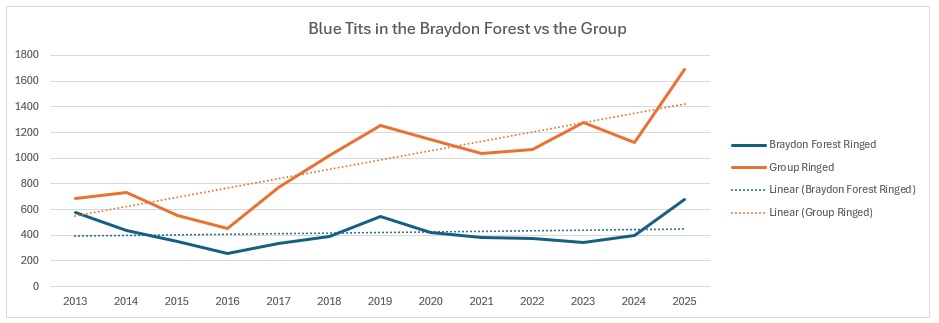
Let’s start with the numbers of fledged birds ringed and how the population in the Braydon Forest vs the total ringed by the West Wilts RG by year:
It is pretty clear from this graph that the population trend in the Braydon Forest is very stable and that the trend is pretty static. When you compare that with the Group results it is clear that the rest of the group sites are showing a population expansion. A lot of that is down to Jonny taking on new sites. However, one of the key things about two of those sites and the Braydon Forest, is that they have large numbers of nest boxes installed for titmice, bats and dormice in those woodlands. Those two sites have over 88 boxes between them: 50 in Green Lane Wood and 38 in Biss Wood. Some of those boxes are intended for dormice, but Blue Tits are frequently found in those boxes. Whereas in the Braydon Forest we have no titmouse boxes, and most of the dormouse boxes have been removed from our ringing sites. However, between October and until the weather improves in March, I do supplementary feed all of my ringing sites, topping up once per week with peanuts and seed mixes. As Jonny does with his sites, so the only difference in our records is the lack of nest boxes in the Braydon Forest!
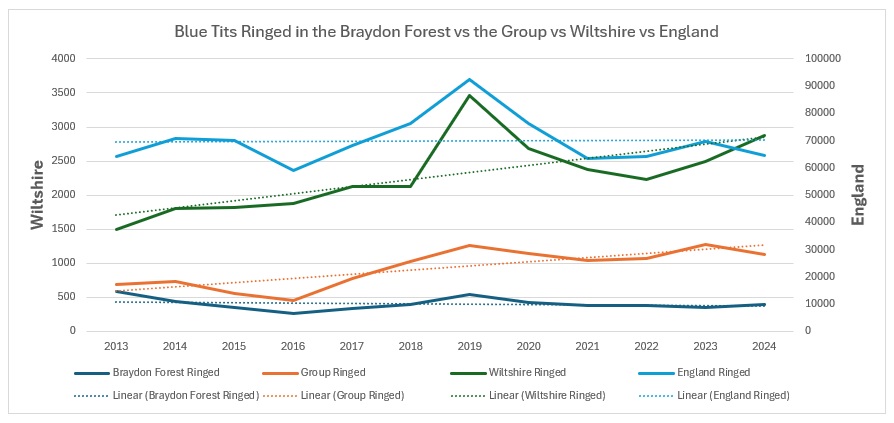
If we look at the ringing records for which we do have data for both Wiltshire and England, 2013 to 2024, it looks like this:
The interesting thing to note is that the trend line across England matches the trend line for the Braydon Forest, whereas the WWRG total matches the trend for the whole of Wiltshire (obviously, I have had to use separate axes because the England numbers are huge). It is pretty clear that 2019 was a very good year for Blue Tits, although the bulge is somewhat less for the group and even less so for the Braydon Forest.
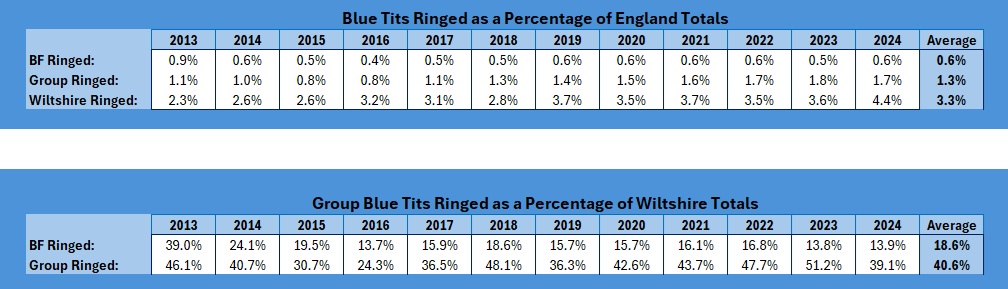
If you look at the totals on a proportionate basis, it gets more interesting:
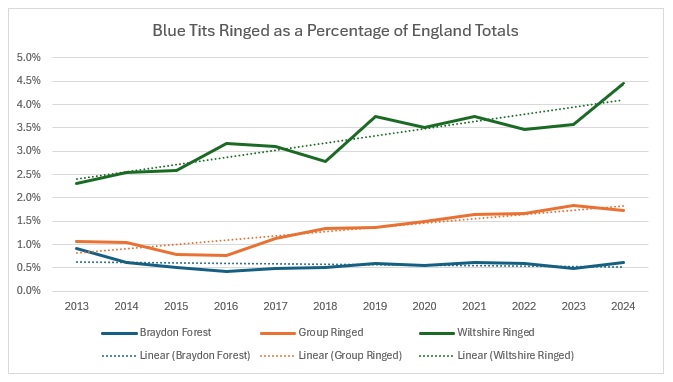
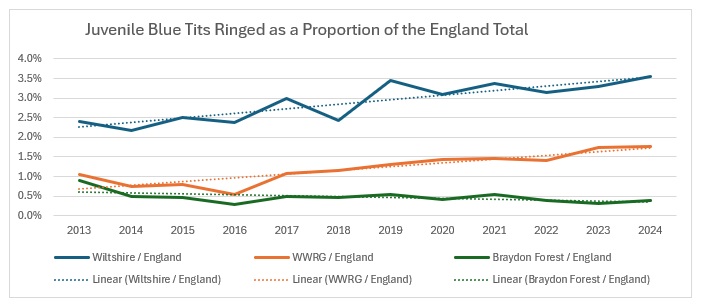
When we graph up how this looks, firstly as a proportion of England as a whole:
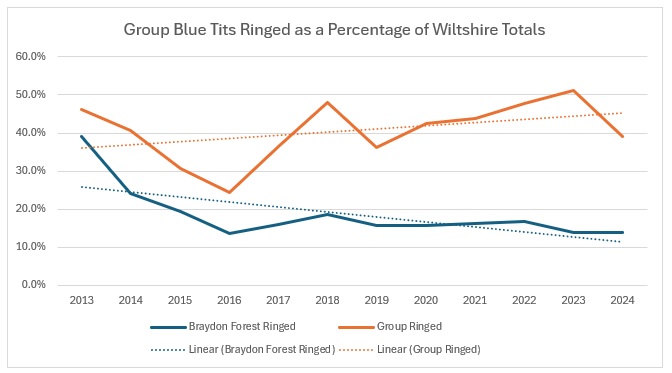
Again, it is clear that the Braydon Forest trend is stable, but also showing a slight decline. When we look at them as a proportion of the Wiltshire total:
The decline in the Braydon Forest against the increase in the Group is very much clearer when compared at this scale. Some of this will be due to the additional sites taken on outside of the Braydon Forest but, when you look at the overall picture, stability is the word in the Braydon Forest, whereas growth is what is happening across the Group and Wiltshire as a whole.
Where is this staggering increase in Blue Tits across the whole of England that is causing decline of other species? What does it say about the population of Blue Tits in the Braydon Forest, supplementary fed throughout the winter in the woodlands, and fed all year round in many of the local gardens? To me it says that the provision of nest boxes is a far bigger driver of population expansion than feeding. The paper that started all of this was produced by Shutt et al in September 2021. Their paper on establishing Blue Tit movements by taking faecal samples at known distances from the feeding stations identified that Blue Tits can move long distances. There were several things I found concerning about this study: there was no individual identification of the birds; so they did not know if it was one bird going backwards and forwards or many birds just passing through. If they did do this analysis, I could not find it in the paper they published, although the BTO ringing scheme was acknowledged. The other issue they did not address is the simple fact that they got their faecal samples from titmouse nest boxes they put up at known distances from the feeding stations and they took no account of the impact of providing nest boxes on the expansion of the Blue Tit population. At the time I stated regularly throughout my piece, that I wasn’t questioning their results, just that I was not finding the same situation in the Braydon Forest. That said, I did raise the question of not taking account of providing nest boxes for collecting samples. I have no wish to malign them, so you can read their paper here:
I believe that the Edward Grey Institute of Ornithology use pit tags to monitor movements for their study: no need to provide nest boxes, just tags on the birds and receivers at the feeding stations.
In response to Shutt et al. I published an assessment of the movements in and out and around the Braydon Forest, and they are minimal. We do have the second longest movement of a Blue Tit ever recorded in the UK: AVF6109, ringed in the Highlands of Scotland in November 2019 and recovered in Ravensroost Wood in January 2022, a distance of 639km in just over two years. If you are interested in seeing just how minimal the movements in and out of the Braydon Forest are the link to my blog piece is below:
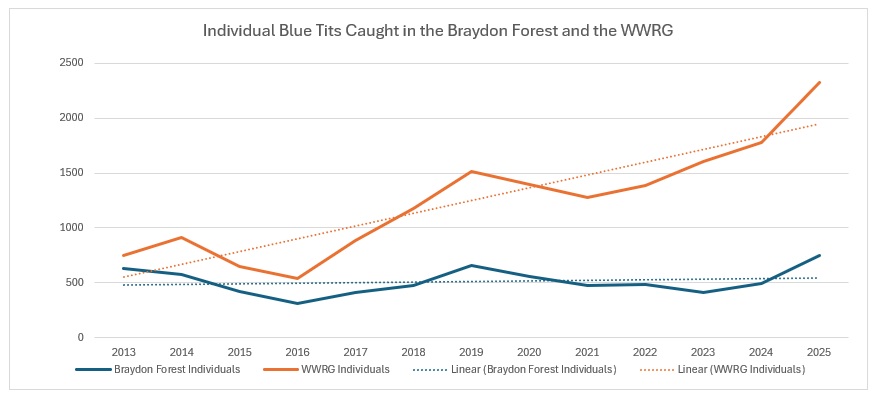
I have also had a look at the number of individuals processed each year in the Braydon Forest and by the Group as a whole. By individuals, I took birds ringed and retrapped, and counted each ring number split by year, counting multiple occurrences in the year as one and not the sum of them all:
The trend is very much the same as it is for the ringing numbers.
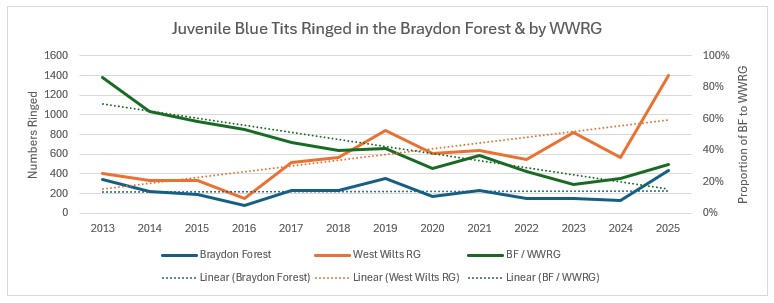
Finally, I have looked at the number of juveniles ringed in each year for our group and the Braydon Forest:
This shows the data up to, and including, 2025. As you can see, there is a stable situation in the number of juveniles ringed in the Braydon Forest over that period, despite the spike this year. When you look at the juvenile recruitment as a proportion of the Group, there is very clear decline within the Braydon Forest.
Looking at the trends as a proportion of the total juveniles ringed in England is quite informative:
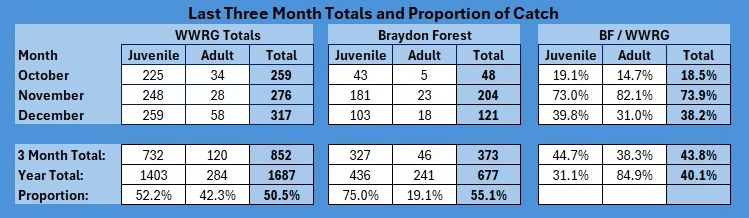
I have had to leave out the 2025 group data as I don’t have the values for Wiltshire or England to compare. Again, it just goes to show that the Braydon Forest situation seems to be very stable. It is somewhat surprising as in the last three months of 2025 we had our biggest catches of Blue Tits:
As you can see, we caught 55.1% of our entire Braydon Forest Blue Tit catch in those three months. What I find surprising is that, despite a 73% of the catch in November being juveniles, the sort of proportion I expect, but the rest of the quarter brought it right down just 31.1% of the Group’s catch in that period. Our proportion of the adults caught in that quarter is remarkable: nearly 85% of the entire Group catch! Over the year it seems that juveniles made up 43.8% and adults 40.1% of the Group’s annual catch.
To finish: I plan to keep monitoring the numbers and will update this post as and when I get the final data figures for 2025. One of the key reasons for carrying out this work was because both the Group and our little Braydon Forest project on Marsh Tits have generated some excellent results for that species this year, which I would contend, in the Braydon Forest, is down to the fact that there are very few artificial nest sites. I won’t spoil the surprise.
I went out to top up the feeders ready for a session on Wednesday. I was rather pleased to find a Woodcock hoovering up some of the seed under the feeder. It flew off as I approached and landed within a nearby stand of conifers, where I have seen them before. When it warms up a bit I will have a go at catching it. Anyway, I had to cancel Wednesday’s session at Somerford Common, due to a head cold, so I decided to try again this morning. At first it didn’t look as if we would manage to get out, as the forecast was for it to be -4oC today but, fortunately, the forecast changed and that it would be above freezing from 9:00. When we arrived on site at 7:30 it was -2oC and by the time we had set up it was above zero and, although one could never say it got warm, it certainly became less cold.
I was joined for the session by Laura, Adam, David and Pete, and a little later, by Claire. It was great having that many hands available to extract the birds in cold conditions. Claire scribed alongside me, with the others processing the birds.
We set our usual nets but moved the ringing station into the paddock where we have the feeding station. The reason for that is that there is a very muddy slope leading up to the feeding station area: it is either a slip hazard when it is above freezing (hence my reference to it as Sommerford Common previously), or a danger to your ankles when frozen. The case today was that we would have both situations at different times during the morning. In the event, the nets along the main path continued to catch very little and from 9:30 the nets froze, which is quite remarkable given that in the paddock area the sun had broken through and it was definitely above zero.
As expected, the catch was, once again, Blue Tit heavy. The good thing about it is that 44% of our catch today were retrapped birds: makes it cheaper for me, anyway. Unlike recent sessions, the catches were very consistent throughout, even as far as the last session, when we caught a final 18 birds. At no point were we under pressure to work through a mound of birds, breaking off to go and get the next batch from the nets, so they weren’t left out in the cold.
The list for today was: Nuthatch 2; Blue Tit 38(26); Great Tit 8(11); Coal Tit 2(3); Marsh Tit 1(4); Wren 1; Dunnock (1); Robin 3(3); Redwing 1; Chaffinch 6. Totals: 62 birds ringed from 9 species and 48 birds retrapped from 6 species, making 110 birds processed from 10 species.
It is a good start for our Marsh Tits: if we keep ringing one per session I will be very happy! But to retrap four of them ringed late last year was very pleasing. Hopefully we will see more of them over the course of this year.
One more Redwing taking our total to three this winter! We were treated to / frustrated by a couple of flocks flying overhead, but they were staying up in the tree tops. Talking of staying in the tree tops, my personal highlight was a Lesser Spotted Woodpecker. It was calling from the highest tree within the stand of trees that the Woodcock had flown off to on Tuesday. It eventually flew off. We did have a Great Spotted Woodpecker come in. It flew down from the trees and headed for one of the peanut feeders! It hit the net, bounced off, hit the net again, fell into the pocket, scrabbled out, hit the net bounced off and managed to fly off!
We did our last round at 11:40 and shut the nets as we went. After processing the last birds, we took everything down and packed away: many hands make light work and we were off site by 12:30.
Driving home I had the pleasure of watching a male Sparrowhawk hunting along the hedgerow lining the minor road. It was an icy road so I was driving slowly, so I had the fun of following for about 50 metres before it broke off to follow the next hedge line.
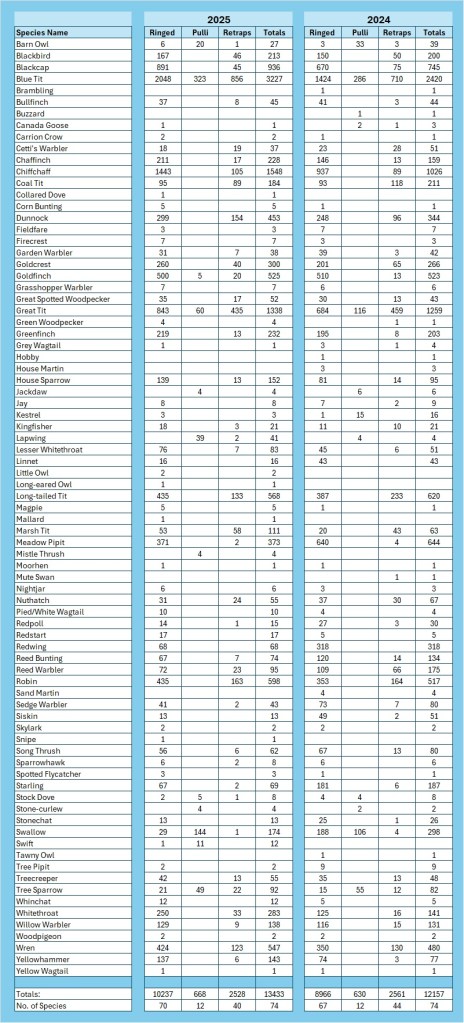
For the fifth year in a row our results have increased in number. The significant increase has been in the numbers ringed, with several significant increases and a couple of significant decreases. It ha beaten last year’s previous best total by over 1,000 birds, the vast majority being birds ringed, a small decrease in retraps and a small increase in pulli.
This was a new species for the group since it came into its current structure at the beginning of 2013:
Adult Little Owl, Athene noctua
The first was caught on the Imber Ranges by Ian and Andy in January. The second one caught this year was by Jonny at his Sutton Benger site. Miranda and I would have been jealous if it wasn’t for the fact that we both got to ring Little Owl when out with the Salisbury Plain group!
Juvenile Little Owl, Athene noctua, (Not my nails!)
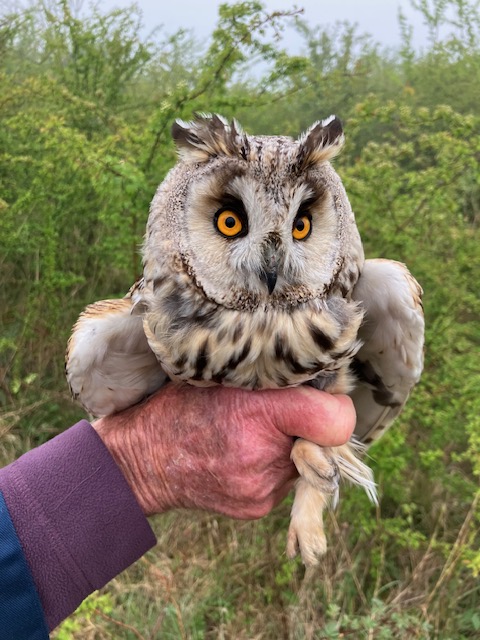
Of course, that wasn’t the only good Owl story: Andy and Ian caught our second ever Long-eared Owl: in April on the Imber Ranges. The first was in August 2020.
Long-eared Owl, Asio otus
Barn Owls had a torrid year across the county. Proportionately, our group has had a better year than the Salisbury Plain group, but it was still one-third down on 2024. However, we did double the number of adults ringed, from three to six. The problem was very much a reduction in the number of voles and field mice available in the Spring, due to the cold dry weather and the failure of grass to grow until much later than usual reducing available prey. Kestrels changed diet to small birds and beetles, so did slightly better.
Alongside that, Blue Tits have had a phenomenal year: over 600 more fledged birds ringed than last year. Great Tits also had a good year, with 159 more ringed than last year but, proportionately, Marsh Tits have fared best of the titmice, with a 159% increase on last year! Several reasons for that: my Braydon Forest sites had their best ever year, with more than double last year’s total, from 19 ringed to 39 ringed. That is the best catch since 2018! In addition, Jonny’s two Trowbridge sites have started to produce numbers and his new site near Lyneham has also added well to the total. Bear in mind that the total number of Marsh Tits ringed in Wiltshire in 2024 was 44 and this year we have ringed 53! Hopefully this isn’t an isolated upsurge. It would be great to see this reflected across the country!
Anyway, all of the figures are there, I will do some detailed analysis on different species. The only declines that I will mention are: the severe decline in Meadow Pipit: that was almost entirely down to their scarcity at Blakehill Farm this year: 97 last year and just 2 this year, plus Jonny’s East Tytherton site dropping from 160 to 36. No idea why, apart from our not getting many Blakehill sessions in due to the continuous winds blowing across the plateau.
The other is Starling: a near two thirds reduction in numbers caught! The key areas in which we catch them are my back garden and Andy’s back garden. My reduction is purely down to my carrying out very few netting sessions in my garden. I only did two sessions in which they were caught and, whilst Andy did 23 this year and 40 in 2024. These are not total sessions but the ones in which we caught Starlings.
Watch this space, I will be providing some further analyses in the near future.
I went out to top up the bird feeders yesterday, having already done so on Monday, but with how the weather has turned in the last week, supplementary feeding has never been more important so far this winter. At 11:30 yesterday the back roads were treacherous: I had to remind myself of the skills I learnt when I learned to drive up in Northumberland! Even though, I had one nasty snaking experience on the way out and, on the way back, the car decided to go straight on at two junctions, despite my only driving at 20mph! So I emailed the team and suggested that they should seriously consider not coming this morning if they were at all concerned about driving in freezing conditions, especially as the forecasts were all predicting -6oC first thing. Fortunately, whilst it was cold, it was -1oC when we arrived at 7:30 but, by the time the nets were open at 8:30, it was above freezing and actually a higher temperature than last Wednesday’s session.
So the nutters in the team, besides myself, are Laura (and Adam) and Pete. We set the same nets as last time we visited this site. The birds started coming in straight away, and how they came in! We were extremely busy all morning, to the point that we decided to empty and shut the nets at 11:00: and took out another 35 birds.
As before, the catch was Blue Tit heavy, but the most pleasing titmouse capture was Coal Tit. We had our second largest haul ever, and the largest since 19th January 2018! However, that catch of 26 birds comprised nine ringed and 17 retraps. Our catch today, 16 ringed and just three retraps, is the biggest catch of unringed Coal Tits we have had. The previous best was 12 ringed in 2013 on the 30th November 2019.
One other titmouse bonus:
Marsh Tit, Poecile palustris
Alongside our first ringed Marsh Tit in our first session of the year, we retrapped four others! Three ringed early last year and one in 2024.
Our third Redwing of the winter duly arrived early on, but no others hit the nets. The list for the session was: Blue Tit 51(8); Great Tit 10(5); Coal Tit 16(3); Marsh Tit 1(4); Long-tailed Tit 5; Robin 3(2); Redwing 1; Chaffinch 1. Totals: 88 birds ringed from 8 species and 22 birds retrapped from 5 species, making 110 birds processed from 8 species. This is our biggest ever catch in January at any of our Braydon Forest sites, a total of 53 Braydon Forest January ringing sessions!
Contrary to the forecasts, at no point did the temperature drop below freezing. At about 11:15 the sun came out and things warmed up quite nicely. About 11:45 the forecast gusts of wind arrived and, coming from the north it was very cold. By the time we had packed away we were pretty chilled, and I don’t mean “laid back”.
With the nets all closed we got on with processing birds. We had quite a few to process as, in the cold, we check the nets more frequently, as the birds are warmer in the bags than in the nets, so we had a fair backlog to process. Laura’s hubby Mark had turned up and cracked on helping me with the scribing. We finally finished processing at close to half-past-midday and set about taking down the nets and packing away. We finally left site at about 13:15
* As a postscript: I had a check on the number of Coal Tits ringed within our group since 1st January 2013 and this number of 16 is the largest number ringed ever within the group.
An excellent December, our best yet, beating the previous best, 2020, by 12 birds! That year’s came from 30 species. This year’s total came from only 27 species. This is the comparison with last December:
Added to our list this year were Corn Bunting, Starling, Tree Sparrow and Yellowhammer. Missing from the list were Bullfinch, House Sparrow, Jay, Linnet, Meadow Pipit, Redpoll and Siskin.
The key differences are a 43% increase in the number of birds ringed and a 46% increase in retrapped birds, albeit from two species fewer ringed and four species fewer retrapped.
It is pretty clear what the main difference is: Blue Tits have clearly had a tremendously good month. That split into 264 juveniles vs 60 adults ringed. Compare with 2024: 107 juveniles to 72 adults ringed. More informative is the ratio of adults to juveniles. In 2025 the ratio is 18.5% to 81.5%, whereas in 2024 it was 40.2% to 59.8%. It looks like it was a good breeding season for Blue Tits this year. The annual results will show more.
Great Tits showed an identical number of retrapped birds but 29 more ringed. That comprised 18 adults and 65 juveniles, as opposed to 9 adults and 45 juveniles in December 2024. The ratios are 21.7% to 78.3% in 2025 compared to 16.7% to 83.3% adults to juveniles in 2024. So it looks as though Great Tits had done a bit better in 2024 than this year. I will do full year comparisons in the next couple of weeks: I have a number of records to come in yet for earlier in the year.
Marsh Tits, with three ringed compared to one last December and 19 retrapped compared with just four last December underlines what an excellent year the species had in 2025. In the whole of 2024 we ringed four adults and 16 juveniles. In 2025 we have ringed 14 adults and 39 juveniles. This is our group’s best ever year for the species. To put it into perspective, last year 44 Marsh Tits were ringed in the whole of Wiltshire, and we ringed 19 of them. We have ringed nine more than were ringed in the entire county last year. My catch has more than doubled, from 19 ringed in the Braydon Forest in 2024 to 39 ringed in 2024, adding to the catch this year are Jonny’s sites at Biss Wood and Green Lane Wood and his new site at Catcomb Wood.
Although Robin totals were close, the majority this December were ringed: 3 adults to 13 juveniles, compared with just seven last December: 2 adults to 5 juveniles. Ratios again: 18.8% to 81.2% in 2025; compared with 28.6% to 71.4%. It will be interesting to see how that works out over the course of the year. My thought is that smaller insectivorous birds have had a much better breeding season than larger carnivorous / omnivorous species.
Last piece from me: Jonny caught a single Corn Bunting at a farmland site near Hilmarton back in January 2024. He has caught no more until this December when he caught five in one session. Lovely and the first bird I ever ringed!
Anyway, an excellent December, even if we have all been pecked to pieces by Blue Tits. All the details are there.
The last session of the year was held in the Firs. It was a cold start -3oC: the inside of my car was frozen, despite the cold weather cover! However, with the group I had coming out from a range of places, mostly south Gloucestershire, I knew we could handle the process without harm to the birds and, I am pleased to say, the team proved me right. I was joined for the session by Laura and Adam, Steph and daughter Lillie (Lillie ringed her first bird at age 6, she is now 16 and an excellent ringer) and Pete. Bea came along with Steph, to keep us entertained! With six of us to extract we could stay on top of the extractions and processing.
The Trust had been in the Firs, doing some more management, opening up the central glade. This resulted in the area down the slope being unsuitable for nets, so we extended the bottom nets by an additional 18m. I had planned to go further. However, this took us to where the bulk of the management work has been carried out: massive clearance of the undergrowth and small trees, leaving just a wide expanse of old Beech and Oak and not suitable for netting. In reality it is probably just as well, given how the morning panned out.
As ever, the first bird out of the nets was a Blue Tit, before they had been opened! Just like recent sessions: Blue Tit was the predominant species. Fortunately, the majority were retrapped birds.
The list for the day was: Great Spotted Woodpecker 1(1); Nuthatch (1); Blue Tit 27(38); Great Tit 8(9); Coal Tit (1); Marsh Tit (3); Long-tailed Tit 2; Dunnock (2); Robin 1(4); Redwing 1; Blackbird 2; Goldcrest (1); Chaffinch 6(1). Totals: 48 birds ringed from 8 species and 61 birds retrapped from 10 species, making 109 birds processed from 13 species.
We had multiple highlights: no Redwing all autumn and winter and now two in two sessions: very happy with that. Seven Chaffinch in one session is our best haul in the Firs since I started ringing there in 2012, and then when I started training in 2015, my trainees started helping me. Looking at the other Braydon Forest sites, the only one that has ever had a bigger catch of this species is Ravensroost Wood: on three occasions at the winter feeding stations, but not since 2018.
Also somewhat ironic: having not caught and ringed a Blackbird since 9th October this year, we caught and ringed one in our last session and another today. Perhaps better than that, we hadn’t caught and ringed any Great Spotted Woodpecker since the 9th September and have now ringed one in each of the last two sessions.
It is quite remarkable that the last two sessions in this wood have produced 222 birds from 14 species. My first two sessions in the Firs, in 2012, caught just 29 birds from 7 species. This year has produced more birds than in any previous year: 583 birds processed from 23 species. The second best year was 2019: with 427 birds processed, from 21 species.
We did a final round and shut the nets at 11:30, processed the final 20 birds and, with so many hands to pack away it was all done very quickly and we were away from site just after midday.
A final note: once again a local hunt, probably the Vale of the White Horse Hunt, allowed their hounds into the wood chasing a fox which, I am pleased to say, managed to escape their jaws. This is criminal activity and the sooner the trail hunting lie is banned the better. As well as foxes and badgers nearby, that wood has roosting Woodcock and a host of other wildlife. It is a nature reserve: not a playground for perverts! Unfortunately, the Wiltshire PCC is pro-hunting and has been proven to have misrepresented sab activities, so dealing with hunting crimes is deprioritised for Wiltshire police – a commonplace situation within UK policing unfortunately.
With Wednesday being blown away by astonishingly strong winds, I was a bit worried about the forecast for this morning. It was for it to be 12 to 14mph, with gusts to 20mph, between 7:00 and 10:00. That was to be followed with base winds of 15 to 20mph and gusting to 29 to 35mph. Unfortunately, they got it absolutely correct and we had to start shutting the nets at 10:30. By then we had caught a decent number of birds, with good variety and a few top catches for this winter.
I was joined for the morning by Steph for the first time for a long time (with daughter Bea and, later, hubby Stuart), Claire, also for the first time for an age, Pete, then Laura and Adam arrived, later than the others as arranged, as they had to make their way back from a family Christmas in Winchester (hubby Mark arrived about 9:00) and, by the time my new friend Ralph turned up with his Mum and his Grandad (see the last Somerford Common West blog piece), it seemed like quite a family affair!
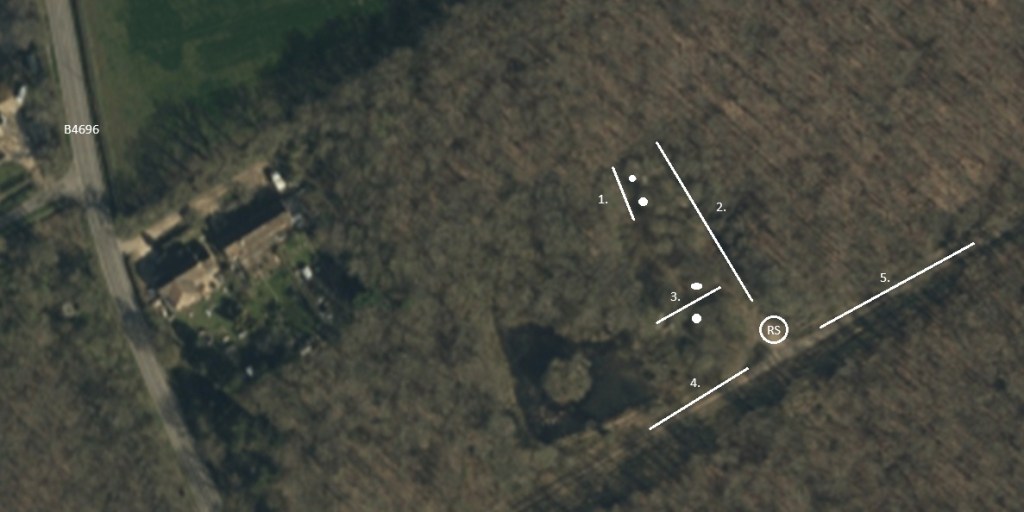
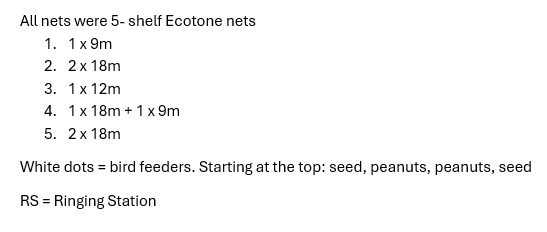
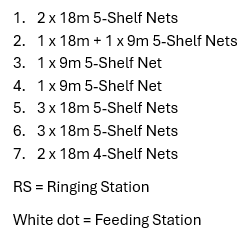
Because of the size of the ringing team we had out, I decided to set some additional nets. We set the following:
It started well, the first bird in the nets, ride 2, before they were even opened, was a Marsh Tit. Not only that, it was a new one: number 39 for the year! We will be in the Firs on Wednesday: I am so hoping for number 40!
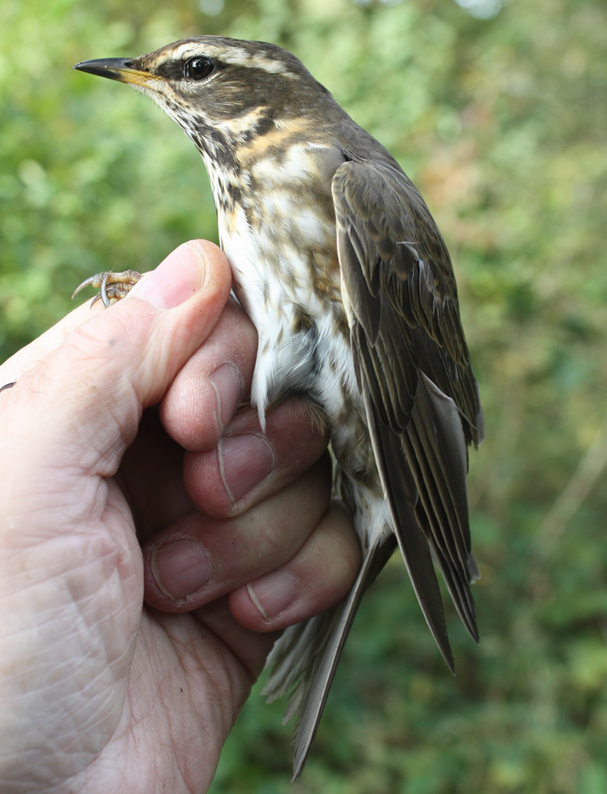
As soon as the nets were open the birds started piling in, and it was very busy for the two hours that we had them open. I went to extract a Great Tit from ride 5. Whilst doing that, I looked along to ride 6 and noticed a number of birds hitting the nets. Ride 6 is not one we use often but in that first round I extracted eight Long-tailed Tits and a Robin. However, the best bird I extracted from that ride was this:
Redwing, Turdus iliacus
Our first Redwing of the autumn! To put this into perspective, it has been our worst autumn / winter catch ever: 25 birds fewer than this time last year! We will need to catch six more in the Firs on Wednesday to equal our worst ever previous autumn / winter result.
The rest of the team were extracting from the nets around the feeding station. I got the better of the deal: no Blue Tits!
As I was walking back from those ride 6 extractions, a Blackbird flew into ride 5. This is the first Blackbird that we have ringed since the 9th October! That is quite an astonishing gap between catches. It is thirteen blank sessions since we caught one! We have ringed 33 so far this year, which is about average, but the longest gap we have had between catches.
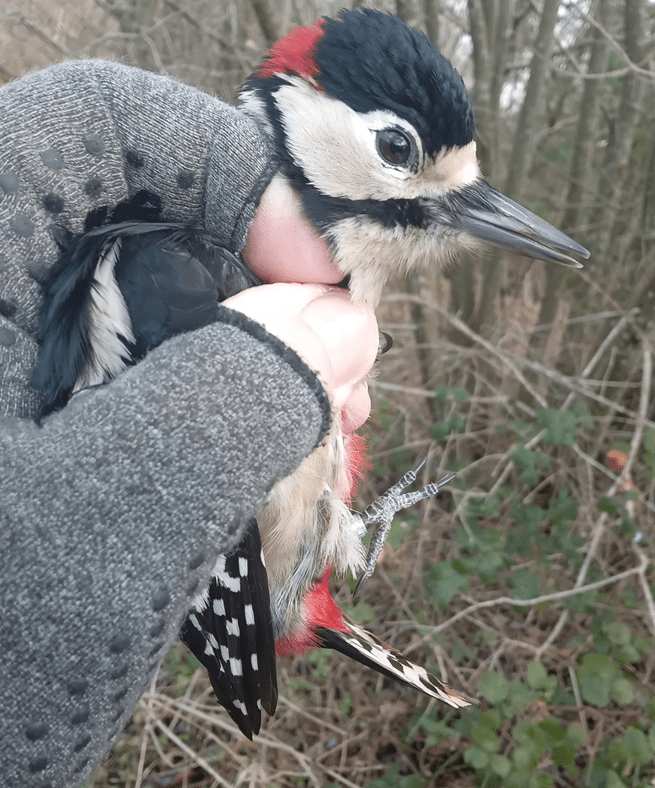
The next good bird was this, we heard it call before it hit the net, Laura went after it straight away and extracted this noisy fellow:
Male Great Spotted Woodpecker, Dendrocopos major
They are always the noisiest birds we extract. If there was a long gap between Blackbirds ringed, it is trivial compared to the gap between Great Spotted Woodpeckers: 18 blank sessions. That said, this year we have had our biggest haul of the species since 2017, with 17 ringed so far. The best was 24 in 2017, and 19 in 2013. So our third best year for them. but front-loaded.
The list from the session was: Great Spotted Woodpecker 1; Blue Tit 27(7); Great Tit 2; Coal Tit 4(3); Marsh Tit 1(2); Long-tailed Tit 6(4); Robin 1(1); Redwing 1; Blackbird 1; Goldcrest 4. Totals: 48 birds ringed from 10 species and 17 birds retrapped from 5 species, making 65 birds processed from 10 species.
It is a shame that we had to close up early: I am pretty certain that we would have hit the 100 mark if we had kept going to midday. I am also pretty confident that we would have added some finches to the list. We did catch a male Chaffinch but, although its legs were not in bad condition, they looked as if they were beginning to show signs of Fringilla papillomavirus infection, so we erred on the side of caution, released it and cleaned up. On my way in, and on my way out again, I did see several small flocks of Redpoll which we do seem to catch post-11:00 at this site.
With everybody mucking in to help us take down, it did not take long to get everything put away, and we were off site by 11:30. It would be churlish to complain about the weather as, for once, the forecast was pretty well spot on. I hope we have the same next Wednesday for our fourth successive record year.













 Ringing In The Braydon Forest & Beyond