Finally, a session that produced more than the same session last year: even if it is just one bird more! It was a very enjoyable session for so many reasons. To start with, I wasn’t working solo. I was on site by 4:45, with David joining me at the agreed time of 05:00. We had all of the nets open by 5:30, but didn’t catch the first bird until 6:15. It was a second year male Bullfinch in stunning plumage.
As has been the case with most sessions recently, the bulk of the birds arrived early, with 18 of the 29 birds caught being before 8:00. Following on from the male Bullfinch, we caught our first recently fledged Chiffchaff of the year:
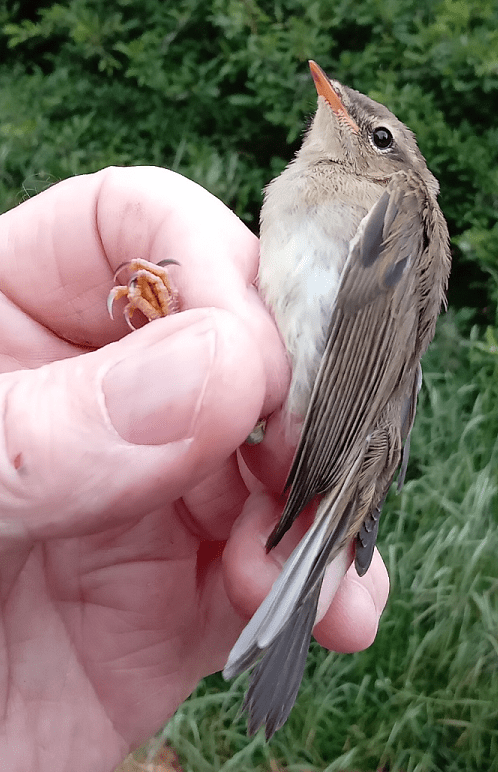
The key to the size of the catch being 13 birds extracted at the 7:25 net round. This was mainly due to the arrival of a small group of Long-tailed Tits, including three recently fledged juveniles:
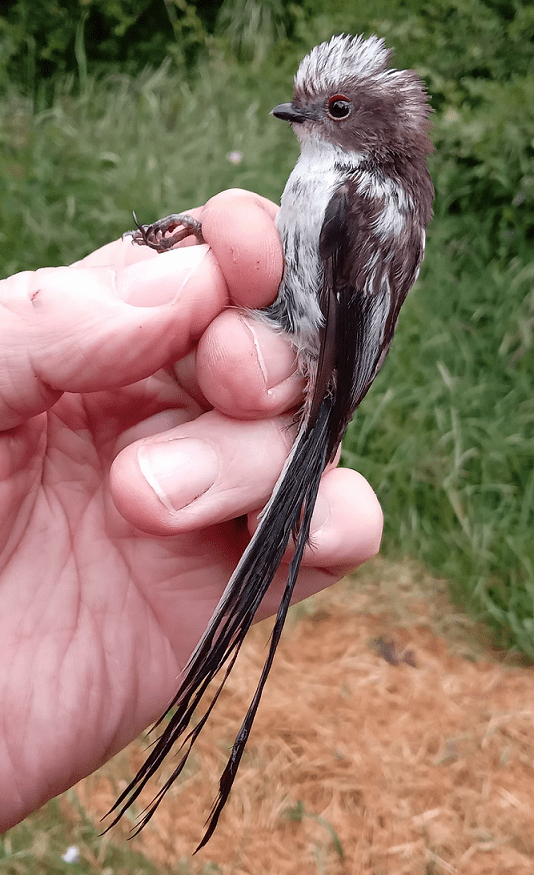
Lovely birds: envious of the hair style! Like the Chiffchaff, our first juveniles of this species this year.
Soon after this catch we were joined by family C: Laura, Mark, Adam & Daniel plus, soon after that, family H: Claire, Nick, Zara and Samuel. Laura is beginning to get the idea that she is the one jinxing the numbers, because they fall away after she arrives, but as we are still having an issue with the midweek sessions, I don’t think I can blame it on her. She helpfully took over scribing duties, allowing me to get on and process some birds.
About 8:30 we were joined by Sarah Binnie. I, and several other ringers running CES projects, were asked by the BTO if we would allow her to join us at one of our sessions. As I understand it, she is a PhD student investigating insect abundance on CES sites. So she joined us and set up a number of pitfall traps, frass collection plates (frass is caterpillar poo) and other assorted insect paraphernalia. Unlike us, she will be active until 18:00 this evening. I am looking forward to finding out what her results are. Goodness knows what she will find but the place was alive with both dragonflies and damselflies. As usual, there was an abundance of Common Blue, Enallagma cyathigerum, and Azure, Coenagrion puella, damselflies. I was delighted to see, for the second time (the first being the previous CES session) a Red-eyed Damselfly, Erythromma najas:

Unfortunately, my phone has taken out the red eye! They were a very deep red. In addition, there was a plethora of Dragonflies: so many emerging, expanding their wings and drying off. However, speciation will be difficult for a while: they all seemed to be green, with little or no colour variation.

I understand that their pigmentation will develop over the next few days so, perhaps by the time of the next CES session (and ringing demonstration) on the 17th, they might be more easily identifiable. This one was almost ready to fly and is probably a female Black-tailed Skimmer, Orthetrum cancellatum:

(Thanks to Rob Turner for giving me the heads up on the Dragonfly ID.)
The bird list for the day was: Green Woodpecker 1; Treecreeper (1); Great Tit 1(2); Long-tailed Tit 4[3](1); Wren 2; Dunnock (1); Robin [2]; Blackbird (1); Cetti’s Warbler (1); Blackcap 1(1); Chiffchaff 1[1](3); Bullfinch 1; Reed Bunting 1. Totals: 12 adults ringed from 8 species, 6 juveniles ringed from 3 species and 11 birds retrapped from 8 species, making 29 birds processed from 13 species.
It is always great to catch a Green Woodpecker. Of the 16 ringed by my team, all bar two have been caught at Lower Moor Farm. Specifically, all bar one of those has been caught in the wildlife refuge area. This area is absolutely covered with ants’ nests, hence why it is favoured by this species.
Another interesting catch was the retrapped Cetti’s Warbler. When it was ringed on the 24th May it weighed in at 16.5g, upon recapture today it weighed 4g less. I can only think that when ringed it was carrying eggs, either that or it has been wearing itself out finding food for youngsters!
Throughout the morning there was so much going on: bird-wise we just missed out on a Sparrowhawk that flashed through and just past the net chasing after a female Blackbird, that escaped into the safety of a thick bush. We also had a nicely marked Buzzard circling around over the site for a large part of the morning. It had large white patches on the underside of the secondaries.
We also had some excellent views of other flying creatures, well, machines actually. Clearly something is being planned to commemorate the 79th anniversary of D-Day as we were treated to the sight of a Bristol Blenheim light bomber, with full invasion markings on wings and fuselage fly through, and sighting of a Westland Lysander, used for reconnaissance and dropping spies in behind enemy lines in World War 2, that flew around several times. We didn’t get to see the Supermarine Spitfire that Trevor (David’s dad) told us was seen flying over Swindon, as well as the Blenheim and the Lysander.
At midday we closed the nets and, with the help of family C and Trevor, got packed away quickly and easily. Big thanks to Laura for providing me with the photos of the dragonflies and allowing me to post them on the blog.
 Ringing In The Braydon Forest & Beyond