After the publication of the last monthly results, one of the senior members of the group mentioned the ongoing decline we seem to be experiencing in the numbers of Willow Warbler we are catching and processing. I have had similar thoughts, so, as there is no chance of opening nets in this current weather, I decided to have a look at the figures to see if it is the case. The data set covered the full years from 2013 to 2022 inclusive.
At a gross level it doesn’t look as though there is an issue. In fact, it looks healthy:

However, the figures are distorted by a quite remarkable passage of 100 juvenile birds in August 2022. If you have a look at the split by month, it is pretty clear that our birds are mainly on passage, either in the Spring or the Autumn:

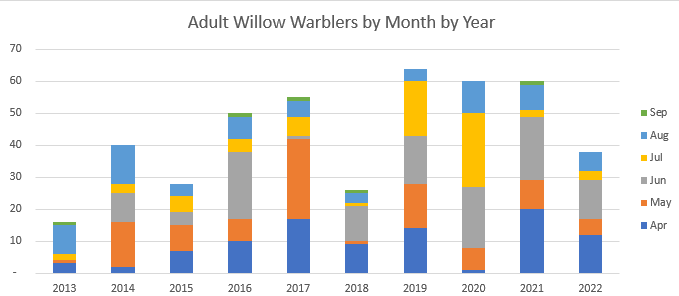
Of the 100 juveniles on passage last year, 72 of those were at the recently dormant Wiltshire Wildlife Trust reserve at Langford Lakes. It was revived for regular ringing in 2020. Also, another previously dormant site, adjacent to the Imber ranges on Salisbury Plain Training Area, was revived in 2018 and has been a significant contributor ever since. As juvenile passage had considerably skewed the trend, I had a look at the adults processed over the period:
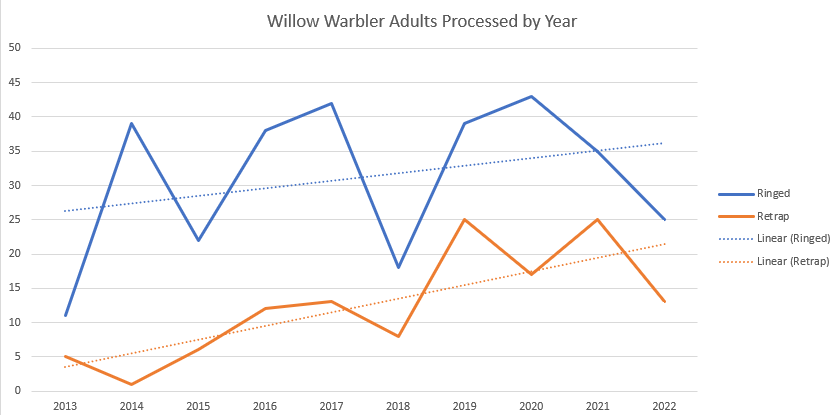
The trends are still upwards, which was definitely counterintuitive. However, one of the other things that need to be considered is the amount of effort put into catching and processing the species over the period. So I counted the number of sessions run between the beginning of April and the middle of September each month, whether Willow Warblers were caught or not, and worked out the average catch per session by year:
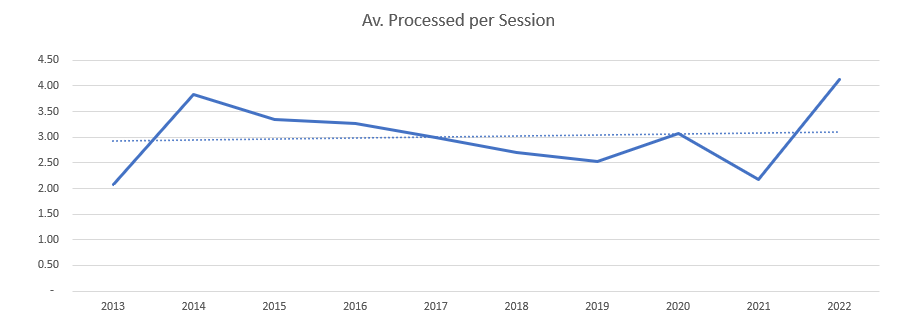
As you can see, there is still a slight incline.
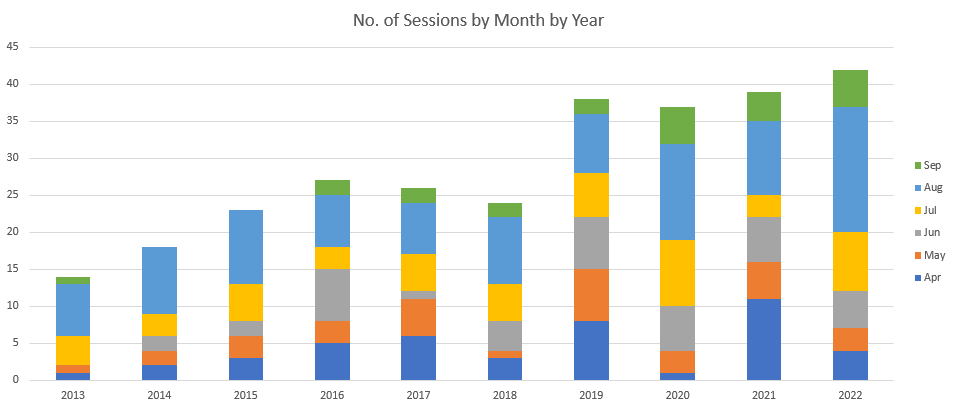
As you can see, the effort has certainly increased over the years as other individuals got to carry out their own ringing sessions.
I did a review of each of the sites that have been in operation throughout the entire period, and got a clear indication of why it seems that we have a decline. The sites that I looked at in isolation were: the Ravensroost complex, Somerford Common and Lower Moor Farm. All of these sites have delivered Willow Warblers over the period, all have exceeded 100 birds caught.

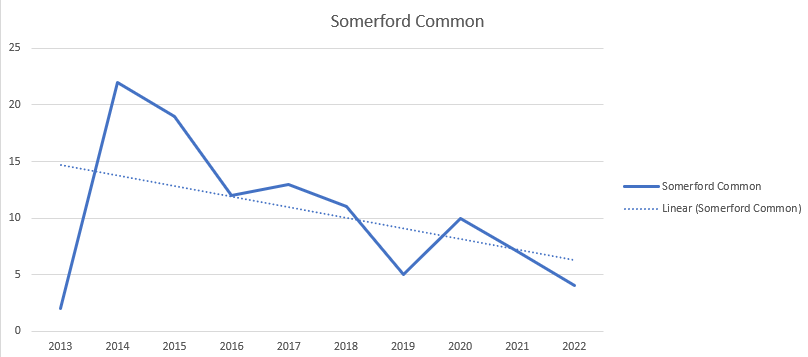
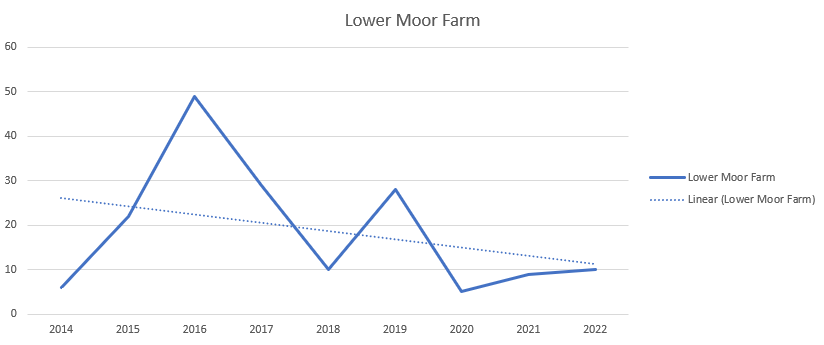
As you can see: what were the mainstays of our Willow Warbler catches in the north of the county are in serious decline.
What is the explanation for the rise in numbers, as shown by the first two graphs? The simplest answer is the expansion of activities within the last 4 years, as new C- and A-permit holders have taken on their own sites:

They have added a considerable number of birds to the catch, whilst the older sites have definitely shown a decline.
Perhaps the crucial questions are: are there changes to the breeding population or a change to passage movements? I had a look at the results for males and females in breeding condition. Unfortunately, prior to 2018 there is a dearth of records of the bird’s sexes. They aren’t easy: females can only be sexed by the development of a brood patch and males by the development of their cloacal protuberance. The results were as follows:
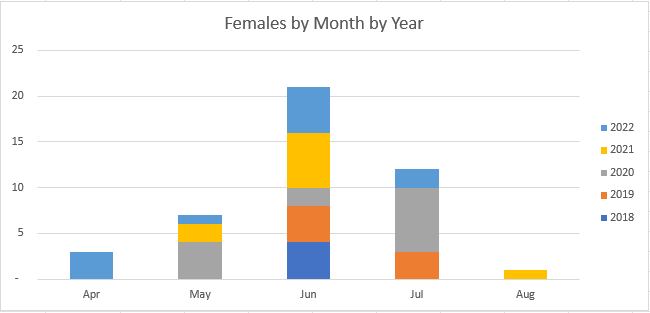
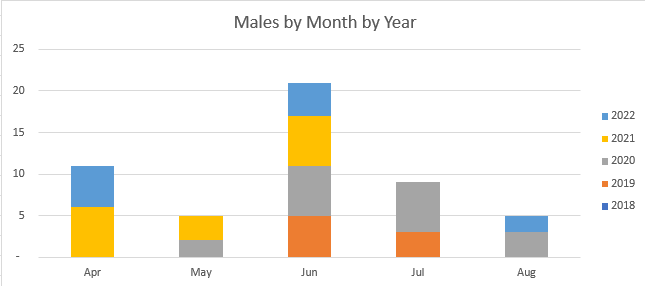
As is clear, the majority of results are in June. In my opinion, females are unlikely to be developing a brood patch whilst on migration into the country, as they probably don’t enter breeding condition until they are ready to breed. The individual female in August was on migration, with her brood patch in the process of feathering over. With males it is less clear, as they are looking to establish territories almost as soon as they arrive in a suitable location. However, the peaks in May, June and July do seem to indicate that there is a reasonably stable breeding population in our part of Wiltshire.
When you look at the overall numbers of adult birds coming into Wiltshire, compared to those that stay around to breed, you can see that passage is the key to numbers caught in and around our sites:
So, how about juvenile productivity? When juveniles fledge they are designated as age 3J in BTO coding. Looking at the data we get the following results:

The trend line shows a very slight decline across a pretty volatile seasonal variation. If we look at the split by month by year:
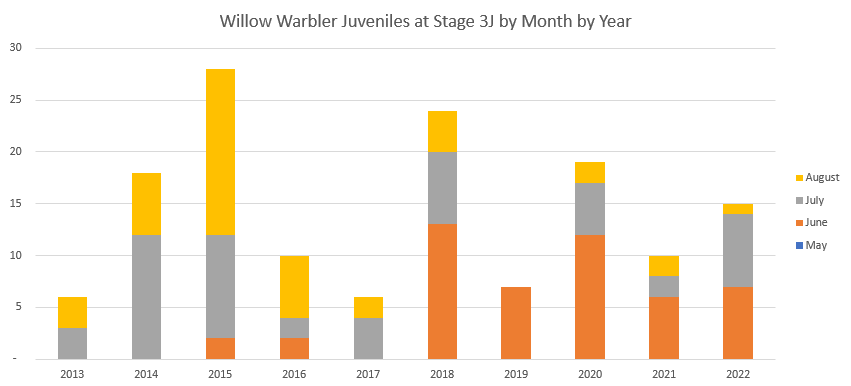
There are a lot of juvenile captures in August. This raises the question of whether they are locally bred birds or autumn migrants. A similar question could be asked about July captures as well, but I tend to think that would be related to how far along the post-fledging moult path they are.
What do I mean by that? As well as identifying juveniles as 3J, there is a subdivision, based on moult, of either 3JJ or 3JP. 3JJ is a bird in full juvenile plumage, whereas 3JP is a bird undergoing post-fledging moult. I tend to the idea that a bird with a 3JJ moult code had to have fledged within the local area. Not necessarily at the site at which it is caught but certainly not yet on migration. Birds that are undergoing post-fledging moult have fledged somewhat earlier and could possibly be on migration. (Once they have completed their post-fledging moult, they lose the JP subscript and become simply an age code 3 (with a moult code of O for “Old”, somewhat ironically).) So I decided to have a look at the number of 3JJ youngsters caught at the sites:
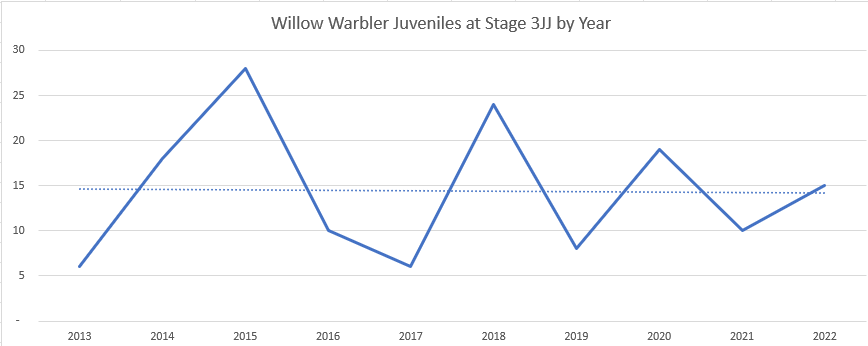
That pretty well mirrors the overall picture for 3J’s. When I split it out by month, it looks somewhat different:
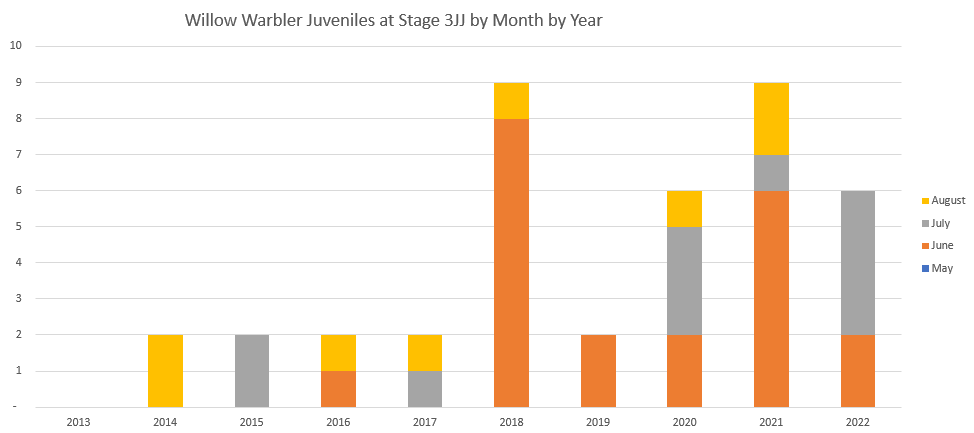
The key difference is in the significantly reduced number of this stage of juvenile bird (3J) being found in August. As one would expect: birds on migration might reasonably be expected to have substantially completed their post-fledging moult, so 3JP or 3O. The graph below shows all juvenile Willow Warbler designations (3JJ, 3JP and 3O):

Even though 2022 totally distorts the picture if looking at raw totals, with the exceptions of 2020, you can see that August is certainly the busiest month for juvenile birds. With so few in September it would seem that August is the key month for autumn migration for this species.
To examine what might be happening at the three sites I mentioned previously, which would explain why I think the species is in decline in my area, I did similar graphs for the Ravensroost Complex, being the site most frequently surveyed over the period:
Ravensroost Complex:
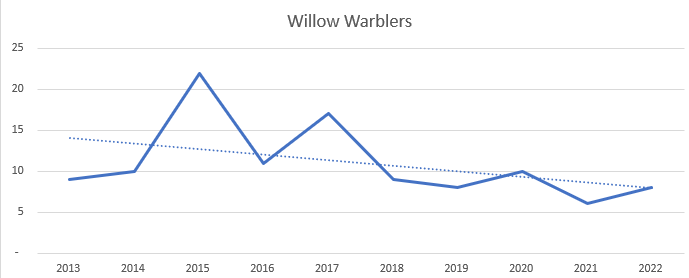
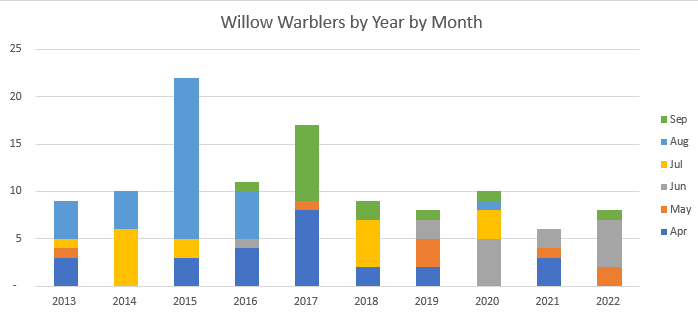
These two charts show the fluctuations over the years and the numbers by month. As you can see, Spring passage, April and May, was reasonable in 2013, 2015, 2016, 2017, 2019 and 2021 but the most significant change is to the Autumn passage, August and September, which drops off after 2017.
Looking to see whether the reductions are down to a change in the numbers of juveniles produces the following graphs:
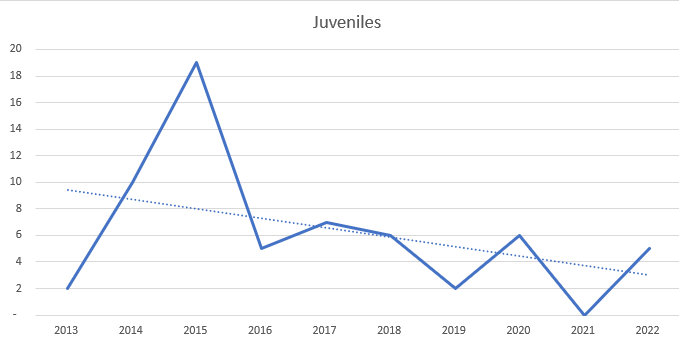
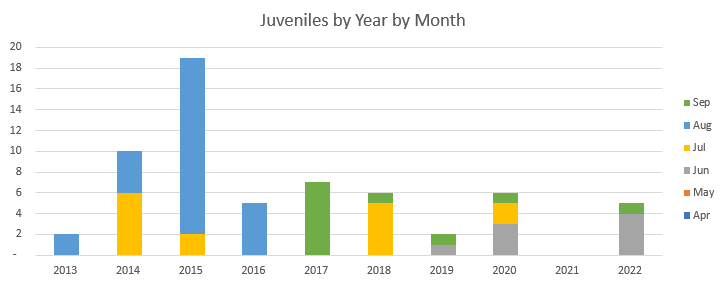
From these charts it would seem that the issue with juveniles is on passage, with the numbers post-2018 well down. Interestingly, June and, probably, most July youngsters are likely to be locally bred, but none of them were moult code “J”. Ironically, given the reductions overall, the most likely positive breeding happened in the years 2019, 2020 and 2022.
When you look at the picture for adult birds it is a little different:

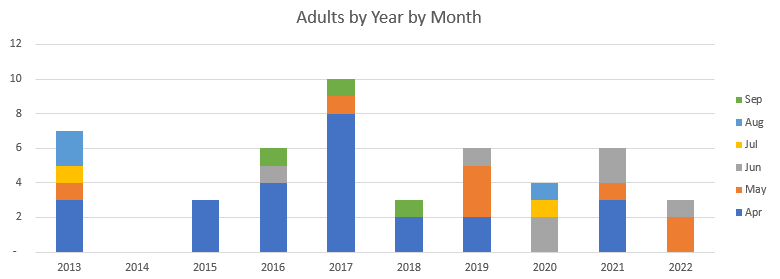
There is a slight increase over the period, despite a blank in 2014, in which 14 sessions were carried out in the complex between the beginning of April and the end of September. Clearly Spring passage is the busiest, as shown for the figures for April and May in every year except 2020. However, that was down to Covid restrictions.
Conclusion:
Although there appears to be an increase in the number of Willow Warblers in our area, this is related to an increase in activity and expansion into different sites by those recently getting the chance for independent ringing. The older sites in the north of the county are showing significant decreases, for reasons unknown, but based around a fall off in Autumn passage.
 Ringing In The Braydon Forest & Beyond