I had a quick trip to Clattinger Farm yesterday, to meet up with Rosie, check on some Swallow nests, and then ring a brood of five Swallows, all done under licence and as part of the BTO Nest Record Scheme. Interestingly, two of the nests contained four eggs in each. They were warm, so clearly being brooded. By my estimation they will be fledging towards the end of September (15 days incubation, 22 more days to fledging, according to the BTO Nest Record data). The birds we ringed will almost certainly fledge within the next two weeks, as their feathers were two-thirds grown.
This morning I planned to carry out a session at Blakehill Farm in the fields behind the Whitworth Building. I was joined by Rosie and Miranda for the session and we all met at 6:00. Driving round the perimeter track to the Whitworth Building I firstly had a Kestrel take off from a post just in front of me and had lovely views as it flew away into the mist. This was then followed by a Wheatear that post-hopped along the track in front of me for about 200m, giving me brilliant views of the bird. My first of the autumn. We set the following nets:
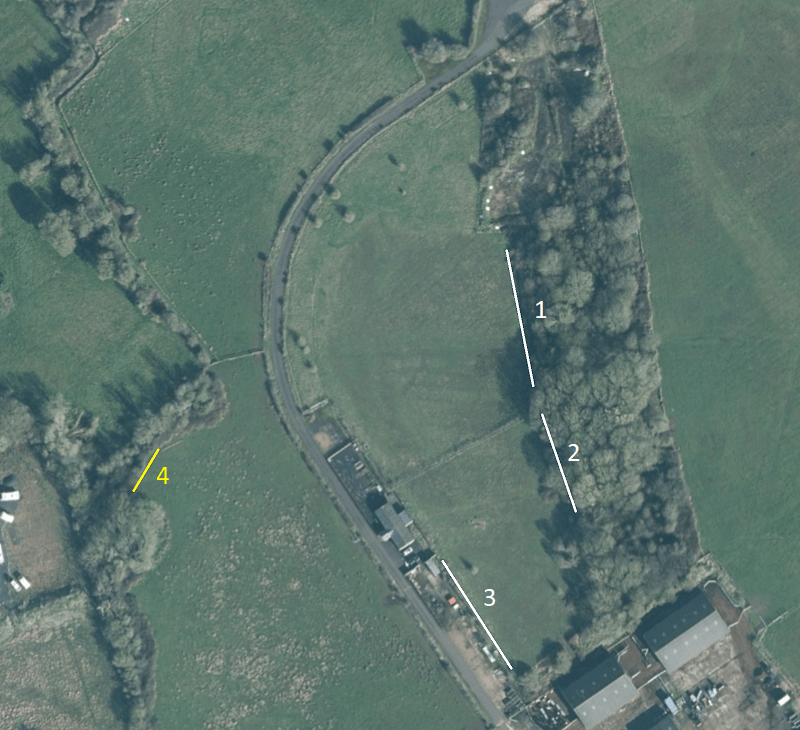
To explain this diagram: 1 was 2 x 18m nets + 1 x 12m net; 2 was 2 x 18m nets; 3 was 2 x 18m + 1 x 12m net and 4 was 1 x 18m net. Net rides 1 to 3 were the nets we actually set for the start of the session, and used until 10:30. However, rides 1 and 2, set along the tree line produced just one bird: a Wren, right at the start of the session. The breeze got up, they were billowing and getting stuck in the trees and the brambles, so we closed them and took them down. Needless to say, as soon as we started to close them they caught another bird. However, it was the Wren that we had originally caught and ringed, so I just extracted it and released it. Net number 4 was set up subsequent to closing nets 1 and 2, just to test the position. It failed and didn’t catch a single bird.
As usual, Rosie had to leave for work soon after 9:00, having just had the opportunity to ring two birds. To the catch itself: it was not big but I am not going to complain. All birds, apart from the previously mentioned Wren, were caught in the 2 x 18m + 12m line along the hedgerow / path. There were no adults and no retrapped birds. The list was: Great Tit [2]; Wren [1]; Robin [2]; Whitethroat [1]; Lesser Whitethroat [2]; Chiffchaff [1]; Willow Warbler [1]; House Sparrow [2]. Total: 12 juvenile birds ringed from 8 species.
The two Lesser Whitethroats are actually my first two of the year. It has been a stunningly disappointing year for this species at my sites. They have been declining since 2020, coinciding with the overall declines in catches at Lower Moor Farm and Ravensroost Meadows, so to catch two today was very pleasing:
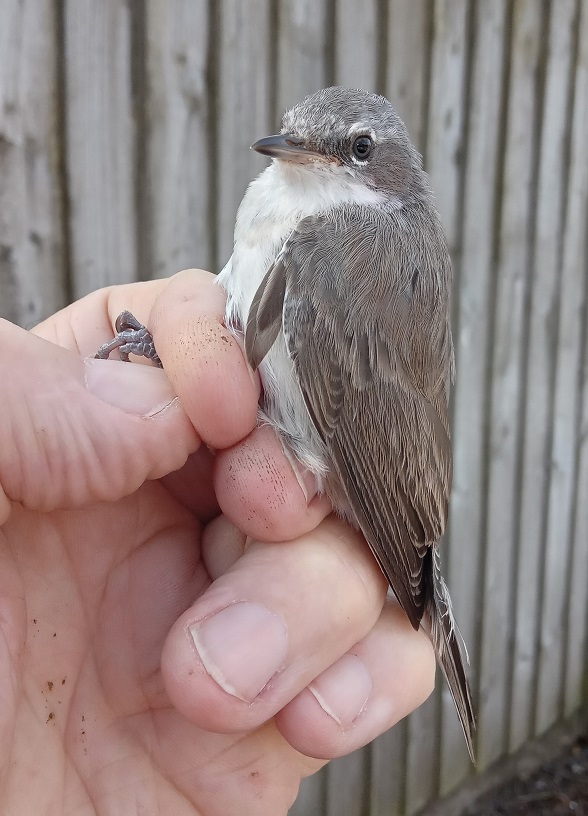
juvenile Lesser Whitethroat, Curruca curruca
The first one was accompanied by a juvenile Whitethroat. Their numbers at my sites have crashed since 2021. This was our first juvenile of the year:
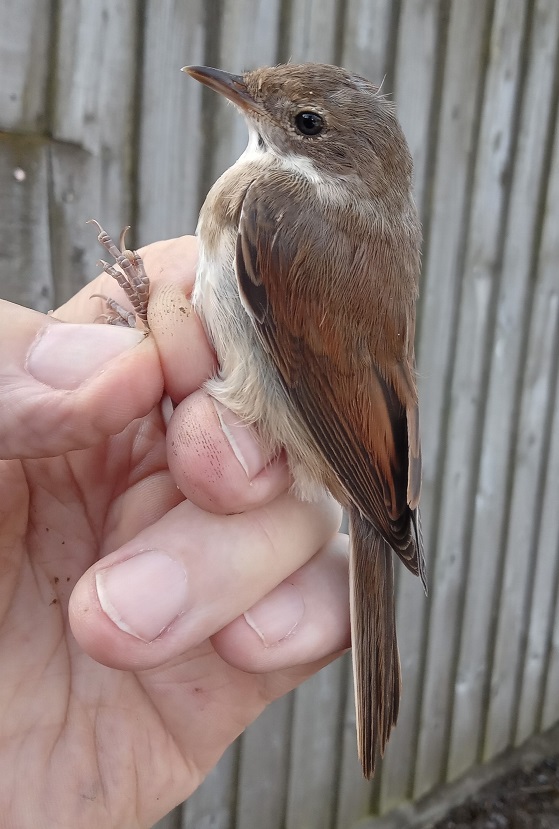
juvenile Whitethroat, Curruca communis
Although we have ringed some House Sparrow pulli this year we had not caught any fledged juveniles until the two today:
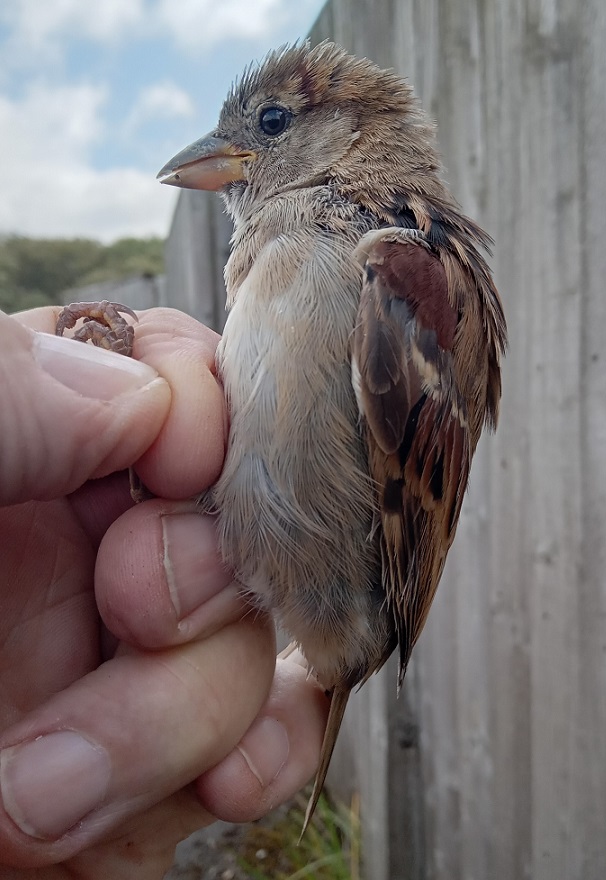
juvenile House Sparrow, Passer domesticus
The House Sparrow is one of the few Passerine species in the UK where the adults and juveniles both go through a full post-breeding / post fledging moult into full adult plumage, making it impossible to age them accurately as the autumn progresses. Others that have this moult strategy are the Nuthatch and Long-tailed Tit. This one was already able to be sexed: its head was developing grey feathers and its wing was developing the dark chestnut feathers typical of the male’s plumage:

Unfair on the juvenile Robins, Great Tits and Wren that don’t make the picture gallery, but we did catch a very striking juvenile Willow Warbler:
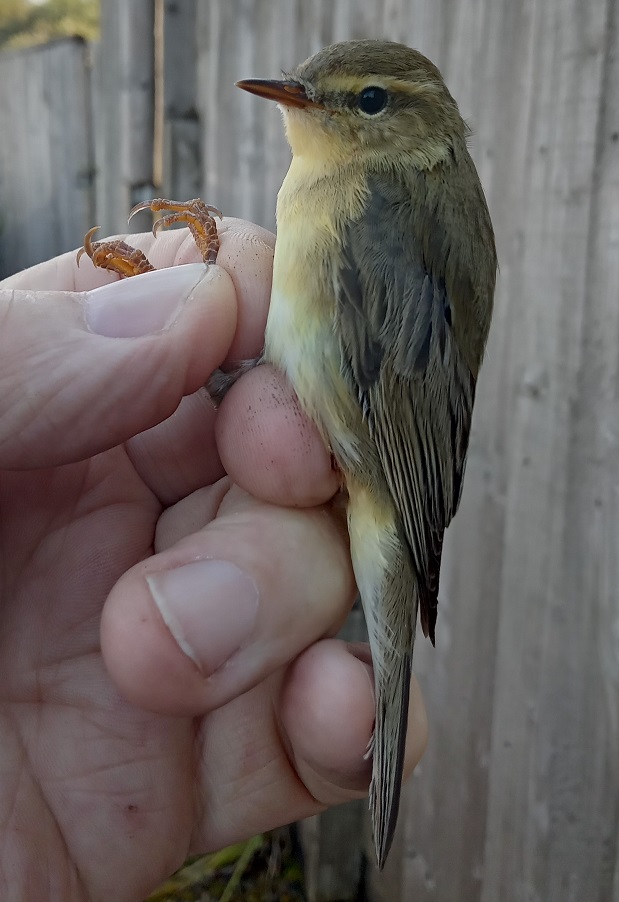
juvenile Willow Warbler, Phylloscopus trochilus
With the wind picking up, and the catch having died off completely, Miranda and I shut the nets at 11:30 and took down. We were off site by 12:15.
 Ringing In The Braydon Forest & Beyond