The best laid plans and all that…..
With my car scheduled for a service on my usual Wednesday session I decided to get a session in today. When I checked the weather forecast (Meteo and the Met Office) both said it would be dry all day but, far more importantly, that there would be very low wind speeds until lunchtime when a weather front would roll in and we could expect wind and rain. As I had agreed with Jonathan, the Wildlife Trust’s (excellent) farms manager, that I could resume ringing activities on the plateau area this week, as the cattle would have been moved off the area of the plateau that is left fallow all year round onto the areas that had recently been cut and baled for hay. I don’t have access to the plateau during the breeding season, to avoid any possible disturbance to the Curlew and Skylarks that nest in the area.
Having agreed to meet Miranda at 6:00, but waking earlier than expected, I was on site by 5:30 and started setting the plateau nets. Miranda joined me at 6:00 and, as we were putting the finishing touches to the third net she said “cattle”! Sure enough, a small herd of some 30 heifers came trotting across the plateau towards us and the nets. Fortunately, one look at the pair of us and they sped up and ran off into the northern area of the plateau and we didn’t see them again this morning. We must be very scary! I texted Jonathan, who apologised profusely. I mean, how dare his crew actually take advantage of the same bank holiday weekend the rest of us did, having worked all the hours available cutting, turning, baling and collecting the bales for the last couple of weeks! No harm done anyway.
I decided to see if any Meadow Pipits had arrived yet and set up a Mipit triangle net set. If I had checked my records beforehand I probably wouldn’t have bothered: I have never caught a Meadow Pipit at Blakehill Farm in August – and I still haven’t!
The nets we set were:
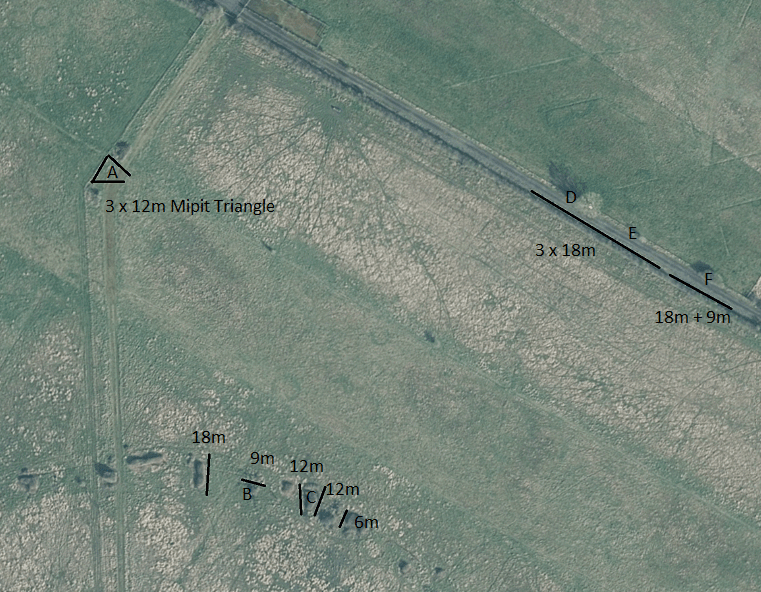
Now that we are out of the breeding season and, in this case, focusing on migrating birds, I set lures for Meadow Pipit (A); Stonechat (B); Whinchat (C,E); Blackcap (D) and Willow Warbler (E). True to form, the only lure that actually worked was that for the Blackcap. Whether the lure was instrumental in attracting in the few we caught is arguable.
We were pleasantly surprised to catch two Whitethroat, two Lesser Whitethroat and the obligatory first round Wren at about 7:30. Unfortunately, that was about it for the plateau nets. The wind got up much earlier than was forecast and the nets just stopped catching. Our Meadow Pipit net caught absolutely nothing until, at 10:30, with the wind so strong that we had to shut the plateau nets and the Mipit triangle, it produced a juvenile Great Tit.
Although the nets on the perimeter track were largely protected from the westerly wind, there was still quite a lot of billowing. With no sheer forces to endanger the birds, we left the perimeter nets open and I was pleased that we did, as two of these beauties flew into the nets at 10:00:
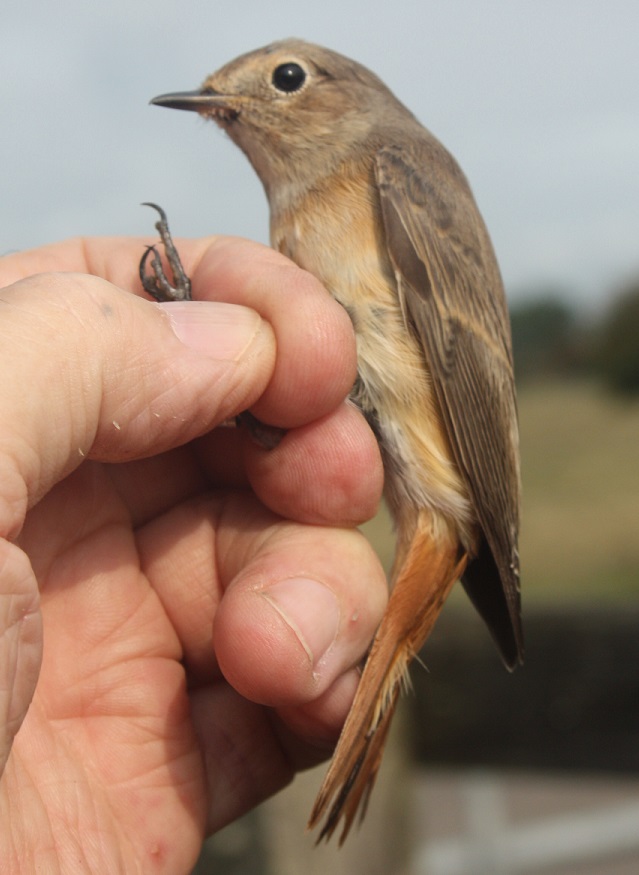
juvenile female Redstart, Phoenicurus phoenicurus
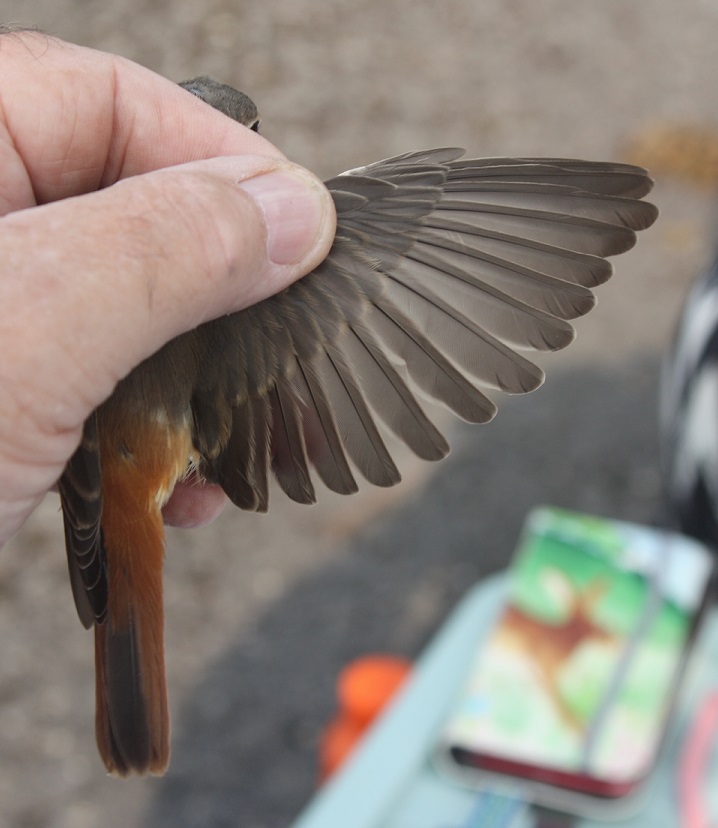
The central tail feathers on the Redstart are dark, those on the Nightingale are uniform across the tail, which is a handy identification point if you just catch a glimpse of a red-tailed bird. I had only caught five Redstart at my sites before today, and I had never caught more than one on any occasion.
We are certain that the wind was the key factor in the low numbers caught but, never mind the width, feel the quality! The list for the day was: Great Tit [1]; Wren [2]; Redstart [2]; Blackcap [2]; Whitethroat [3]; Lesser Whitethroat [3]. Totals: 13 juveniles ringed from 7 species. Definitely not my biggest catch but a nice selection of birds.
Once we had finished taking down I had an appointment with the RSPCA Oak & Furrows Rehabilitation Centre to ring this fabulous bird:
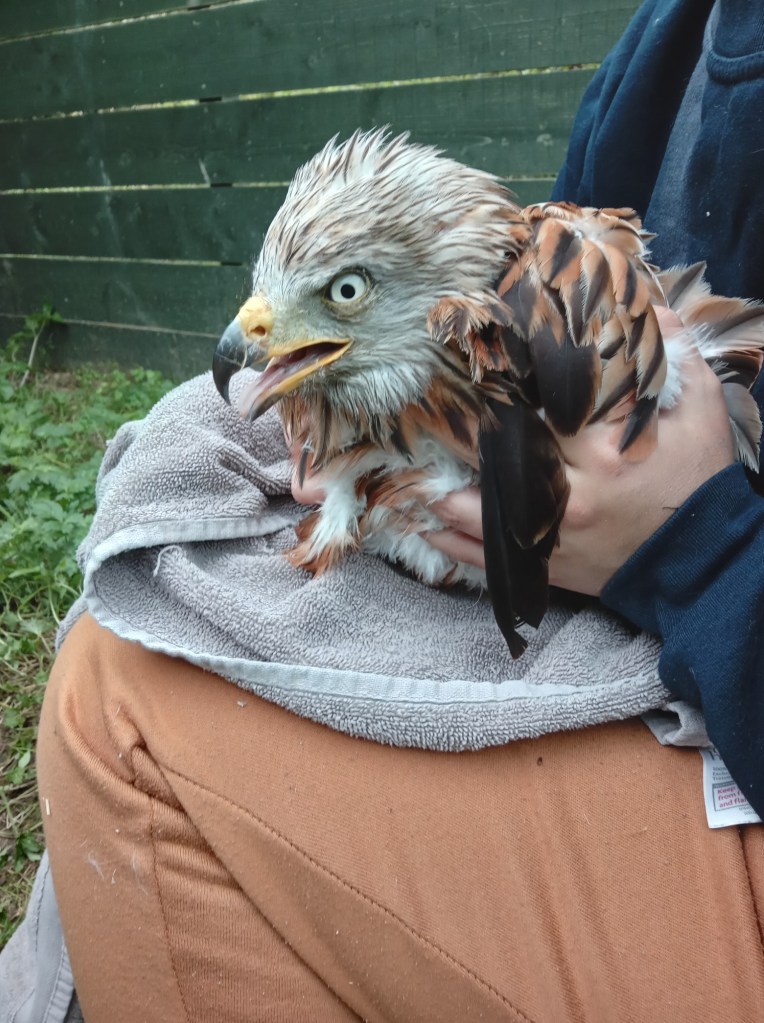
Red Kite, Milvus milvus
It is an adult male and is scheduled to be released back into the wild by the end of the week. He has made quite astonishing progress, if his weight is anything to go by: on the 20th August he was weighed at 750g. We weighed him again today, nine days later, and he weighed in at 1,040g. That is a staggering weight gain: nearly a 40% increase in just 9 days! Given its diet, it brings a whole new meaning to the term “chickenfeed”!
Whilst I was there I was asked to look at a juvenile Sparrowhawk that someone had brought in. It is already ringed so I have taken the details and did all of the usual biometrics and entered the data into the central database. Unfortunately, whomsoever ringed it has not yet entered the capture details into the database, so I haven’t had any feedback on it yet. I almost always enter my data on the same day, if not I do it the next day. It is an online system and, if used properly, it is fast and efficient. Not everybody does.
All in all, a very satisfying morning, despite the weather and the cattle!
 Ringing In The Braydon Forest & Beyond