The point of a Constant Effort Site (CES) is to allow direct comparisons across the years. This is done by setting the same nets in the same places for the same length of time for 12 sessions, approximately 10 days apart, between the beginning of May to the end of August / first week of September. I started my CES at Lower Moor Farm in 2015 and, it is entirely possible, 2023 might well be the last. By committing to a CES invariably reduces the time available for my other sites. It all depends upon how Spring 2024 shapes up. I think that this graph shows exactly what the issue is:
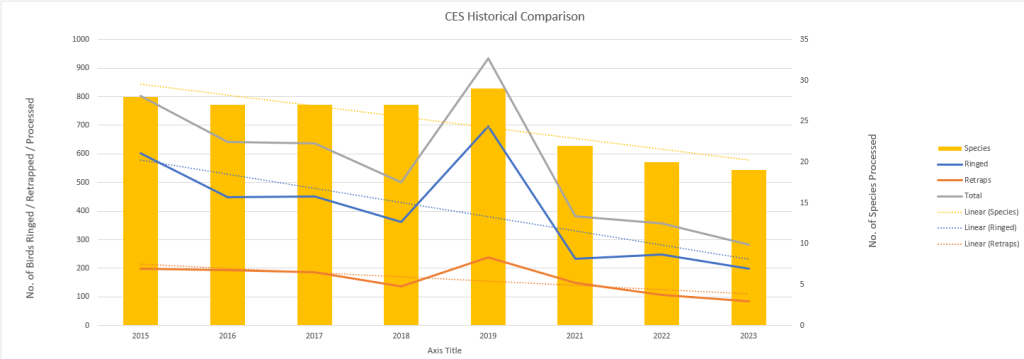
Every single trend is downwards and, without the anomalous and exceptional year of 2019, the downward trend would be considerably worse. What is also significant is the decline in the number of species. This would indicate a reduction in suitable habitat for some of those species. I have had discussions with the Wildlife Trust to try and identify whether this is the result of habitat change or a genuine reduction of bird numbers in the area. There will be further discussion on habitat in part 3.
In this first part of my assessment I have had a look at the species that are my key reason for carrying out the CES at Lower Moor Farm: summer visiting warblers. In the next part I will look at the trends in resident species.
There are no active reed beds at Lower Moor Farm: the ponds and lake are ex-gravel extraction pits. Mallard Lake, until it became polluted by fertiliser run-off from other farms, was a marl lake. It now has a couple of thin reed fringes but not sufficient to support breeding Reed or Sedge Warblers. Unsurprisingly, the commonest warbler species are Blackcap and Chiffchaff.
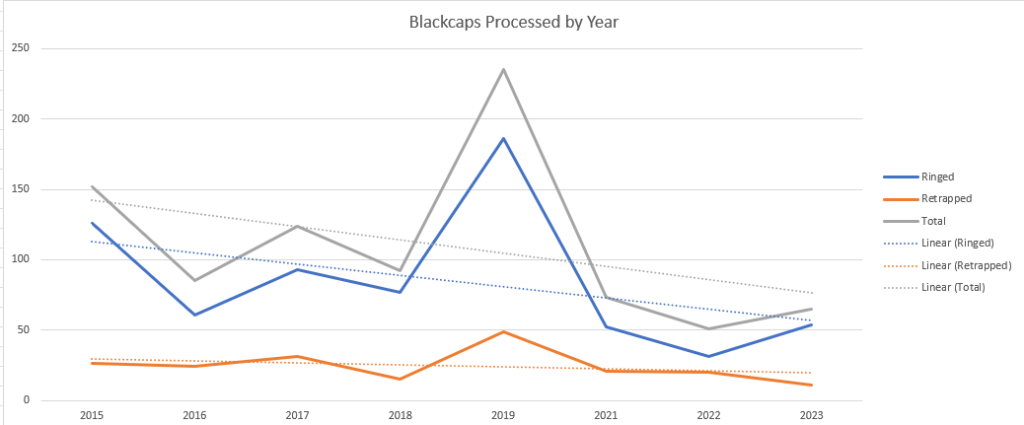
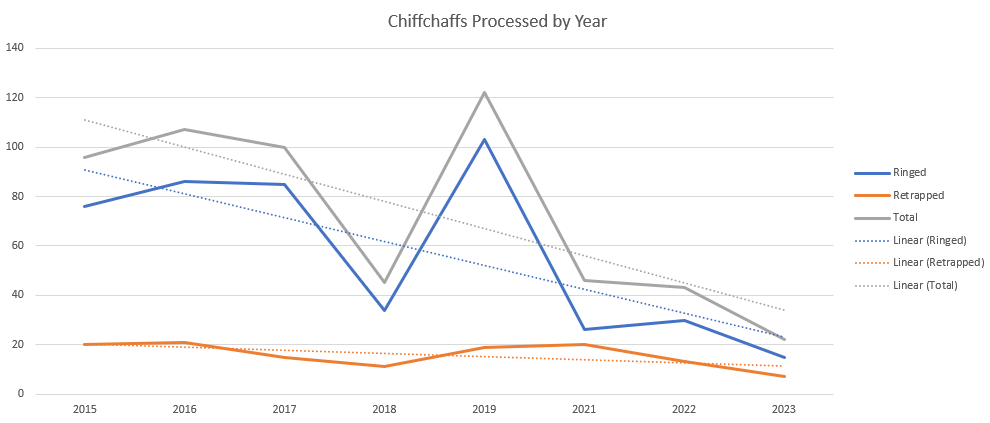
As you can see, the retrap rate for Blackcap is relatively consistent, the numbers ringed have declined significantly. Interestingly, CES 11 and CES 12 this year each produced 17 Blackcaps, and those are the best catches of this species in any CES period. That just shows how poor the rest of the sessions have been for this species. Chiffchaff decline is precipitous and a considerable cause for concern. However, if that is bad, the situation with the less common warbler species is even worse. It used to be my best site for Garden Warbler but, again, their numbers have declined dramatically:

Similarly, the fall off in Willow Warbler numbers is significant:

If this is bad, then what has happened with Common Whitethroat and Lesser Whitethroat is catastrophic. Common Whitethroat were not significant in the catch for the first three years but, between 2018 and 2021, we had some hopeful signs, only for them to be dashed in 2022 and non-existent in 2023:

Lesser Whitethroat was even more disappointing as they were a solid contributor between 2015 and 2019 and then nothing since!

Obviously, with migrant warblers there can be many factors affecting numbers: primarily weather conditions. Certainly the last few years have been much less stable than we have been used to but it has not been bad enough to severely affect the CES sessions themselves, with only one being missed as a result of bad weather (session 3 in 2022).
I do have some ideas. For example, Garden Warbler and Blackcap have overlapping habitat requirements, with Garden Warbler preferring lower level vegetation for foraging, Blackcaps taller level vegetation, and they compete, with Blackcap seemingly outcompeting Garden Warblers. It is why when I can use lures I use Garden Warbler and it works for both species.
Part 2 will follow as soon as I can get it done.
 Ringing In The Braydon Forest & Beyond