Following on from yesterday’s look at the decline in warbler numbers, I have now had a look at the more regular resident species: Blue Tit, Great Tit, Long-tailed Tit and Wren.
Blue Tit:
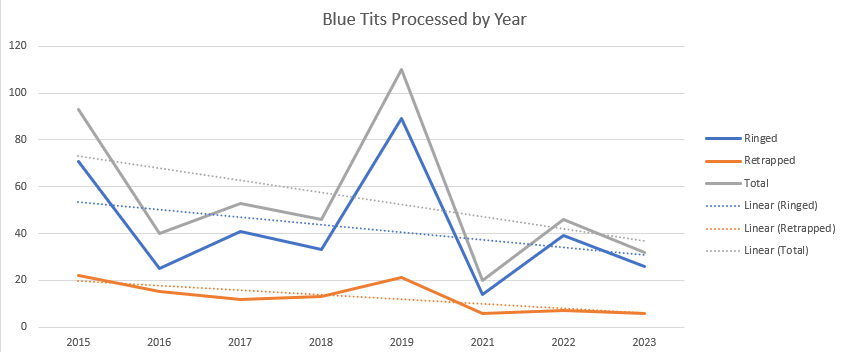
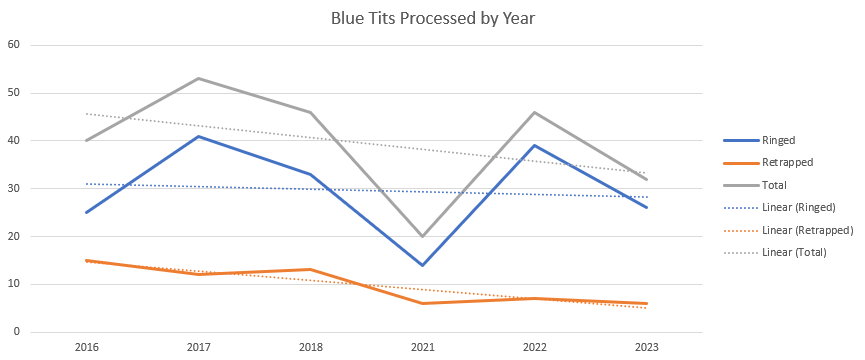
As you can see straight from the off, the trend is every bit as downward as it is for the warbler species. Clearly, the catches in 2015 and 2019 could have exaggerated the recent decline, so I recast the data minus those two years. The decline is less precipitous but still there:
Great Tit:
Long-tailed Tit:
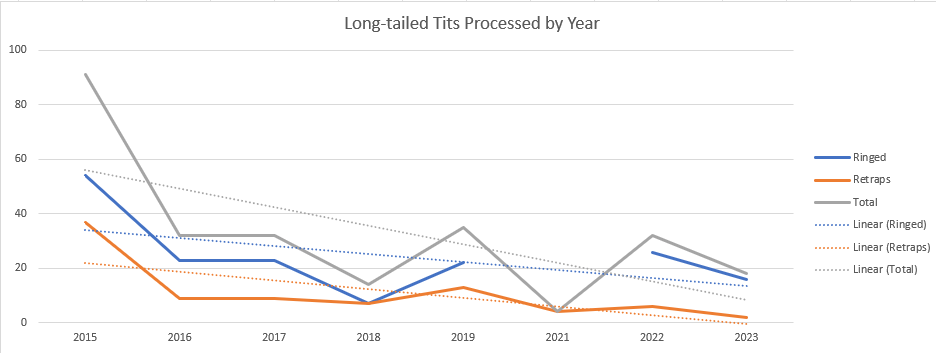
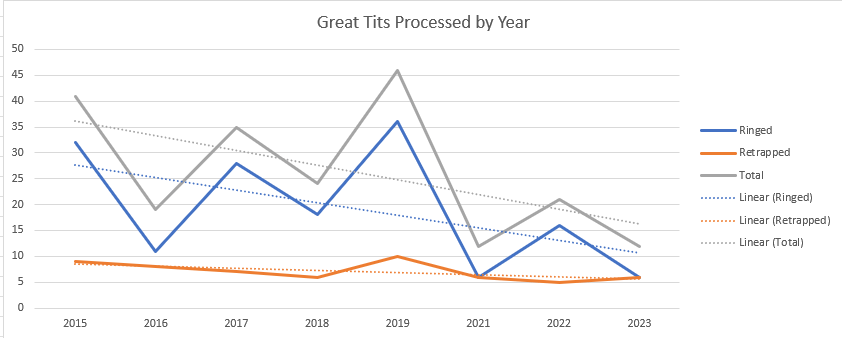
So far, so much the same. My thinking was that all of these species, except Garden Warblers, are, basically, gleaners, removing insects from leaves. I then had a look at those resident species that have different feeding strategies: Robin, Dunnock and Wren.
Robin:

As you can see from this, the trend for birds ringed is pretty well static and the decline in retrapped birds is rather shallow. Overall, they are a consistent contributor to our CES sessions.
Dunnock:
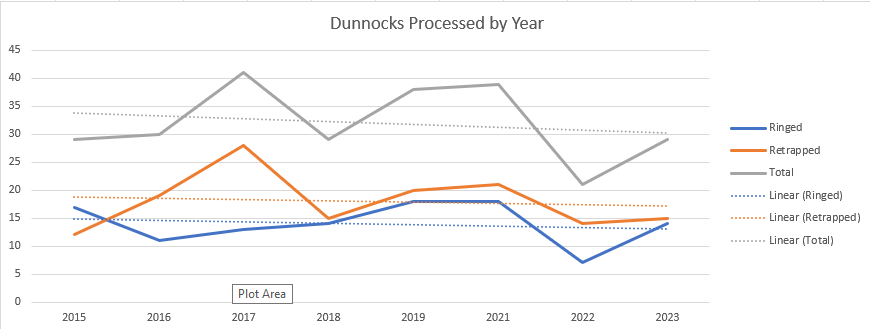
The only species that I have analysed that has a higher retrap rate than the ringing rate. There are very shallow declines at all levels, but not as pronounced as for the warbler species or the Blue, Great or Long-tailed Tits.
Wren:

Another species with a shallow decline. The biggest reduction, although nothing like as pronounced in the warblers and tits, is in the retrapped birds.
What is driving the declines?
This is clearly the $64,000 question. I have had my theory on the problems, but as it is a nature reserve run by the Wiltshire Wildlife Trust, what I want to do about it has to fit in with their management plans. Fortunately, I had a meeting with both the Conservation Director and the Farm Reserves Manager of the Wildlife Trust and we have agreed upon a plan of action. In fact, the Farm Reserves Manager led the way in what needs to be done on the site. Fortunately, his ideas coincided completely with mine.
Since the Covid lockdown, two key areas of the CES have become overgrown. The canopy has closed over on those two rides, saplings have grown up and added to the thickness of the tree stock, filling in what used to be a nice open area. All of this has led to a darkening of the rides and, possibly more importantly, the wildflowers attractive to insects and other invertebrates have almost entirely disappeared from these two rides, leaving behind an under-tree flora consisting almost entirely of Stinging Nettle and Common Cleavers (Goose Grass, Sticky Jack, Sticky Willie).
The plan over this winter is to open out the undergrowth, cut back the canopy and thin the tree stock back to where it was pre-Covid and see if that improves the situation. We shall see what happens.
 Ringing In The Braydon Forest & Beyond