At the beginning of this week the weather forecast was for Storm Agnes to make any ringing impossible before Friday. Fortunately, by this morning it had opened a window for a woodland session. With the volunteer group being busy in Ravensroost this morning, Webb’s Wood was the next on the list.
I met up with Rosie, Miranda and Teresa at 7:00. This morning I decided to try out a different set of nets from our usual ringing area. This time we set up along the main tracks and the bridle path that leads to Echo Lodge Meadows:

We put up the following nets:
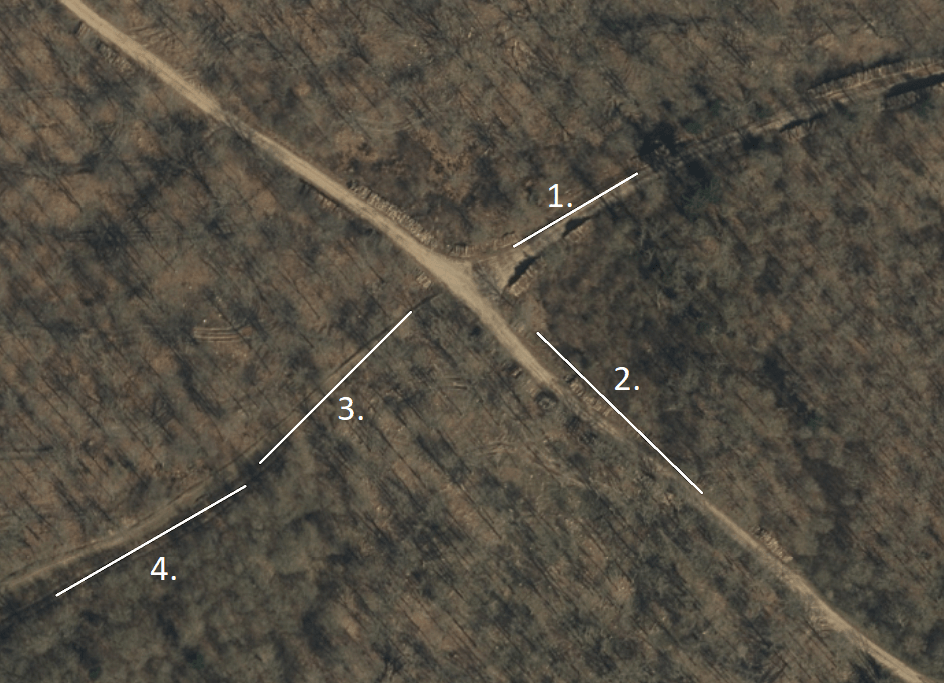

I put lures for various migrants on each net set, plus a lure for Marsh Tit on set 2. Webb’s Wood is, for its size, my worst site for Marsh Tits. Although Webb’s is almost exclusively native deciduous woodland, primarily Beech, and it is certainly a moist woodland, the problem is probably the lack of an extensive shrub layer. The Beech was previously closely planted, leaving little understorey. It was thinned significantly over-winter 2020 / 2021, as a lot of the Beech was harvested, but it is taking time for the understorey to establish. Marsh Tits being highly sedentary, unlike other Tit species, it is unlikely to be populated by inward recruitment, so it is up to its small population to produce the offspring to fill the new niches.
This morning’s first round produced three Robins and a Marsh Tit! It proved to be the only Marsh Tit caught this morning. It is now sporting some nice distinctive colour rings, enabling it to be recorded by sight by local birders, in what is now a 10 year project monitoring the health of the Marsh Tit population in the Braydon Forest (holding on well, if you are interested)

Marsh Tit, Poecile palustris
Round three produced a male Nuthatch. Already, it was impossible to tell whether it was a bird of this year or older. It was clearly a male, and was also Teresa’s first opportunity to ring the species:
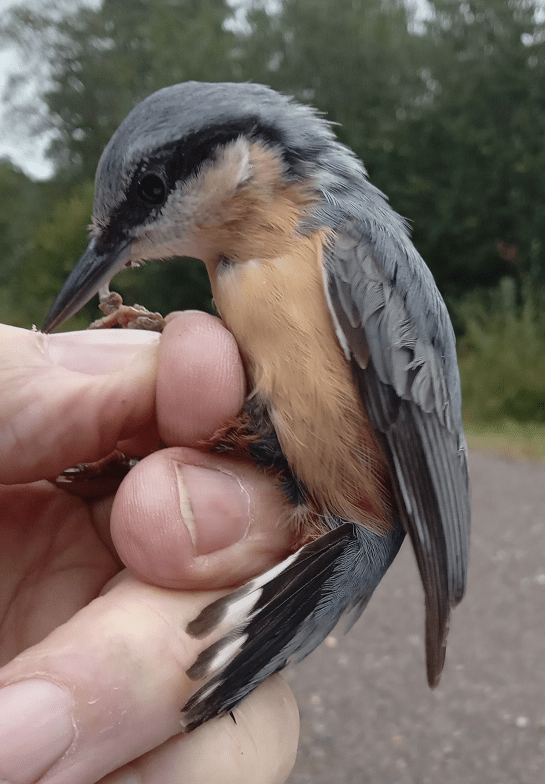
Nuthatch, Sitta europaea
Each round produced a small number of birds, until Rosie left for work, whereupon the birds decided that they would push off as well. For just under an hour-and-a-half we did not catch another bird! At 10:30 I changed the Marsh Tit lure for Goldcrest. Almost immediately we caught three Goldcrest adjacent to it.
The forecast was for wind to start gusting upwards of 20mph from 14:00. Unfortunately it arrived three-and-a-half hours early, at 10:45 the nets started billowing too much to be safe, so we closed them and packed away.
The list for the session was: Nuthatch 1; Blue Tit 3; Great Tit 3; Coal Tit 1; Marsh Tit 1; Wren 1; Robin 3(1); Goldcrest 7. Totals: 20 birds ringed from 8 species and 1 bird retrapped, making 21 birds processed from 8 species.
Without that late flurry of Goldcrests we would have had a very dull, if short, session, excepting the Marsh Tit and the Nuthatch so, thank goodness for Goldcrests! With the nice catch of Goldcrest at Somerford Common last week, this has been our best September for the species in the Braydon Forest. October is when they usually arrive. That said, on Monday Teresa released a juvenile Siskin at Somerford Common. It had been sent to the RSPCA Oak & Furrows wild animal rehabilitation and recovery centre from a vet in Cirencester, having been rescued from a member of the feline scourge and successfully returned to health by the team there. As soon as it was released it was joined by three other Siskin. That is very early for this species in the Braydon Forest. In fact, we have only one other record for them in September (in 2020) and only one record for November, back in 2013. Apart from that, all of our Siskin catches have been in February or March, bar one other – four birds in my back garden in April 2014! Perhaps this is a sign that winter is arriving early? The way the weather has been this year, who knows?
 Ringing In The Braydon Forest & Beyond