After last week’s ringing demonstration for the Malmesbury & District Natural History Society, today it was the turn of the Swindon Wildlife Group (SWG), affiliated with the Wiltshire Wildlife Trust. The last time we did a ringing demo for SWG at Blakehill Farm was on the 20th August last year. Unfortunately, we only caught eight birds! They were quality and included Blackcap, Whitethroat, Lesser Whitethroat, Willow Warbler and, especially, only the second Tree Pipit ever ringed at Blakehill, and the first time any of the SWG had seen one there. So they were delighted. However, with it being the tail end of the Autumn migration, I was concerned that we might have a repeat but without the redemption of such a special bird for the site. Fortunately, although there was no Tree Pipit, I need not have worried.
There is always a risk with setting up a session at Blakehill, as it is so exposed to any wind. The forecast was for it to have light wind, with the gusts getting stronger over the course of the morning. They got it wrong again: only this time it was to our advantage, as it remained flat calm until 11:45, soon after we had started to shut the nets and take down.
I had the luxury of a large team out to help me. Ringers represented by Rosie, Miranda, Steph, David, Adam and Teresa. Helpers by Laura, Andy and Daniel, and last, but by no means least, Steph’s daughter, Bea, whose role was to keep me smiling! Which she did admirably.
We met at 6:30, with the attendees due at 8:30, and we set the following nets before they arrived:
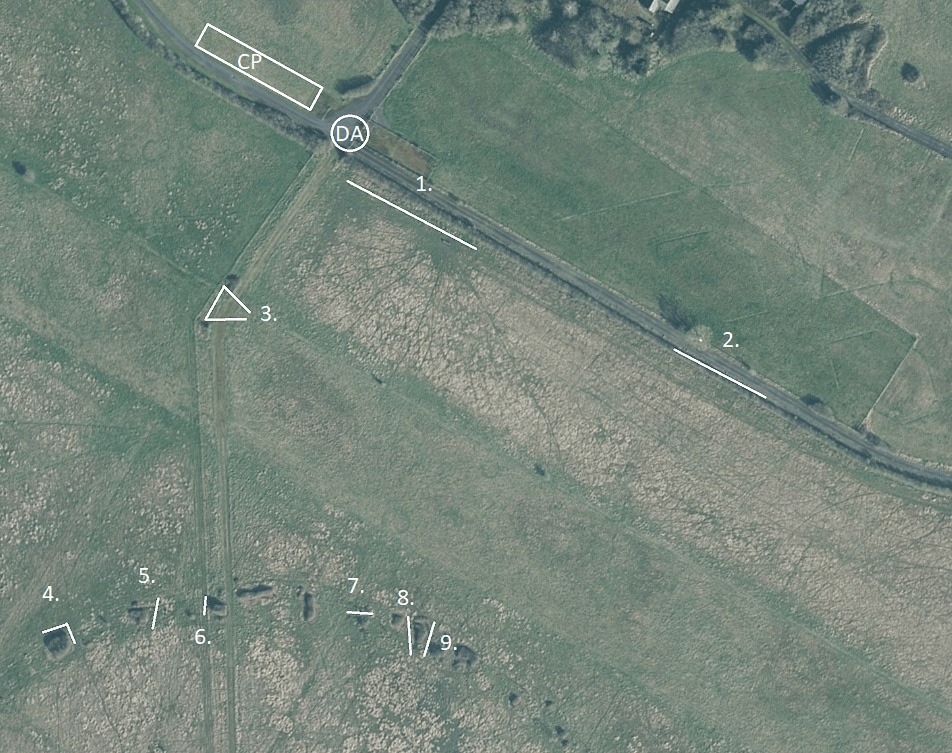

The neighbouring landowner kindly allowed us to use his field as a car parking area for the morning. Which, with the size of our team, plus the SWG team and then the twenty attendees, was very helpful.
The first bird out of the nets was, as seems to be de rigeur for this site, a Wren. Our first round proper was an indication of things to come: two Linnet and one each of Meadow Pipit, Reed Bunting and Stonechat. Linnet numbers seem to have declined quite precipitously at the site, as Robin Griffiths, volunteer warden and highly knowledgeable, incessant observer, of all wildlife in this area, commented when we caught these two. Our ringing records do bear this out, with just two caught in 2020 and 2021, none last year, five in 2019, 16 in 2018, 25 in 2016 and 42 in 2015! To be fair, 2017 only produced 3, but the overall trend is significant decline.
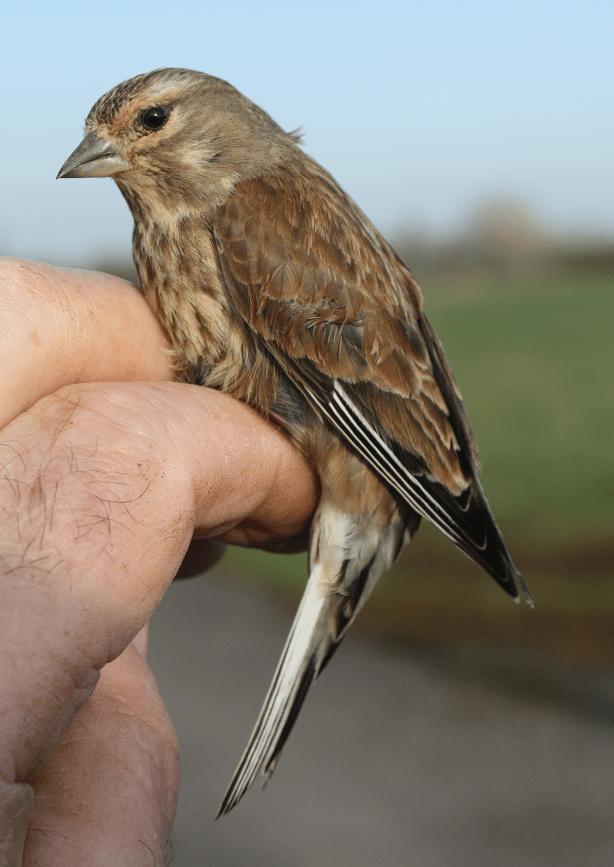
Linnet, Linaria cannabina
The bulk of the catch came between 8:00 and 10:30, which meant that the attendees certainly got their money’s worth. Our Mipit triangle delivered in spades. We had our usual autumnal fall of Reed Bunting. September and October are our best months for catching these birds at Blakehill. This year is no different.
At 11:00 we were delighted to catch another two Stonechat: a juvenile female and a stunning adult male.
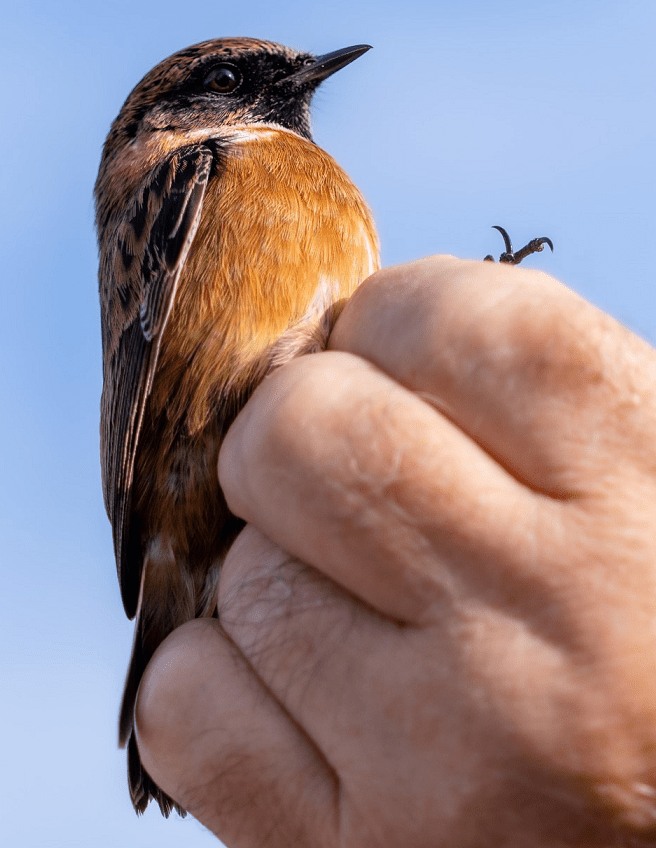
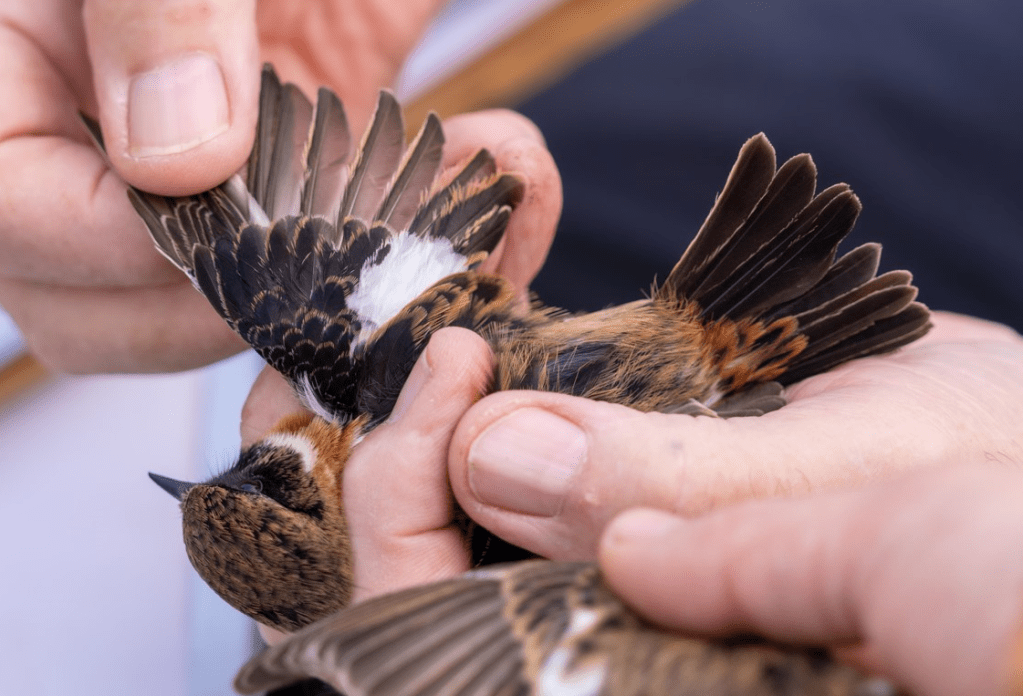
Adult male Stonechat, Saxicola rubicola
Towards the end of the session we had a small fall of three Chiffchaff. It is hard to know whether they are genuinely on migration out of the country or planning to overwinter in the Cotswold Water Park, as many do.
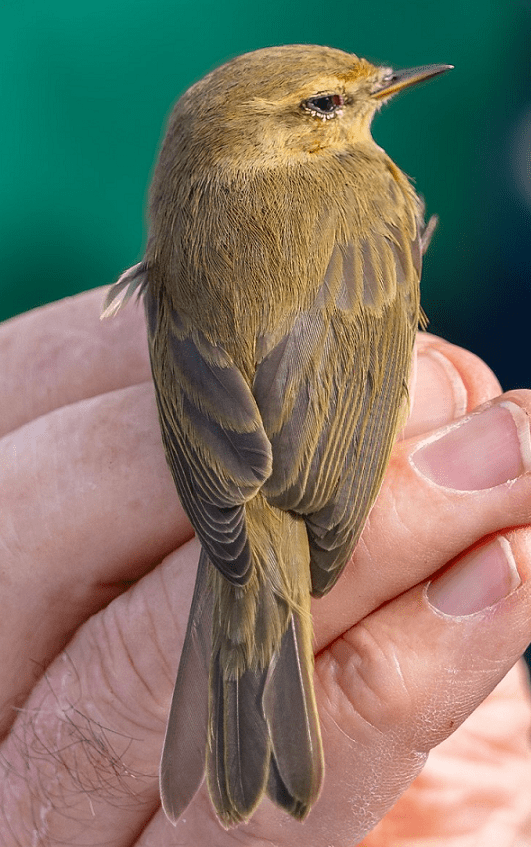
Juvenile Chiffchaff, Phylloscopus collybita
We also caught two Blackcap. At this time of year they would probably be late departing migrants that have fledged here this summer: both were juveniles. The female weighed in at a decent 20.3g. Fledging weight is usually about 16.5g, so I would suggest that she is definitely fattening up for the journey south. The male weighed in at 18.9g, so is probably doing the same. If it was a recently arrived migrant, as ringing has shown that we have a winter population migrating to the UK from central Europe, I would have thought it would have used up some of its fat reserves and would weigh less than that. I could be wrong, of course.
The list for the day was: Blue Tit 17(2); Great Tit 4; Long-tailed Tit 1; Wren 3; Dunnock 2; Meadow Pipit 47; Stonechat 3; Robin 2; Blackcap 2; Chiffchaff 3; Starling 1; Linnet 2; Reed Bunting 17. Totals: 104 birds ringed from 13 species and 2 birds retrapped from 1 species, making 106 birds processed from 13 species.
The thing I find odd about the Blue Tits we catch at Blakehill Farm is that the majority are not caught in the hedgerow, but in the sparse bushes out on the plateau. My natural thought about Blue Tits is that they are woodland and garden birds, not birds of the wide open spaces.
The session was a huge success with the attendees. A large number of people were shown how to safely hold and release a bird. I like to teach people how to do that, you never know when it might be required. We were packed away and off site by 13:00. With so many birds, all of the ringers got to ring a decent number of birds, which is not always the case at a ringing demo, as often it falls just to me to do the processing. So everybody went away happy.
The photos of the Stonechat and the Chiffchaff were courtesy and copyright of Teresa.
 Ringing In The Braydon Forest & Beyond