After lots of reports of Redwing arriving in Wiltshire already this autumn, and Jonny catching nine at his Sutton Benger site on Monday, I decided to run a session at Somerford Common, one of my two best sites for the species. I have caught them this early in the month on three other occasions, with the earliest being at Blakehill Farm on the 9th October 2021. With it forecast to be windy, Blakehill Farm was a non-starter. Besides, I seem to have been there and written about it quite a lot recently, and hope to be there again this coming weekend. I also wanted to try out some different net setting at Somerford, in anticipation of the coming winter, and planning where to set the feeding station for when the weather turns.
Another reason for going to Somerford Common was that Teresa, who volunteers at the RSPCA Oak & Furrows Wildlife Rescue Centre, released a rescued (from the feline scourge) and recovered Siskin here a week ago. It was immediately joined by another small group of Siskin before moving off. I wanted to see if they were still in the area.
I was joined for the morning by Miranda and Teresa and we set the following nets:

Nets 1 to 4 were all single 18m 5-Shelf nets. Net 5 was an 18m net + a 89m net, both 5-Shelf nets. I set lures for Redwing on 5, Siskin on 3 and a mix of migrants on the other nets. After a couple of hours with no activity on net 3, I swapped the lure over with the one on net 2. Still to no avail on the Siskin front. The ringing station was set up behind a hedgerow, out of sight of the various nets.
Unlike either Saturday or Sunday, it was a slow session, with nothing like the activity levels we had over the weekend. However, round one produced two Redwing. To quote Hannibal Smith “I love it when a plan comes together!”. That said, apart from a flock of about 25 that flew over mid-morning, those were the only Redwing that we caught.
It is hard to complain though: the next round produced three Marsh Tits and a Goldcrest. We have ringed 15 Marsh Tits so far, year to date, which is our best for four years. This should set us up nicely for 20+ by the end of the year.
It was a pretty varied catch for this time of year in a woodland setting. However, we didn’t see or hear any Great Spotted Woodpecker or Nuthatch, which is most unusual for this particular site. Mind, if that is unusual: to not see, hear or catch a Blue Tit is a real rarity in one of my woodland sites. We did catch a few Great Tits, one of which was extremely reluctant to let go of my hand:

Juvenile male Great Tit, Parus major
That bird sat like that, back to my palm, holding on to my finger and thumb for a couple of minutes. Certainly long enough for me to open my phone, enter the security pin, select the camera icon and take a couple of photos, and then it sat there some more before deciding to leave. I have never had an experience like it before!
Talking of experiences, we caught an interesting (to me, at least) juvenile Treecreeper. Ageing a Treecreeper is quite simple: each of the primary coverts on an adult are either entirely brown, or have a tiny pale cream pinpoint at the tip. Juveniles have quite a pronounced tear drop shaped cream spot at the tip of each of the primary coverts. The juvenile we caught today rather took this to extremes:
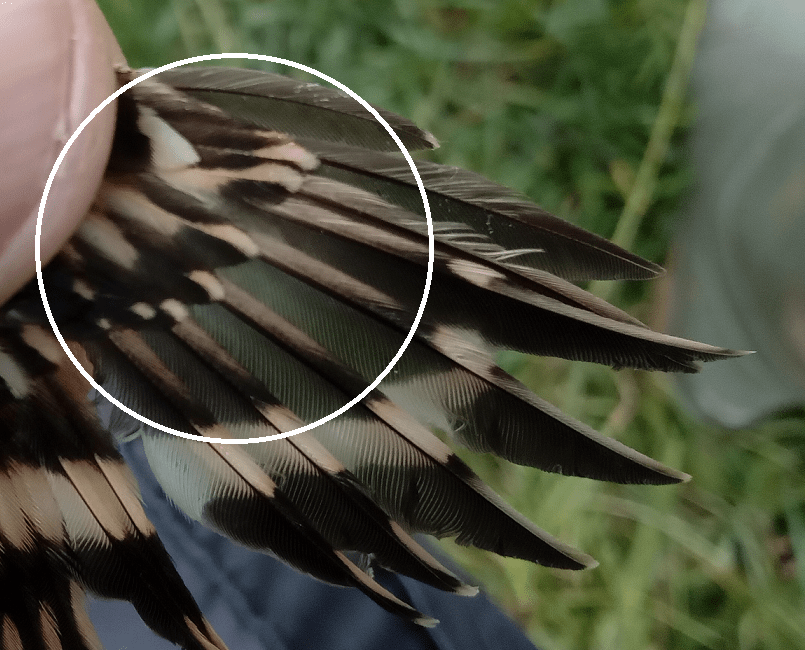
Primary coverts of a juvenile Treecreeper, Certhia familiaris
Our weather recently has been bouncing between extremes of heat, strong winds and rain, occasionally torrential. This has an impact on parent birds ability to feed their young. As a result, feather development in young birds can reflect those difficulties, with distinct barring as the feather growth is interrupted or held back by lack of food. These are called “fault bars”. We found an excellent example in a Blackcap we caught towards the end of the session. When we looked at the tail feathers the barring was very obvious:

Tail feathers of a juvenile Blackcap, Sylvia atricapilla
Fault bars can be zones of weakness, and one can often find feathers that have broken along one such zone.
The list for the day was: Treecreeper 1; Great Tit 4; Marsh Tit 2(1); Long-tailed Tit 1(1); Wren (1); Robin (1); Redwing 2; Blackcap 1; Goldcrest 6. Totals: 17 birds ringed from 7 species and 4 birds retrapped from 4 species, making 21 birds processed from 9 species.
Once again, Goldcrest was our top species for Somerford Common, just as it was back in September. It wasn’t the busiest session but it was thoroughly enjoyable. Given that the weather forecast for the week had shown Wednesday to be wet, windy and no chance of ringing. By yesterday the forecast had changed to it being windy and wet from midday. Then this morning it had changed again to windy with the rain coming in mid-afternoon. The wind was nothing like as strong as forecast, and the woodland protected the nets from what there was, so the weather did not impact on the session at all.
One of the more interesting things we found this morning were these:

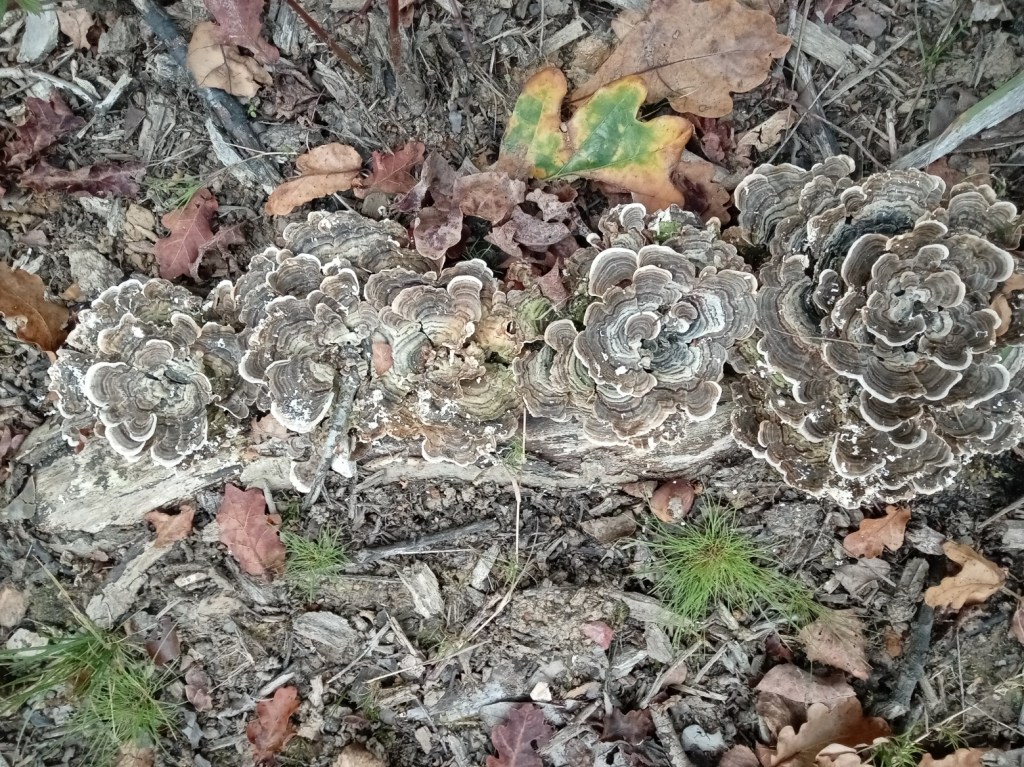
Turkey-tail Fungus, Trametes versicolor
We took the nets down in stages, finally packing everything away by 12:30. The rain finally arrived at 19:30 this evening!
 Ringing In The Braydon Forest & Beyond