Okay, it wasn’t actually a marsh but our site at Somerford Common has so much standing water that it might well become one. We haven’t had too much rain in the last few days, but Forestry England have had a rather large tractor on the site, carrying out the usual ride maintenance, but the under-wheel conditions (is there such a thing?) have resulted in a real mire, and left some pretty deep water-filled ruts, along the main ride.
Marsh Tit, though, is probably the wrong common name for Poecile palustris, as they are associated with, primarily, broad-leaved woodlands in the UK. As it says in “The Birds of the Western Palearctic”, they prefer their woods moist to dry, but not wet.
This was the second CES session for this winter. We were on site at 7:00. I was joined by Teresa and Andy and, after doing the school run, Steph. The same nets were set as in winter CES session one. Having set the nets, leaving them closed so that we didn’t get any unexpected early arrivals, Andy and Teresa went back to set up the ringing station whilst I opened the nets. Unfortunately, two birds had decided that they couldn’t wait for the nets to be open and had already entangled themselves. Fortunately, that meant they had to wait for me to free them and, doubly fortunate, two Marsh Tits: one new, one retrap.

Marsh Tit, Poecile palustris
That was the start of our best haul of Marsh Tits since an identical catch on the 27th December 20210: one new bird and six retrapped birds. One of the retrapped birds was over four years old, with another two being over three years old. Nothing near the species longevity record (11 years 3 months) but longer than the typical lifespan of 2 years. For a red-listed bird its population in the Braydon Forest is not just stable but showing a slight increasing trend. In the following graph, the trendlines show this to be the case. Even when the 2017 spike is removed, the trends on both ringed and retrapped are still upward:

Retrapped birds can distort the picture, so I did a quick analysis of the numbers of individual birds by age group and year to give a better indication of how things are going for them:
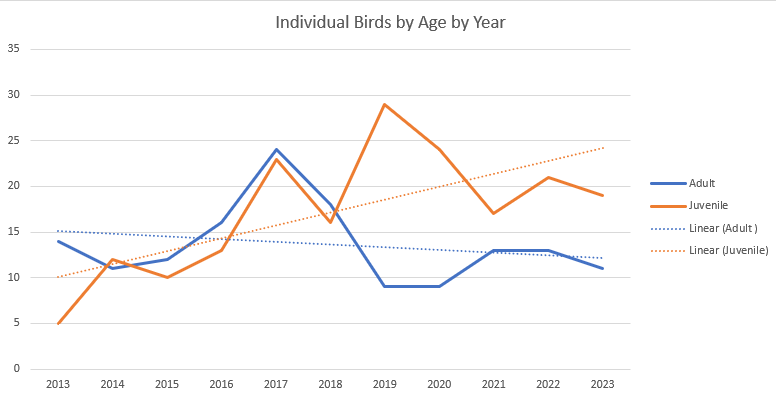
As you can see, it is birds classified as juvenile that are driving the overall stability of the species in the Braydon Forest.
Obviously, Marsh Tits are a bit of an obsession for me, having helped persuade Forestry England to make it the priority bird species for their Braydon Forest management plans, but there was a lot else going on. Talking of Forestry England, we were joined by Sian from that organisation. She had driven past on her way to another site, saw the activity and stopped off to say hello. She spent a while with us, seeing what we do and learning how to safely handle and release a bird. She also found out what it is like to be bitten by a Great Tit (we spared her the Blue Tit experience – didn’t want to put her off). For the second session running we had a couple of Redwing drop in: unfortunately a fair few dozen flew over, some just missing the nets – as did a female Sparrowhawk. It was quite remarkable watching as she shot out of cover, noticed the net and did an almost vertical lift to get over it.
We are having a good year for Nuthatch, another four ringed this year will make it our best ever. Another Lesser Redpoll was caught, but several bounced off the nets, plus we had another small catch of Goldcrest. They are looking on target to be on par with recent year catches. For our woodland at the start of the winter it was a pretty good and varied catch:
The list for the day was Nuthatch 1; Blue Tit 5(6); Great Tit 6(9); Marsh Tit 1(6); Coal Tit 1(2); Redwing 2; Goldcrest 4; Chaffinch 1; Lesser Redpoll 1; Bullfinch 1. Totals: 23 birds ringed from 10 species and 23 birds retrapped from 4 species, making 46 birds processed from 10 species. It is not often that we get equal numbers of ringed and retrapped birds.
The catch dropped right away by 10:30. We shut the nets at 11:30, took down and left site by midday.
 Ringing In The Braydon Forest & Beyond