This week’s session was scheduled for Ravensroost Wood. As the local volunteer group carry out their works on a Wednesday, and ne’er the twain shall meet (we all get on fine – just too many vehicles), we went in this morning. I was joined by Rosie, Miranda and Teresa at 7:00. I decided to try a new net position (it caught two birds, I won’t try it again), which turned out to be the only one that wasn’t ankle deep in mud!
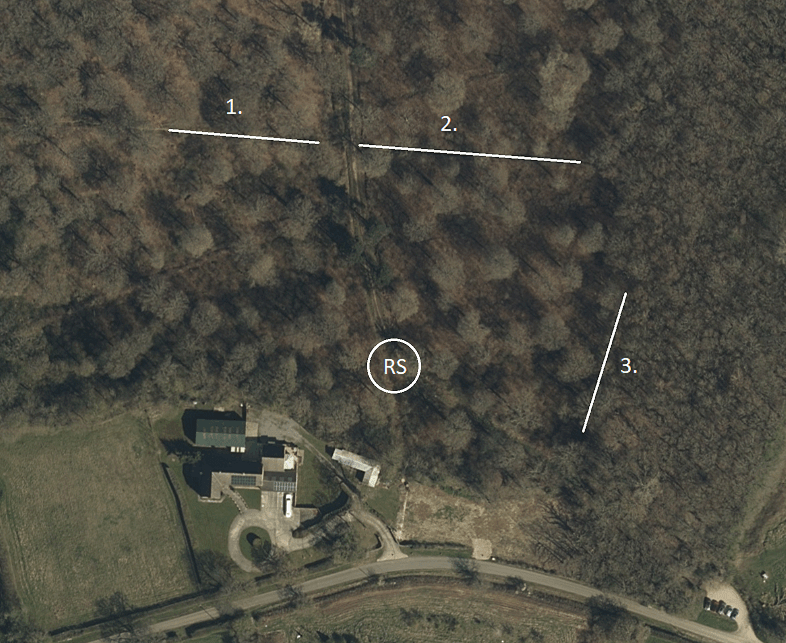
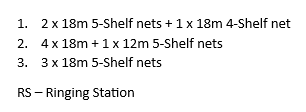
Rides 1 and 2 were incredibly muddy and, as is my wont, I managed to become intimately involved with it, tripping over a guy rope and measuring my length in the mud. As I had a bird attached to the carabiner around my neck, and protecting that was my main concern, there is not a lot you can do to fall elegantly and minimise the mud spatter.
The first round started nicely, only five birds, but two Nuthatch and a female Bullfinch alongside two retrapped Great Tits ringed at my previous session there. Round two was somewhat larger, at nine birds. Key amongst them in the catch was a Marsh Tit. The eighteenth ringed so far this year, that this was followed three rounds later by our nineteenth means that this year is looking good for the species in the Braydon Forest. As I have done very little ringing in Ravensroost Wood this year, and all of it in the eight-year coppice area, that I have ringed four there (0ne adult, three juveniles) this year is quite surprising. My next session will be at the north end of the wood to see whether we can increase that number.
Between 9:00 and 9:30 we captured four Goldcrests, but none afterwards, which was a bit of a surprise as they are usually absolute suckers for the lure. Talking of birds that come to the lure: we did actually catch a Redwing immediately over the lure. In that round we caught the second Marsh Tit and two Lesser Redpoll.
At 11:00 we were joined by one of the Wiltshire Wildlife Trust’s well-being groups. As luck would have it, that was our only empty round of the morning. We agreed that if we caught anything in our last round I would give them a shout so they could come over and I could show them what it is all about. Fortunately, we caught a Blue Tit, a Great Tit and this little beauty in that round, so we did have something to show them:
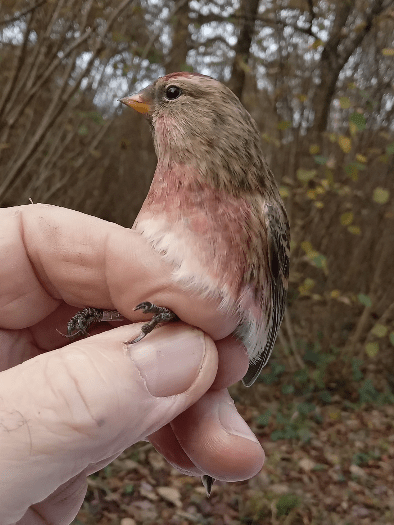
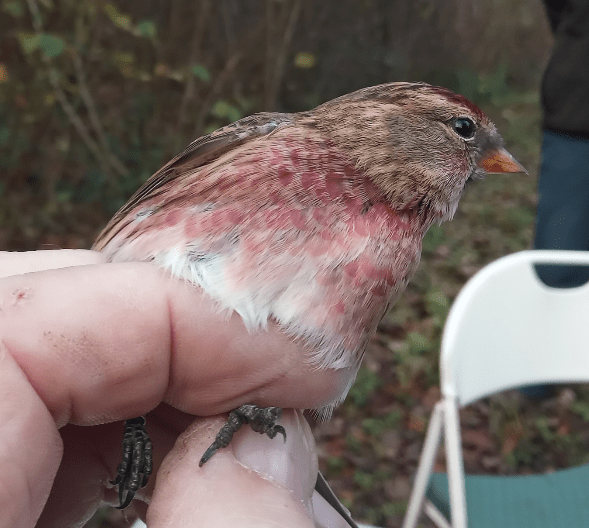
A beautifully marked juvenile male Lesser Redpoll, Acanthis cabaret.
Everybody was wowed by it. I was surprised at how well marked its plumage is. It was definitely a juvenile: the tail tips were very pointed, the classic identifier.
The list for the day was: Nuthatch 2; Blue Tit 4; Great Tit 2(2); Coal Tit 2; Marsh Tit 2; Long-tailed Tit (1); Wren 1(1); Dunnock 1; Robin 3; Redwing 1; Goldcrest 3(1); Lesser Redpoll 3; Bullfinch 1. Totals: 25 birds ringed from 12 species and 5 birds retrapped from 4 species, making 30 birds processed from 13 species.
I am quite surprised at the number of species, given the size of the catch, for this site. Even at my last session here, with 63 birds caught, it was 11 species, which was the most to date at that time.
Having finished my mini ringing demonstration we did the last round, closing the nets as we went: no more birds so we started taking down at about midday and were away from site by 12:45.
 Ringing In The Braydon Forest & Beyond