As luck would have it, on the only decent day since our freezing session on the 2nd December (Wednesday of last week) I had a major family commitment (mother’s 93rd birthday, absolutely couldn’t be missed). Friday was too windy and the rest of the time was wet, windy and totally miserable so, benefit of being retired, I arranged for a session at Webb’s Wood for Monday morning as the weather was looking possible.
I was joined for the session by Teresa, Laura and Andy. Laura and Andy helped setup and take down, Andy scribed, Laura extracted and Teresa did a bit of everything except scribing. We met at 7:30. The drive up to the ringing site was fun: several Robins and Song Thrushes and two Woodcock were quick to move out of the way. We did not catch any Robin or Song Thrush in the session (I wasn’t expecting to catch Woodcock, so wasn’t disappointed). Missing out on Robin is most unusual: since I started ringing at Webb’s we have managed 69 sessions and Robins have been caught in 65 of those sessions. So, an unusual missing species.
It was pretty windy when we got to the ringing site and, at first, I was unsure whether we would be able to set all of the intended nets. However, after setting up two net sets in sheltered areas, the wind dropped and I could set all of the nets that I had planned. That included two nets around the feeding station that I set up last week, before the weather turned horrible. The set up was:
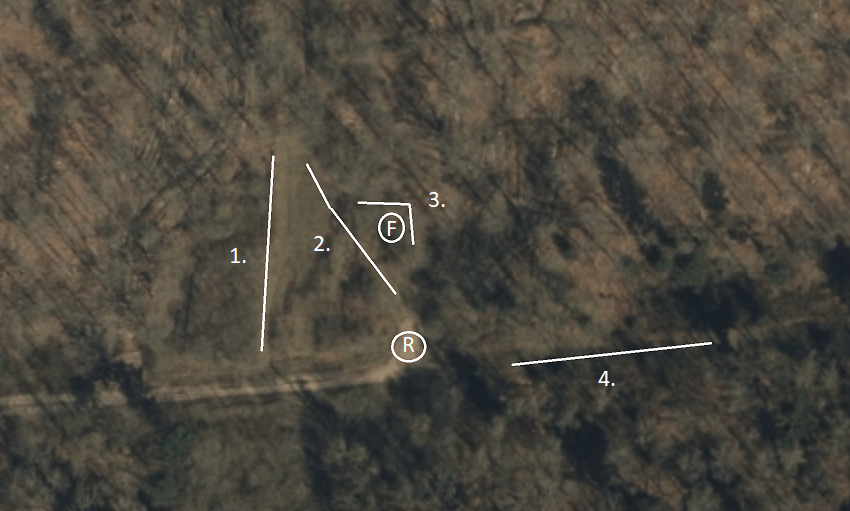

We had the nets open by 8:15 and I put a number of lures on the net rides: one to three had mixed finch calls on the lures (Lesser Redpoll, Siskin & Brambling) whilst ride four had Redwing and, from 10:00, Goldcrest, Firecrest, Long-tailed Tit & Chiffchaff). Things didn’t actually get going until 9:00 and, apart from the lures, it was very quiet, with very little other bird noise about. However, at 9:00 the Latvian love song did its job and we had three Redwing in ride four, which was followed 15 minutes later by a female Bullfinch. This is our fourth Bullfinch ringed in the last four weeks: all of which have been female! Where have all of the males gone?
Whilst Teresa was processing this bird we couldn’t help but notice a large flock of small birds flying around the tops of the trees around the ringing station. It became clear that they were Lesser Redpoll responding to the lure and, sure enough, they came lower and started to hit the nets in rides one and (mainly) two. We sat back to see how many were going to catch. By 9:30 we decided it was time to get them out: 15 Lesser Redpoll and three each of Blue and Great Tit. The next round produced another three Lesser Redpoll. That was it with that species, until our last round at 11:30 when we ringed another one and retrapped two from our last Webb’s Wood session on the 5th November. It is good to know that they are staying around. The 15 in one haul is our largest individual flock catch of Lesser Redpoll and the 21 processed is our largest in any one session in the Braydon Forest. The previous largest session catch was 20 on 5th December 2021, with a single largest haul of 11 birds.
The list for the morning was: Great Spotted Woodpecker 1; Nuthatch 1; Blue Tit 9(4); Great Tit 8; Coal Tit 1; Redwing 3; Chaffinch 1; Lesser Redpoll 19(2); Bullfinch 1. Totals: 44 birds ringed from 9 species and 6 birds retrapped from 2 species, making 50 birds processed from 9 species.
What is remarkable about this catch is the absence of any Goldcrest, Robin or Wren in the catch. Teresa’s highlights were the Nuthatch that she processed and this beauty:
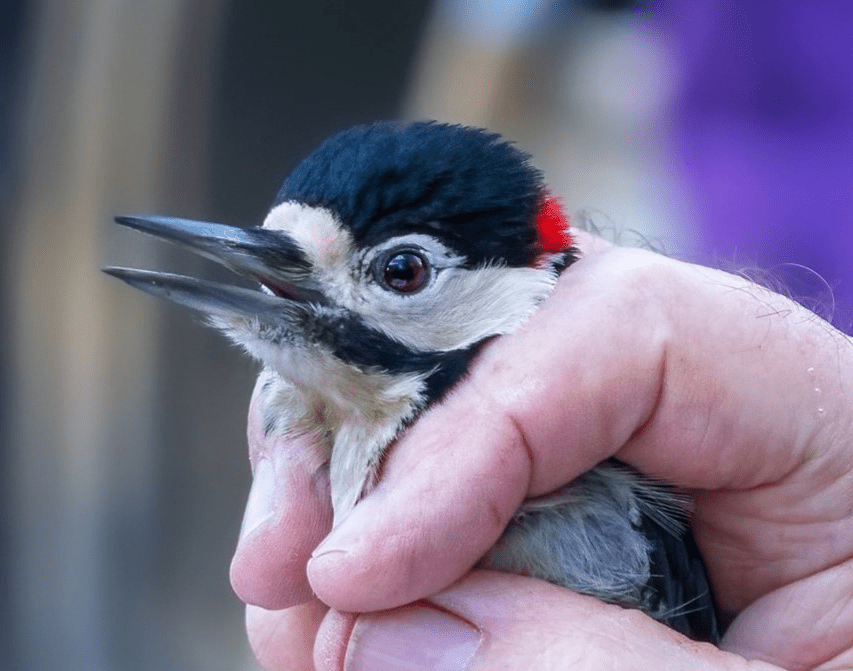
Adult male Great Spotted Woodpecker, Dendrocopos major (photo courtesy of Teresa)
This has been our quietest year yet for this species in the Braydon Forest: only our ninth this year: about 75% of the average annual catch.
We did catch three Chaffinch but, unfortunately, the two that I took out of ride four were badly infected with Fringilla papillomavirus and I released them unringed before applying liberal quantities of antiviral hand wash so that there was no chance of passing the virus on to other birds.
We missed out on a Woodpigeon that hit the net, settled in the pocket briefly, but then extracted itself and got away. We always heard and saw Jay and Raven flying around. There were also two sightings of Muntjac and, somewhat later, two rifle shots. As, on leaving the site, we found that the gate had been locked our assumption is that the shots came from one of the stalkers Forestry England use to control deer numbers. I will be having a chat and asking FE to tell the stalkers to leave the gate open when we are on site. Our ringing site is a long way from the car park and should, for whatever reason, we need the attendance of a medical unit they will have cut off access.
The wind got up again at 11:00, so we started closing the most exposed and taking them down. Everything was packed away by midday and we left site soon after (soon after I had opened the gate for the gang to get out!). I then spent another 30 minutes visiting the other Forestry England sites that I ring at, topping up the feeders there. It was nice to see some Crossbills flying around at both of my Somerford Common sites. If only! They don’t respond to lures particularly, but needs must! We will be there on Thursday, so fingers crossed.
 Ringing In The Braydon Forest & Beyond