Having been confined to woodlands for the last few weeks, it was delightful to be able to get out to the wide open spaces of the plateau of Blakehill Farm! I was joined for the session by Justine and, delightfully, because I wasn’t expecting to see them Rosie arrived with Tanya. Tanya was a colleague of Rosie’s at the Wiltshire Wildlife Trust and came out ringing with me until she moved to a new job up in Shropshire. It was lovely to have her company again. They were with us from just after 7:00, but had to leave at 10:30 as they had other arrangements made. We met at the Chelworth Industrial Estate side of Blakehill Farm. The hedgerow on that side of the farm is currently undergoing a significant piece of maintenance: the hedge is being laid. It has just reached halfway through my usual ringing area and I will probably not make use of it there until there is a bit of regrowth. However, this work has been ongoing for a few years, until it was decided last year that it had to be completed by the end of 2024, which has sped up the process. That means that there is a considerable stretch that has been laid for a few years and I will spend some sessions this year looking at how that is being used by the local birdlife.
As of 10:00pm Friday night, the weather forecast was for it to be dry all day, with a breeze coming from the south-south-east as the morning progressed. Suffice to say, we had a few drops of rain whilst setting up the nets and until 8:00. To be fair, the forecast had changed overnight, but what is the point of a forecast which is, essentially, looking out the window and saying what you see. We set the following nets:
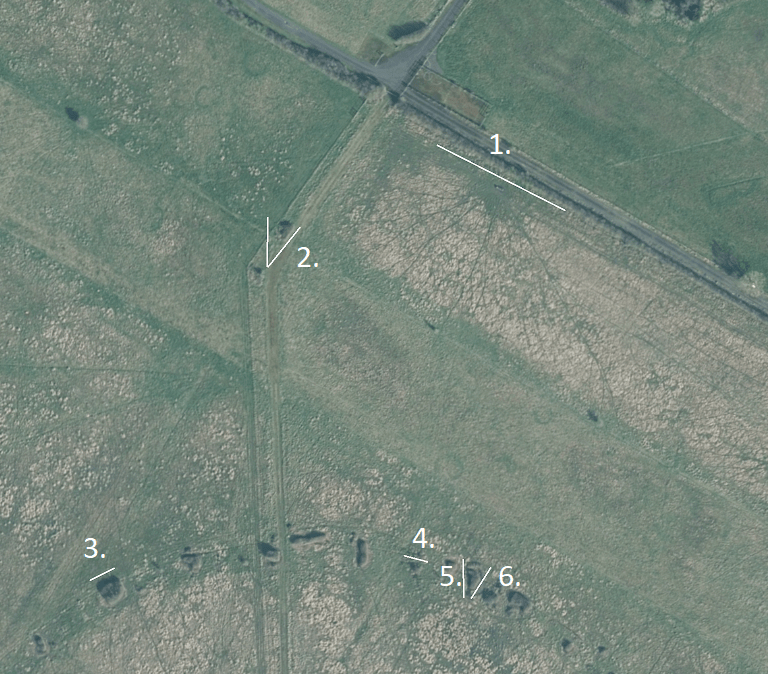

Net set 1. was set up along the plateau side of the hedgerow, on the basis of the forecast wind direction. More about this later!
After the over-abundance of Blue and Great Tits in all of our recent woodland sessions, I did say to Justine that I would love a couple of Stonechat today and that I would happily pack up if we were that lucky. Well our first round produced: two Stonechat, adult male and female, a Meadow Pipit and two Reed Buntings! I am delighted with that catch. To put that into perspective: we had only caught and ringed 33 Stonechat before today and we have never caught them this side of Christmas: all bar one had been caught in the September to November period.

Male Stonechat, Saxicola rubicola
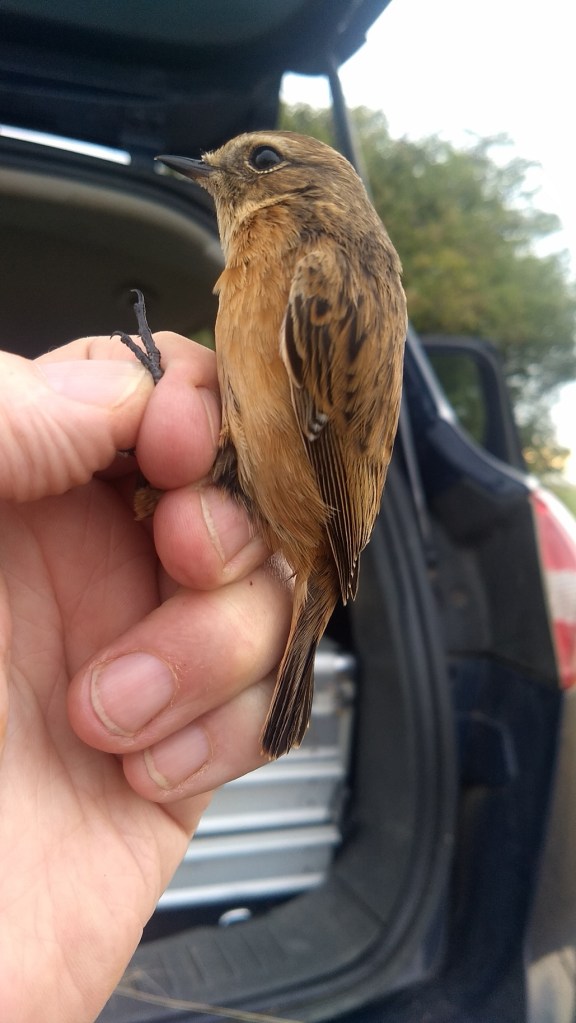
Female Stonechat, S. rubicola
As for Meadow Pipits, we haven’t caught any in February since 2017, and that was two birds, so I was very pleasantly surprised to have this one.
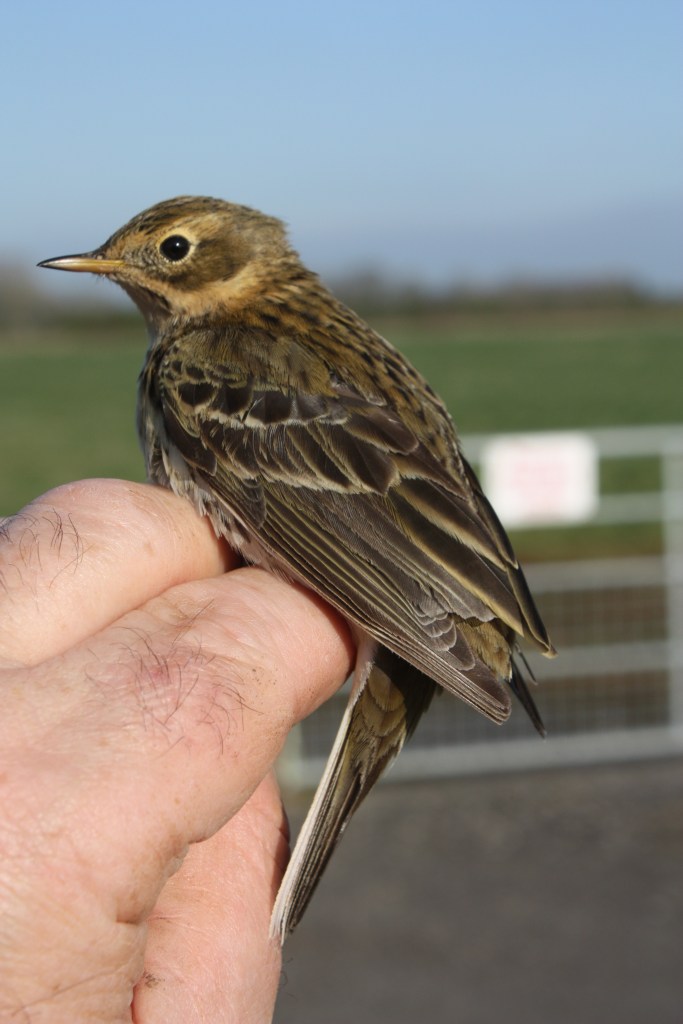
Meadow Pipit, Anthus pratensis
Similarly, the last time we caught Reed Bunting in February was also back in 2017. Was this an auspicious start?
Well, the next four rounds produced another couple each of Meadow Pipit and Reed Bunting plus a Great Tit and a retrapped Wren. That was when Rosie and Tanya had to leave. They were both very happy: Rosie had her second ever Stonechat and Tanya her first. Tanya had her first Reed Bunting working with me, but she might have done a few with her current ringing group.
So, the next round after Tanya and Rosie left we were astonished: 17 birds. Our solitary Blue Tit of the day, another Reed Bunting and another 15 Meadow Pipits. That was astonishing: we have never had a catch of Meadow Pipit like that outside of the autumn passage. The breeze had started to get up and, disappointingly, it was a straight westerly wind: opposite to what was forecast. As a result, net ride 1 ended up with two of the three nets embedded in Blackthorn. The central net was absolutely the worst, and I had to cut the net out, taking a rather large number of off-cuts of Blackthorn with it. My good lady wife spent this afternoon going through that net, metre by metre, snipping out the Blackthorn twigs for me. That is love, whichever way you look at it!
We closed all of the nets at midday, extracting the last three Meadow Pipits of the day, ready to take down.
The list for the day was: Blue Tit 1; Great Tit 1; Wren (1); Meadow Pipit 21; Stonechat 2; Reed Bunting 4(1). Totals: 29 birds ringed from 5 species and 2 birds retrapped from 2 species, making 31 birds processed from 6 species.
Extracting net ride 1 took up a lot of time so, by the time we had extracted and packed up all of the nets and the ringing station, it was close to a 14:00 finish.
Whilst we were working we were treated to a number of excellent birding sites: we had a great catch of Meadow Pipits but there must have been well over 50 of them flying around. Alongside them, flying about on the plateau, were at least 30 Skylarks. When the sun came out the males were up and singing: you could almost believe it was Spring! But then, there were very large flocks of Starling flying around. As Justine described them “a murm” – not big enough to be a murmuration but still quite impressive (cue a morning of appalling puns between us). There were Fieldfare in evidence but no sign of Redwing. A Snipe flew through and we had both Red Kite and Buzzard flying around the site. All in all, it was a thoroughly enjoyable morning, despite the best endeavours of the weather forecasters and the Blackthorn, to sour my mood!
 Ringing In The Braydon Forest & Beyond