After eight days of wind and rain and impossible weather for ringing, I grasped the first opportunity to get out. There was still some breeze about, so I decided on Ravensroost Wood, as it tends to be reasonably sheltered. As I had several people also itching to get out bird ringing, I decided to set a few different nets:

All three rides comprised 3 x 18m 5-Shelf nets.
I arrived on site at 6:25 to find Miranda, Sarah, Teresa and Andy waiting for me. Rosie arrived a few minutes later (coming over from the Forest of Dean, with the mess that is the A417 roadworks, I am amazed she gets here at all, let alone on time and ready to help for a couple of hours before heading to work) and we set to getting the nets open. There was bird song everywhere: predominantly Chiffchaff and Willow Warbler, so I was hopeful that we would catch a few. Unfortunately, “few” was the operative word! Don’t get me wrong, it was a thoroughly enjoyable session, even without a preponderance of birds.
We only caught 15 birds, 12 new and three retraps. It started with a retrapped Blue Tit and a Chiffchaff at 7:30. That was the shape of things to come: between one and four birds every 25 minutes, mainly just one or two, sometimes none. The second round comprised two more Chiffchaff and a Blackcap. All three Chiffchaff were able to be sexed as males and the Blackcap was a female. The first of the year, the others caught at Lower Moor Farm on 30th March were all males.
Our next round was the biggest of the session: four birds. Retrapped Blue Tit and Willow Warbler plus new Great Tit and Wren. The next two rounds each produced a single Wren. That second round also produced a female Blackbird, with a very well-defined brood patch, plus the bird of the morning: a female Lesser Redpoll, also started developing a brood patch, but still defeathering. This is notable because, although Lesser Redpoll have historically bred in the Braydon Forest, particularly Somerford Common, recent evidence is very scant. I have to admit, I do not know whether a female bird planning to migrate northward would start preparing to breed before embarking in that journey. The only recoveries we have had of Lesser Redpoll have been one in Glasgow and another in Yorkshire, which rather indicates they head north in the Spring. The only juvenile Lesser Redpoll that we have caught in full juvenile plumage were at Ravensroost on the 6th August 2016. We were so surprised to see them that we initially misidentified them as Linnets! Why was it so surprising? Two reasons: the earliest anybody in the group has caught Lesser Redpoll is in October and the latest, until today, that anybody has caught them is the 6th April.
Much as we were enjoying the chat, without the birds we decided to pack up at 10:30. Needless to say, we did have one last bird hit the nets as we were taking the nets down. It was a Long-tailed Tit: a female with a very well-defined brood patch:
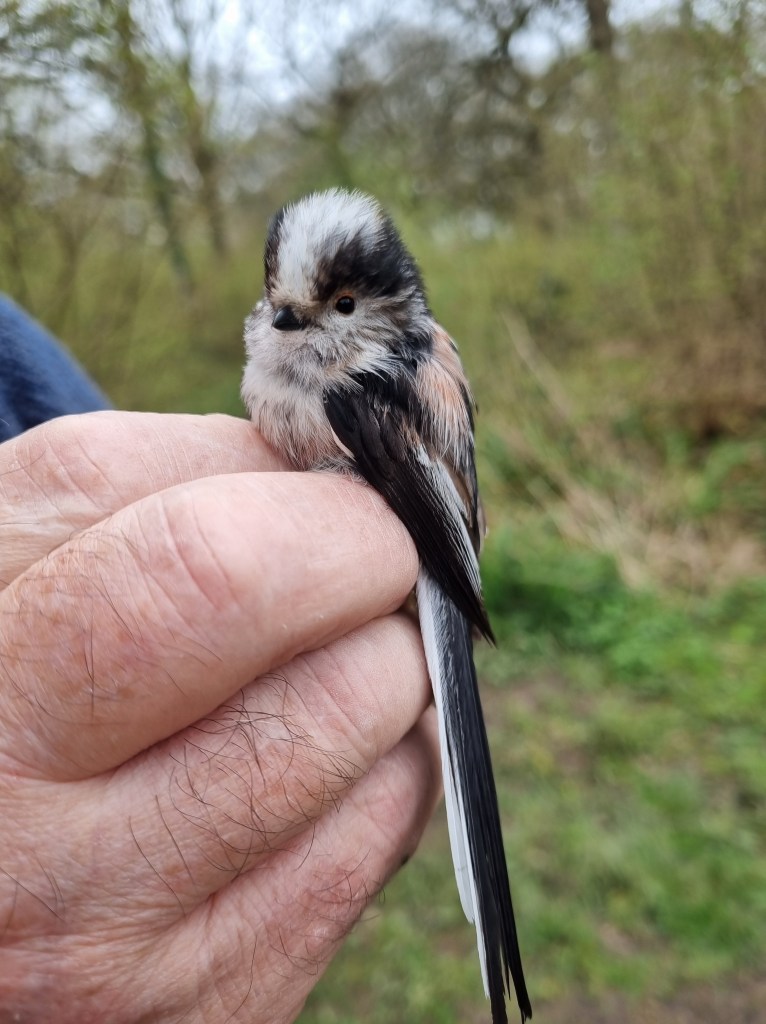
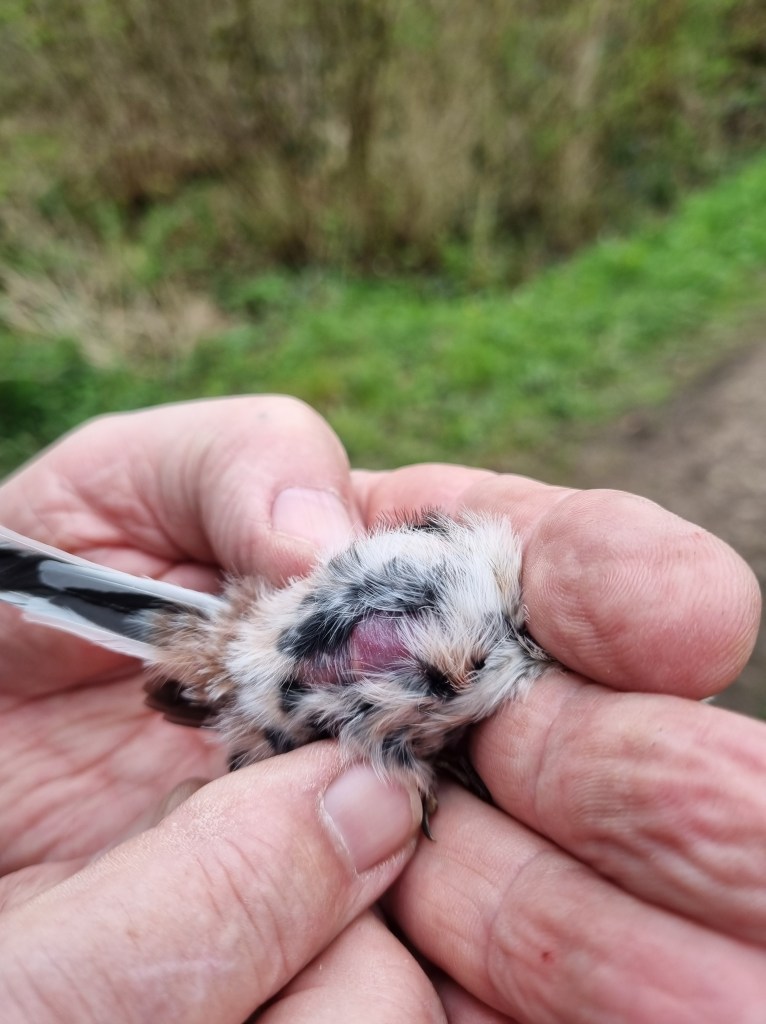
Long-tailed Tit, Aegithalos caudatus. Photo 2 showing the well-developed brood patch. (Photos courtesy of Sarah Emery)
For the absence of doubt, the portrait photo was taken after I had blown on her belly to show the brood patch. As you can see, the minor indignity of having her belly displayed didn’t disturb her undoubted good looks! Beautiful bird.
The list for the session was: Blue Tit (2); Great Tit 1; Long-tailed Tit 1; Wren 3; Blackbird 1; Blackcap 2; Chiffchaff 3; Willow Warbler (1); Lesser Redpoll 1. Totals: 12 birds ringed from 7 species and 3 birds retrapped from 2 species, making 15 birds processed from 9 species.
With everything packed away we left site by 11:30: quiet, but quietly satisfying!
 Ringing In The Braydon Forest & Beyond