Over the last few years I have become increasingly disillusioned with the Constant Effort Site (CES) catches we have been getting, as the number and variety of catches have declined significantly across the reserve. From the first full year, 2014/15, until 2019/20, we averaged just under 52 birds processed each session across the full year. The average between 2020/21 and 2023/24 has consistently declined to 31.1, with the last year 1st April 2023 to 31st March 2024 averaging just 26.9 birds per session. The decline is almost entirely down to the reduction in catches in the CES sessions. Last year also recorded our lowest ever number of species, at 23. In 2022/23 we recorded 25 species but, prior to that, we averaged exactly 30 species per annum. I decided that if the pre-CES sessions were very low I would possibly retire the CES. I wouldn’t give up working at Lower Moor Farm: how could you give up the site that delivered a Yellow-browed Warbler, the second ringed in Wiltshire; an acredula Willow Warbler, the first ringed in Wiltshire (as far as I can ascertain) and a Firecrest. Instead I would expand the activity to different parts of the reserve to see whether the birds had relocated elsewhere away from the wildlife refuges. Our session at the end of March produced 30 birds and the one on the 17th April produced 36 birds. These are about average for this time of year, with winter visitors disappearing and summer visitors just beginning to arrive, so I decided to give the CES another year.
We have had discussion with the Wildlife Trust about the issues potentially affecting the suitability of the habitat and agreed on plans of action. Some has been carried out: the trees along ride 4 have been thinned and some have been topped out. There is more to do to both ride 2 and ride 4 but, of course, work cannot continue until after the breeding season, and the Trust has many differing priorities and limited resources. I am grateful for what has been done so far. The saddest loss to me is the absence of Lesser Whitethroat: we haven’t caught a single one at the site for over three years. Until 2019/20 we could reliably catch 10 of them each year: most of which were juveniles almost certainly reared on the site.
A final push to continuing with the CES this year was a request for help , last year we played host to Sarah Binnie, a PhD student at UEA, carrying out her PhD looking at the relationship between the prevalence of insect life and the number of juvenile birds being produced at CES sites. This year we have been asked to help her studies by deploying sticky traps alongside one of our net rides: just one trap per session and then send her photographs of the results. I put the trap in a tree along ride 4:

I was joined for the morning by Rosie, Miranda and Teresa. We were on site and had nets open by 6:30 and caught the first bird at 7:00. Just before Rosie had to leave for work we were joined by her new trainee, Ellie. It is great to see that the Trust are taking on some new staff. Hopefully more will follow.
Unfortunately the session was nowhere near as good as the previous one. It was quite remarkable in one way: over 70% of the catch were retrapped birds. That sounds grand, but we had just 12 retraps and 5 new birds in the catch over a six hour period. It is a good job we had plenty of other things to keep us occupied!
The list for the day was: Wren 1; Dunnock 1(2); Robin (2); Song Thrush 1; Cetti’s Warbler (2); Blackcap 1(2); Garden Warbler (2); Chiffchaff 1; Goldcrest (2). Totals: 5 birds ringed from 5 species and 12 birds retrapped from 6 species, making 17 birds processed from 9 species.
One of the Garden Warblers, ACJ5243, was ringed as a juvenile in August 2019, so that is five journeys to and from the Congo rainforest: a mere 6,000 mile round trip, so just the 30,000 miles so far!
So, whilst we didn’t have a massive haul, there was a lot going on. There was plenty of birdsong: Blackcap, Garden Warbler, Chiffchaff and Willow Warbler, as expected, but we also heard our first Cuckoo of the year. Not only that but I was treated to not one but two Hobby flying over Mallard Lake! The Great Crested Grebes were still courting on the Lake. The funniest thing we saw this morning was a Cormorant trying to swallow a huge Rainbow Trout. It took a long time before it managed to swallow it down.
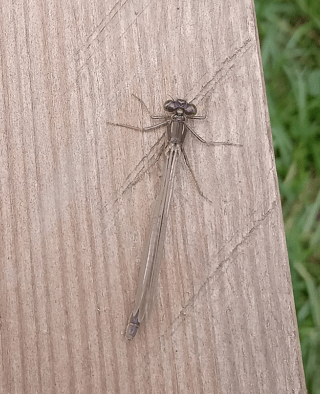
There was a very pronounced irruption of damselflies: all too dark and dull to identify yet (okay, I could get the book out, but I have a lot of other stuff to write once I have finished this blog!). This one came and sat by me on the bench:
We carried out the six hours allocated to the session, packed up and were off site by 13:00. As we were packing up I discussed the situation with Miranda, and decided that we will keep the CES core but add some extra nets away from the CES nets, to test whether the birds have simply moved away from the CES site to other parts of the reserve. i.e. make more work for ourselves!
 Ringing In The Braydon Forest & Beyond