With the weather forecast saying that it would be raining until at least 5:30, I arranged for us to meet at the Firs at 6:00. Unfortunately, I still woke up at 4:30 and, by 5:00, was up and ready to go. Fortunately, it had stopped raining, so I went early to site. Just as well that I did and, equally, just as well that I took my brush cutter too. The grass and bramble have shot up and across the glade, so I spent the next thirty minutes ensuring we had some room to set our nets.
At 6:00 I was joined by Rosie (doing her usual, helping set up, ring a couple of birds, go to work), Miranda, Sarah, Teresa and Andy (Andy helped with the initial setup, until the rest of the crew arrived, but then went off to work, and then came back to help pack up at 11:30). We had the nets open before 7:00 and had our first birds out almost straight away.
Numbers-wise, it was a reasonable session for this time of year in the local woodlands. However, in many ways it was a remarkable session. The first indicator of how the session was going to go was our third round at 8:00 when we took a juvenile Robin and our first juvenile Blackcap of the year:
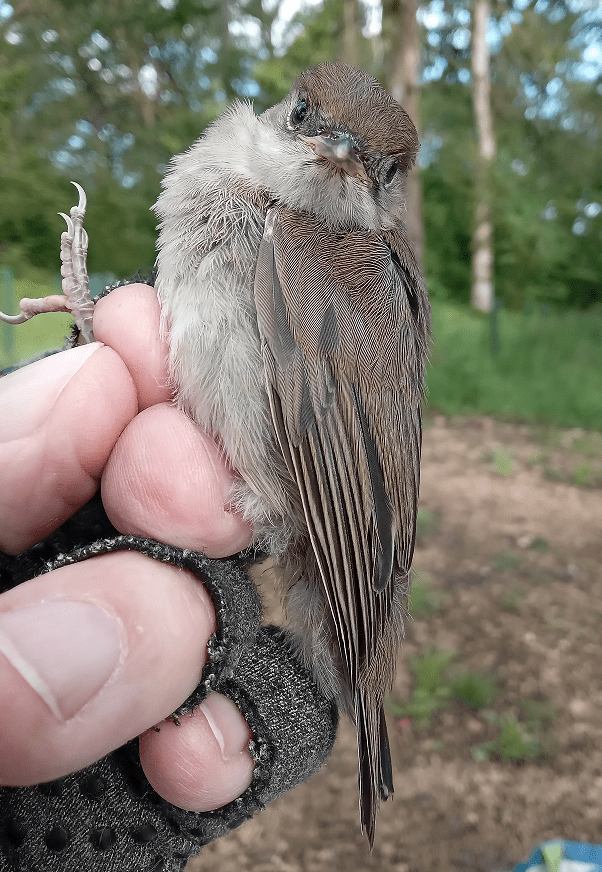
Juvenile Blackcap, Sylvia atricapilla
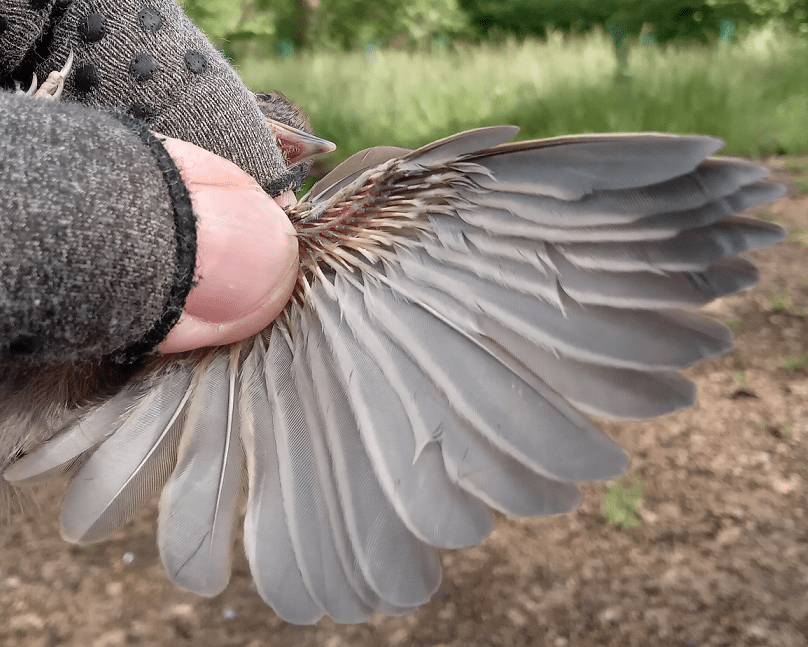
It was a very young bird, it seemed too young to be out of the nest. Its wings were still showing a lot of pin:
This was then followed a couple of rounds later by this:
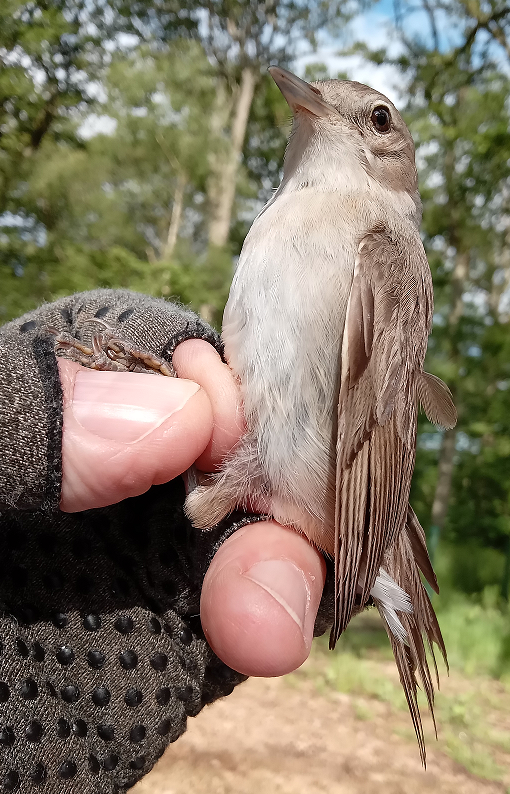
Garden Warbler, Sylvia borin
This was only the second Garden Warbler ever caught in the Firs. The first was in June 2019. A couple of rounds later we caught another in the same net as the first. The first was a male, the second was a female with a fully developed brood patch. Hopefully there will be young this year. Their presence could be a result of two things: previous work by the volunteer group and the Ash clearance has opened the wood up somewhat and the understorey has reached that height that I think of as being optimal Garden Warbler habitat.
We then caught our first juvenile Chiffchaffs of the year:
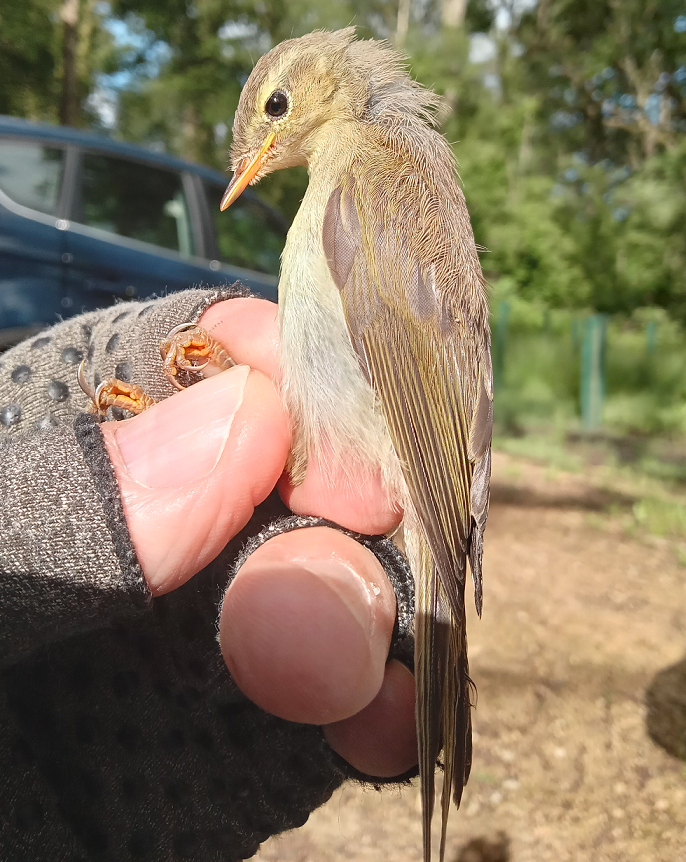
Juvenile Chiffchaff, Phylloscopus collybita
We did have a pretty big, probably family group, of Chiffchaffs flying around the nets. We left the vicinity, to give them a chance to drop into the net. Unfortunately, only one of that group did. We might have passed the forty mark if they had all dropped in. Hard on the heels of these was our first juvenile Marsh Tit of the year. That was the one species that I was concerned might have been affected by the works that took place at the Firs over the winter of 2022 / 2023.
The list structure is: ringed [juvenile ringed] (retraps). Today’s catch was: Jay 1; Blue Tit 2; Great Tit 1; Marsh Tit [1]; Long-tailed Tit 1; Wren 1; Dunnock [1]; Robin [4](1); Song Thrush 2(1); Blackbird 1(2); Blackcap 3[2](1); Garden Warbler 2; Chiffchaff 2[6]; Goldcrest 1. Totals: 17 adults ringed from 11 species, 14 juveniles ringed from 5 species and 5 birds retrapped from 4 species, making 36 birds processed from 14 species. That is an excellent catch variety in such a small woodland.
Teresa was delighted to extract and ring her first Jay. What is more, she did it with minimal damage to herself! When she processed it I remembered to give it a pen to hold on to, to keep its feet occupied, and we kept the bag over its head to keep its beak out of harming way. If only I had remembered all of that when I ringed the Jay at Lower Moor Farm on the 15th May!
We carried out the last round at 11:20, shutting the nets as we went. It delivered a single bird. With five of us taking down we were done very quickly and off site by midday.
 Ringing In The Braydon Forest & Beyond