Barn Owl checking in the Braydon Forest was carried out for a very long time by a stalwart volunteer of the Wiltshire Wildlife Trust, Paul Darby, and his team. I joined his team in 2015 and, when Paul retired from monitoring them, I took over the job. Unfortunately, his entire team retired at the same time. It took a while to build it up again. The key differences were that Paul did not have a schedule 1 licence, so could only check and clean boxes in the winter months, and isn’t a bird ringer. Whereas not only do I have my schedule 1 licence but, thanks to work I had done with my first trainer, Matt Prior, and then with experienced ringers of raptors, Simon Lane and Rob Hayden, the BTO added raptor pullus and adult endorsements to my ringing licence. However, I didn’t really get started until I got my A-permit and trainer’s endorsement, and it is amazing how many people will offer to help when they have the chance of putting a ring on a Barn Owl. The first two years were quiet, as I was feeling my way into it, primarily looking at the Wiltshire Wildlife Trust boxes at my ringing sites. In 2017 we ringed eight chicks and in 2018 we ringed six chicks and one adult.
Thereafter, we branched out to the other sites in the north of the county, boosting the catches. From 2021 on, we ringed 27, 22 and 20 Barn Owls respectively. 2021 was a stellar year, last year was awful: we ringed 20, but lost three to probable intra-brood cannibalism. This was almost certainly down to it being a poor vole year. We didn’t find any boxes with a larder: a cache of voles for the lean times, as we had done previously and, I am pleased to say, as we are finding regularly this year.
2024 has started excellently: my trip to the lower Wylye valley, back in May, was encouraging as a portent of what might be to come. What I found back in the Braydon Forest was that we were at least two to three weeks behind the broods further south. My early visits this year indicated that we are going to have a good year. Up to yesterday, we had ringed 17 youngsters from four nests: three broods of five and one of two. As of now, we have ringed 23 from six nests, because this morning we ringed another brood of three at Somerford Farm and this afternoon I ringed a brood of three at Lower Pavenhill Farm. The first four broods ringed this year were all from boxes that failed last year.
What is pleasing about today’s catch is that Somerford Farm box failed last year and the box I checked this afternoon has been up for two previous breeding seasons, but has never been occupied. It was only last winter that I found any sign that any Barn Owl had been near the box. I know of another three boxes that have young that will be ready for ringing in a week or two. One of those boxes, in a barn at Somerford Farm, has been up for five years and has never seen any owl activity in all that time, until this year. When I checked it on the 9th May there were three eggs laid. On checking it today we saw both parents leave the box as we approached and inside we found these:
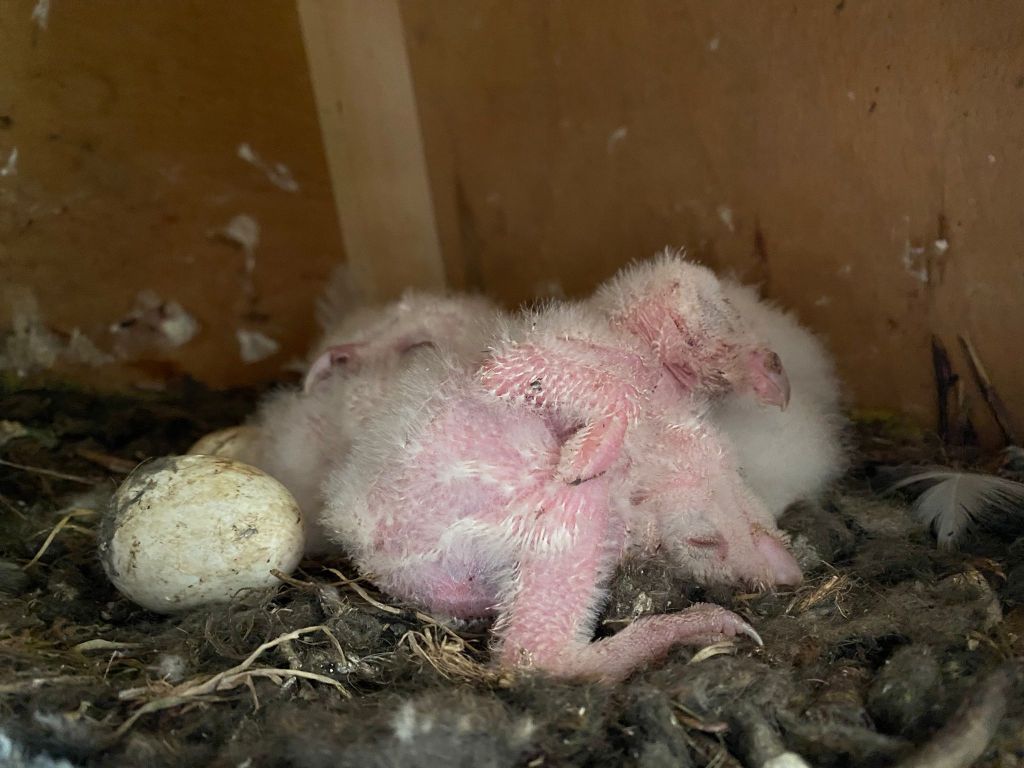
I have to be honest, I had rather expected them to have been somewhat more developed than this. There are five hatchlings and two warm eggs, plus a few stashed voles. On the floor, underneath the box, was a pellet. I chose not to take a photo (although I am considering going back and doing so): it is the first pellet I have ever seen with a rodent’s tail sticking out of one end. It looked bizarre and slightly disturbing.
Alongside these broods ringed and the three ear-marked for later, I still have another twenty or so boxes to check. Talking of which, whilst checking this last box we were approached by a local farmer who is very interested in putting up a couple of boxes, and who is aware of another local farmer who is also keen to promote owls on their land. At our first stop we were approached by a man who runs a local stables / riding school who expressed his disappointment at not having managed to attract any Barn Owls to his boxes: so disappointed that he took them down! Anyway, I have offered to go and have a look at his site and make some suggestions about possible positioning for the boxes that might give them some success.
Things are looking rather good for wildlife in and around the Braydon Forest. Apart from the significant quantities of land owned and managed by the Wiltshire Wildlife Trust and Forestry England, so many of the farmers are on board with encouraging nature. With Jonny Cooper getting farmers focused on providing suitable habitat for both Curlew and Lapwing in this area, things are looking encouraging.
 Ringing In The Braydon Forest & Beyond