Having been laid up all week, since my visit to Cumberwell Park Golf Club last Sunday, where I got to ring my first ever Little Owl, I was very pleased to be able to get out for CES6 this morning. Suffering from severe muscle problems in my back, and being dosed up to the eyeballs on painkillers and anti-inflammatory pills to enable me to cope, I was delighted that Rosie and the entire Childs family: Laura, Mark, Daniel and Adam, could join me for the session. Not only that, but they insisted on doing all of the setup and pack away work, and for me to take it easy and do nothing. I must milk this for as much as possible, as long as possible!
It was a reasonably good session but, it was only when I returned home and checked, I didn’t realise how good it was compared to 2023: last year’s session produced just eight birds from four species! To be fair to last year, the weather turned bad and we had to close the nets after four hours at 10:00. No such issues today: the weather was calm, once the early morning cloud cover dispersed it was a lovely blue sky and a warm sun: not too hot.
We had the first birds in the nets by 6:20 and then every round produced two or three birds per round. There were several highlights:
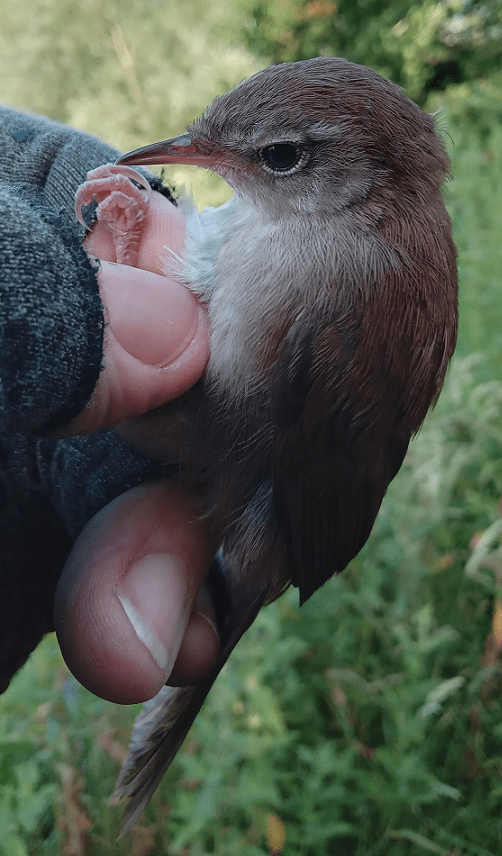
Juvenile Cetti’s Warbler, Cettia cetti, our first juvenile of this species this year.
This was followed by a male Reed Warbler: our first caught at Lower Moor Farm in June. We have caught them annually on passage both on the way in (May) and on the way out (August and September) but there are no significant reed beds on the site to support breeding:

Reed Warbler, Acrocephalus scirpaceus (photo courtesy of Mark Childs)
There was also something rather unusual: we found a female Blackcap with a tumour over the right eye:

Blackcap, Sylvia atricapilla. As well as the tumour over the eye there is another growth appearing at the base of the top of the beak. We also had a juvenile Blackcap which showed that life has been hard at times for the earlier broods:

As you can see, there are multiple fault bars on this birds tail. They represent interruptions in the availability of food.
Finally, we retrapped two Blackbirds, a male and a female. Laura was a little concerned at the state of the male’s cloacal protuberance. When she passed it to me to see what she meant, it did look rather red and sore, and then it deposited this on the ringing table:
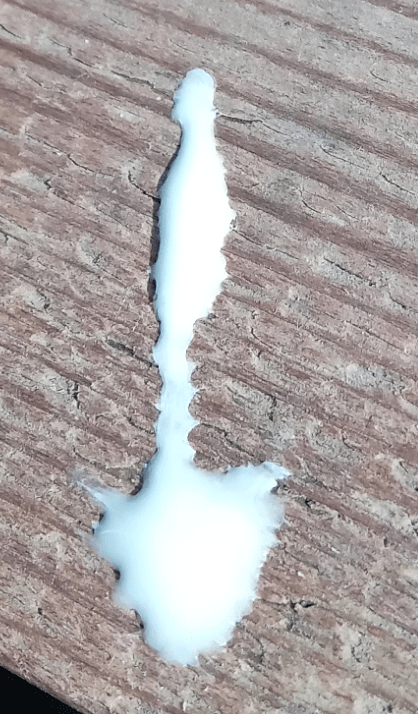
I am not an expert but I have the strongest impression that I know exactly what that is and that he was excited rather than sore!
This was the list for the session: Blue Tit (1); Great Tit [1](1); Wren [3]; Dunnock (1); Robin [2](2); Blackbird (2); Garden Warbler [1]; Cetti’s Warbler [1](2); Reed Warbler 1; Blackcap 2[7](3); Chiffchaff [2](1); Bullfinch 1. Totals: 4 adults ringed from 3 species, 17 juveniles ringed from 7 species and 13 birds retrapped from 8 species, making 34 birds processed from 12 species.
We had everything packed up and were leaving site by 12:30.
There were quite a few photographers around this morning: hunting for Norfolk Hawker dragonflies. We had really good views of one: but I thought it was a Brown Hawker: however there were no blue spots along the abdomen and it is (just) too early for its flight season. I wish that I had taken a photograph for evidence. According to the creature’s name and the map in the “Field Guide to the Dragonflies and Damselflies of Great Britain and Ireland” by Steve Brooks, illustrated by the wonderful Richard Lewington (who kindly signed my copy) they are only found on the east coast of Norfolk but, apparently, they have spread westwards over the last 20 years, reaching as far west as Devon.
 Ringing In The Braydon Forest & Beyond