Unfortunately, due primarily to bad weather, I ran out of space to run CES 7. I could have done it on Monday but, after events over the weekend, I decided that I wanted to stay away from the public and ringed in my garden. At the time, the last day in its window was Wednesday, 10th July, and I had planned to run it then. On Monday the forecast was that it would be dry but, unfortunately, the weather decided to change and foil the plan: with rain between 8:00 and 10:00 in the morning and very strong winds. With today looking dry and sunny, I decided to make sure that CES 8 went ahead. I arrived on site at 5:00 and started setting the nets. Laura joined me at 5:30 and we had everything set by 6:30.
It wasn’t a very busy session: the results were better than CES7 last year (17 birds from 8 species) but worse than CES8 last year (37 birds from 13 species): perhaps that is the result of running the session so early in the window this year.
The list for the day was: Treecreeper [2]; Blue Tit (1); Great Tit (1); Long-tailed Tit 1(1); Wren [3](1); Dunnock [3]; Robin [1](2); Song Thrush [1]; Cetti’s Warbler [2]; Blackcap 2[2](2). Totals: 3 adults ringed from 2 species, 14 juveniles ringed from 7 species and 8 birds retrapped from 6 species, making 25 birds processed from 10 species. Of the retrapped birds, the Long-tailed Tit and the two Robins were juveniles ringed at previous CES sessions.
We had three highlights:

Our first juvenile Treecreeper, Certhia familiaris, of the year. We then caught a second juvenile later in the session.
Our first juvenile Cetti’s Warbler of the year:
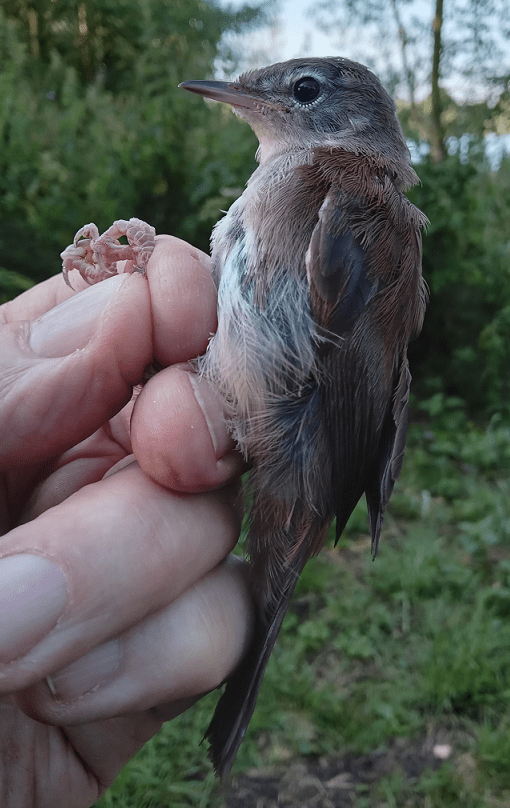
Juvenile Cetti’s Warbler, Cettia cetti. We also then caught a second juvenile later in the session.
The third (sorry, no photo) was our first juvenile Song Thrush of the year.
We had to watch our feet this morning: there were lots of froglets moving through the undergrowth, and so many snails everywhere. We saw plenty of dragonflies: particularly a couple of stunning male Emperors, and loads of damselflies everywhere. They were primarily Common Blues. There were several butterfly species around: Small White, Ringlet, Meadow Brown, Speckled Wood and a solitary Red Admiral.
The wind started to get up at 10:30 and by 11:30 it was blowing quite hard, so we shut the nets and took down, leaving site at about 12:30.
 Ringing In The Braydon Forest & Beyond