Without going into details, the last few weeks have been hard, and certain events have drained the enjoyment I get from ringing out of my system. Today remedied all of that! I had planned to go to Red Lodge until I saw the weather forecast: dry, sun and virtually no wind, so I changed venue to Blakehill Farm. The plateau will be out of bounds until the end of July, in case there are Curlew chicks out there, so we went to the south west of the reserve, to the fields adjacent to the Whitworth building. Driving down to the building I couldn’t help but be struck by just how tall the grassy vegetation has become on the plateau: tall enough for a Roe Deer hind to be stood there and have only her head and ears showing. In the decade that I have been visiting this site I have never seen it so tall. It has to be this combination of alternating rain and sun that is pushing this growth along so quickly.
I was joined for the morning by the Childs family: Laura and Adam are T-permit holders, Mark and Daniel are extremely valuable helpers. We met at 5:30 and set the following nets:
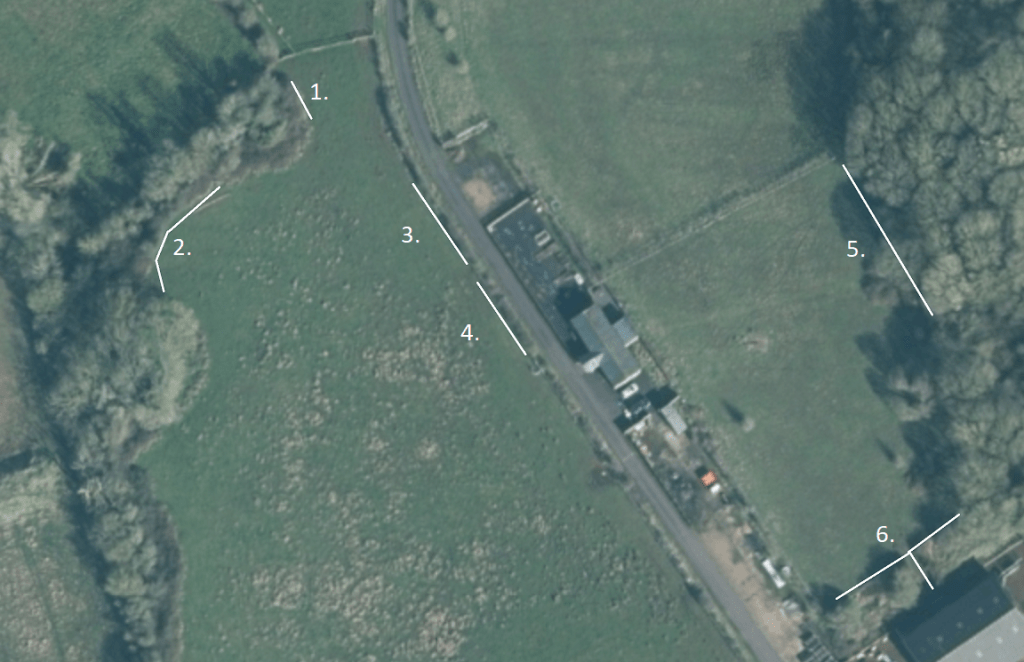
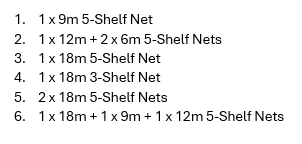
We had the nets open by 6:30 and the first birds were caught at 6:40: a Blue Tit, a Chiffchaff, a Dunnock and a Wren. So far, so unsurprising. Next round: two Blue Tits and a Dunnock. Ho hum, how predictable! Third round we had three of these:

Juvenile Chaffinch, Fringilla coelebs
These are our first juvenile Chaffinch of the year. That was a lovely catch. We caught a male and a female at this same site back in March, I wonder if they were the parents?
Round four produced a couple of Chiffchaff and two of these:
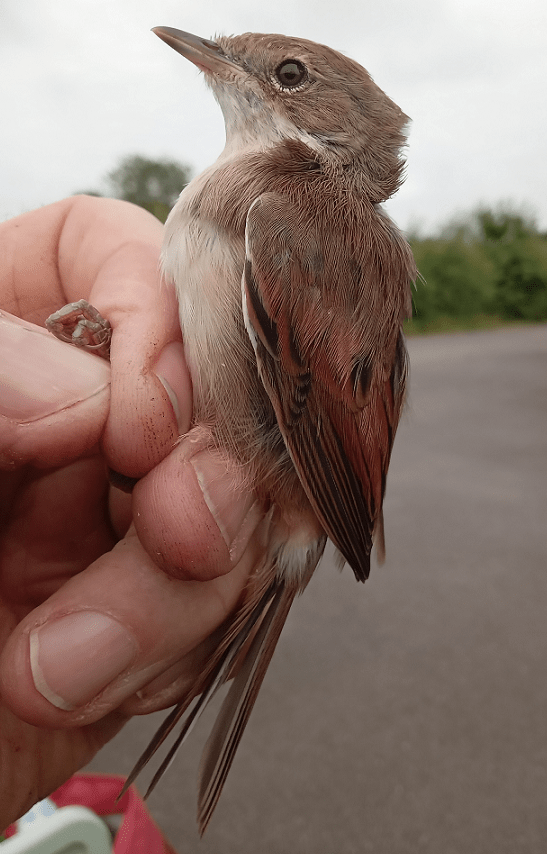
Juvenile Whitethroat, Curruca communis
Again, our first juvenile Whitethroats of the year. We ended up with six Whitethroats: two adults and four juveniles. Things went a little slower after that but, on the penultimate round, we caught this:

Juvenile Willow Warbler, Phylloscopus trochilus
Sorry for the repetition but, again, this is our first juvenile Willow Warbler of the year. It might look a bit tatty but it has nearly completed his post-fledging moult, although it still had lots of body feathers in pin. It was a lovely session: lots of first for the year, what could possibly top it off. Well, in that penultimate session we also trapped this:
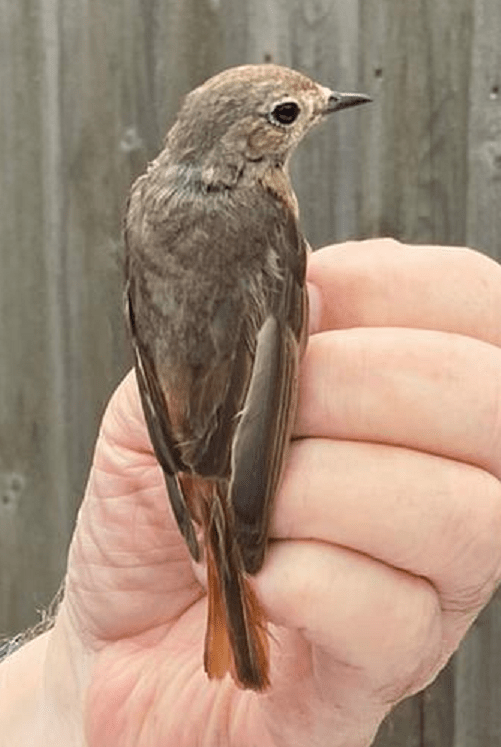
Adult female Redstart, Phoenicurus phoenicurus (photo by Daniel Childs)
Although we catch them regularly on passage in the autumn, two things about this bird are special. Firstly, we have never caught one on this side of the reserve before. We always catch them in the perimeter track hedgerow on the opposite side of the reserve. Secondly, this female, although she has started moulting, still had a properly engorged brood patch. It is entirely possible that she is breeding close by. That is not something that I expected. I don’t rule out the possibility that her young fledged in the last day or so and her brood patch just hasn’t started to regress yet, but the other possibility is tantalisingly exciting.
The catch for the session was: Blue Tit 1[3](1); Great Tit [1]; Wren 1[1]; Dunnock 1(1); Redstart 1; Whitethroat 2[4]; Chiffchaff [7]; Willow Warbler [1]; Chaffinch [3]. Totals: 6 adults ringed from 5 species, 20 juveniles ringed from 7 species and 2 birds retrapped from 2 species, making 28 birds processed from 9 species.
Not the biggest catch but just a lovely session with good people. We closed the nets at 11:30 and took down. Earlier in the session, Mark had noticed that my rear off-side tyre was looking a little under-pressured (as opposed to under pressure). Returning to the car, having taken everything down, it was clear that the tyre had seriously deflated. I carry an electric tyre pump and, fortunately, so do Mark and Laura, because mine was buried under my equipment. After a good 10 minutes getting it back to a decent pressure, so I could drive it home (Mark found the culprit: a nail embedded in the tread) we left site at about 12:30.
As well as a lovely morning with the birds, I was blown away with the huge variety of flowering plants in the two meadows. Particularly the one directly behind the building. I really need to spend some time getting to grips with meadow flowers, as my ID skills are just not good enough, but I am pretty certain that there were in the region of 50 species of wildflower in that meadow. There was a reasonable number of butterflies on the wing: predictably, lots of Meadow Brown, a couple of Large Whites, a few Ringlets and also some Gatekeeper but the best Lepidopteran seen today was the Snout: a moth that looks like a brown Vulcan bomber. If you are in the area, it is well worth a visit.
Not the biggest, but the nicest session I have had for a very long time. The catch was lovely and the company was excellent. Now, if this weather stays like this, and I can get out to Brown’s Farm for some Yellowhammer and Linnet, life will be very good!
 Ringing In The Braydon Forest & Beyond