With the weather set fair for this morning I decided that I didn’t want to hide in a woodland and, so, because the wind was scheduled to be light and from the south-west, I decided to go back to Ravensroost Meadows, hoping that it might be a bit better than last time (just 16 birds). The team worked in relays today: Rosie and Miranda joined me at 5:30, and we got the nets set up. Laura joined us at 7:45, having got Adam off to school, then Rosie left to go to work at 8:00. Miranda was having some stuff delivered, so left at 11:00, and Laura and I shut the nets at 11:30 and took down. We had a slightly different net set today:
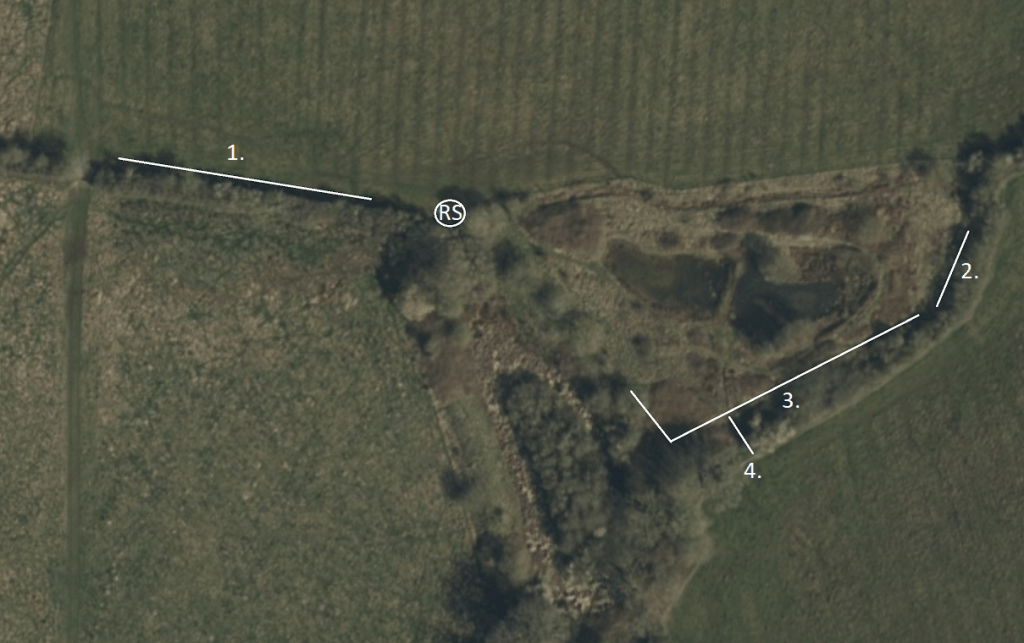
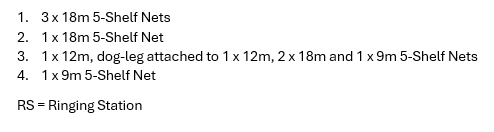
We had a Robin fly into the nets before they had been opened. Our first round, at 7:15, got us quite excited! Our last session at this site produced just 16 birds: our first round this morning produced 14 birds from nine species. Unfortunately, our excitement was a little optimistic. After that each round produced with two or three birds, if any at all, and by the time we shut the nets at 11:30, we had caught 27 birds. Obviously a huge improvement on last time.
That doesn’t mean that it wasn’t fun, it was. The weather started off dry but very misty and the mist hung around until gone 9:00. It was always warm but, once the sun broke through the mist, it was nicely warm. The wind was as light as forecast and just didn’t get blowy at all until after we had closed the nets.
We were really pleased with the variety of the first round: Blackcap, Blue Tit, Chiffchaff, Garden Warbler, Great Tit, Robin, Whitethroat, Willow Warbler and Wren. As we started processing the birds it was nice to find so many juveniles in the catch but, more fun for me, was that a number of the adults had started their post-breeding moult. I might be a sad individual, but I really enjoy looking at the different moult strategies and looking for aberrant individuals. Like this:

Willow Warbler, Phylloscopus trochilus, Primary moult is usually sequential, starting from the centre of the wing working out to the outer edge of the wing. This one has clearly not followed that pattern.
The list from today was: Blue Tit 2(1); Great Tit [1]; Wren 1[2](1); Robin [2]; Blackcap 1[1]; Garden Warbler 1; Whitethroat 1[3]; Chiffchaff 4[3](1); Willow Warbler 1[1]. Totals: 11 adults ringed from 7 species, 13 juveniles ringed from 7 species and 3 birds retrapped from 3 species, making 27 birds processed from 9 species.
After Miranda left at 11:00, whilst sitting down between rounds, Laura called my attention to a Kestrel hunting over the field to the north of the ringing station. We watched it hover and then plunge into the grass. It disappeared for about 15 seconds before flying off to a dead tree in the hedgerow to the east. Through my binoculars we had a clear view of it devouring its brunch! I can honestly say that I cannot remember the last time I saw a successful Kestrel hunt.
The catches remain smaller than we used to get but I think that key to that is a significant reduction in the numbers of insects flying around. Why this should be the case in this area, managed by the Wildlife Trust, full of wildflowers, available moisture and hedgerow vegetation, is beyond me. We saw a few Meadow Brown butterflies, where I used to see swarms. There was the odd Large White and Gatekeeper and a solitary Marbled White. We had a couple of Emperor dragonflies over the pond and good numbers of Common Blue damselflies, but no bees, very few flies or beetles. Mind, Miranda did have a shield bug drop onto her cardigan, and it stayed there like a living brooch for a large part of the morning.
Laura and I packed away at about 11:45, having processed three Chiffchaff caught in the last round, and we were away from site just before 12:30. A very pleasant morning.
 Ringing In The Braydon Forest & Beyond