The first “first” is that this was my first ringing visit to the farm this year. It is at the top of Postern Hill, south of Marlborough, with views for miles around and nothing to “break the wind”, so to speak. Our local weather has become far windier over the last few years, making my visits to Brown’s Farm much more infrequent than I would like. With the wind scheduled to be just one mile per hour, with no gusting until gone 10:00, it seemed a perfect day to go to Brown’s. What a shame that none of my team was available to take advantage of it! The benefits of being retired! It is also the first solo session I have run outside of my garden this year.
With the weather forecast to hit 30oC, I decided that I would pack up at 11:00 or when the shade temperature reached 25oC. I arrived on site at 5:45 and set just seven nets:
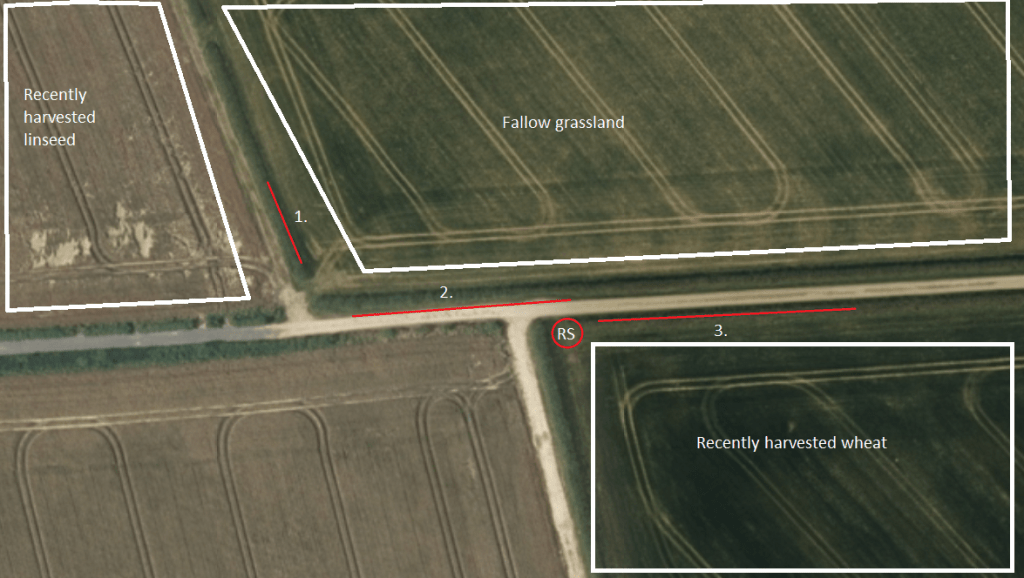

Brown’s Farm is my most reliable site for both Yellowhammer (my only site) and Linnet. In fact, the only other site of mine at which I have caught Yellowhammer is Blakehill Farm: back in October 2016!
This morning started with a Whitethroat in the nets at 6:30 and then, at 7:00, I caught my second bird of the session and a first for me this year:
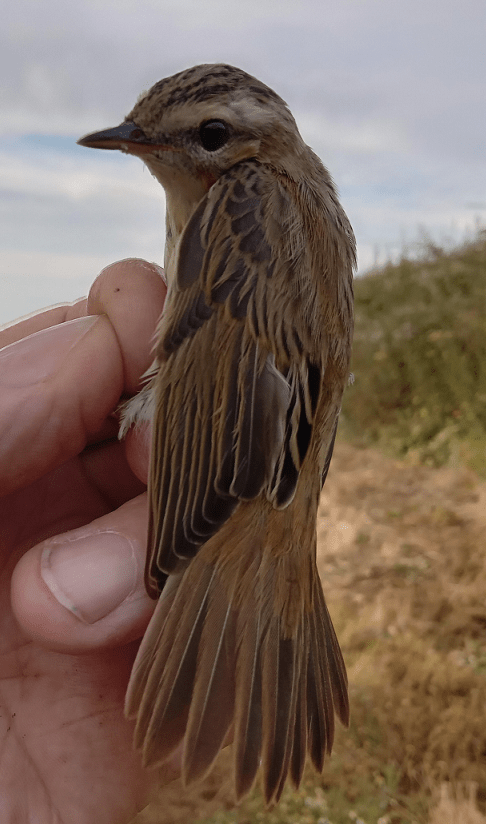
Juvenile Sedge Warbler, Acrocephalus schoenobaenus
This was followed by two Linnets, one of my reasons for being there. Unlike on Sunday at Blakehill, the three Linnets captured today were all female: two adults and one juvenile:

Adult female Linnet. Linaria cannabina
It took a little longer for the next target species to arrive:
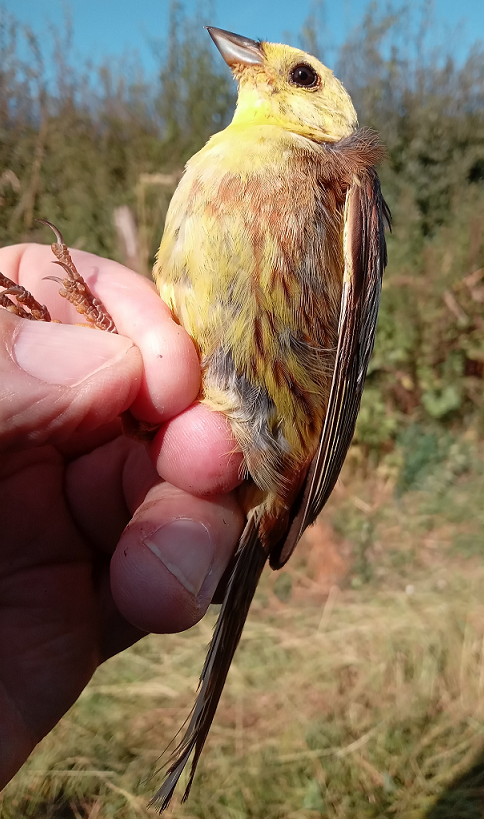
Adult male Yellowhammer, Emberiza citrinella
Keeping on with the “firsts” trend, I also had my first juvenile House Sparrow of the year (and only my second of the species this year):

Juvenile House Sparrow, Passer domesticus
And then, the icing on the cake:

Juvenile Yellow Wagtail, Motacilla flava
This is only the second Yellow Wagtail that I have ever caught and ringed on my rings. I was lucky enough to have ringed five as a trainee at the Icklesham site in East Sussex, then nothing until we caught an adult male in May 2021 at Brown’s Farm. I am aware that numbers have increased on the Marlborough Downs to the north: perhaps they are starting to expand to the south or perhaps the former was on Spring migration and this one is on an early Autumn migration (there’s a lot of it about). Needless to say, another first for the year.
The catch for the session was quite remarkable: 29 birds caught from 14 species! Not huge numbers, plenty enough for me though, and an excellent variety. There were no retrapped birds at all: Blue Tit 1[1]; Dunnock 1[7]; Yellow Wagtail [1]; Robin 2; Song Thrush [1]; Blackbird 1; Sedge Warbler [1]; Blackcap 1; Whitethroat 1[1]; Chiffchaff 1[2]; Willow Warbler 1; House Sparrow [1]; Linnet 2[1]; Yellowhammer 1[1]. Totals: 13 adults ringed from 10 species and 16 juveniles ringed from 10 species, making 29 birds ringed from 14 species. That variety is just astonishing for this farmland site.
The Dunnocks were interesting: one adult and seven youngsters. Four of those youngsters were caught in the same net and had not started their post-fledging moult yet: very likely second, or even, possibly, third brood young. My two favourite BTO codes for birds species are DUNNO for Dunnock and NUTHA for Nuthatch. One of my DUNNO’s was a right NUTHA! I caught it, ringed it, released it in the opposite direction to the nets. Next net check it was back in the net. I extracted it and released in the direction from which it had entered the net, so it could continue its journey. It immediately flew straight back into the net. After extracting it again I took it right away from the nets and released it, whereupon it flew straight back and into the nets. Twice more it did the same thing only on the final time it actually extracted itself and flew off, not to be seen again today!
The farm has fabulous hedgerows, primarily Hawthorn and Blackthorn, interwoven with Dog Rose. Alongside the tracks and between the fields there are no large trees. They are confined to the edges where the fields touch woodland and copses. The hedgerows were planted by the previous tenant farmer over 20 years ago. They have been kept in superb condition, particularly by the current tenant. His management of them keeps them thick and not at all straggly, with a height of just under 2.5m: the height of my nets. When the Crown Estate sold the land off to the current owner, the tenancy passed to the farmer who had the next farm over to the west of Brown’s Farm. Both farms were beef and arable, and the new tenant consolidated the beef production onto his own farm site, so Brown’s is primarily an arable farm now. The cattle sheds were converted to stables and are rented out to a number of horse owners. He has converted a couple of fields into horse paddocks but, unlike so many horse deserts, he minimised the amount of land lost to the horses, established a number of wildflower rich horse tracks around the farm, for the owners to exercise their horses. As well as that, he runs a small scale pheasant / red-legged partridge shoot, and provides supplementary feeding, plus large areas of game cover around the site. It is so small scale that the only pheasants that you see out of season are a pair of Reeve’s and a pair of White-eared pheasants, plus a small flock of Helmeted Guineafowl, that have been there as long as I have been working the site (firstly for the Breeding Bird Survey and, subsequently, bird ringing). Anyway, the point is that, he has kept an excellent variety of wildlife on the site. This morning I saw several Hares, a Fox and a couple of Roe Deer. It compares very favourably with Blakehill Farm for numbers of Skylark territories. Over the time I have ringed there we have processed birds from 36 species.
Anyway, the shade temperature reached 25oC at 10:30, so I started taking down the nets, starting with ride 3, as it had been the least productive: just one each of Whitethroat and Dunnock. Then ride 1 as, although it started strongly, it had dropped right away. I then got held up taking down ride 2 because first time I found a Dunnock had flown in. After I processed that and went to shut them, I found a Blackbird in there. Third time unlucky: it had a Song Thrush in it. This time I shut the nets before processing the Song Thrush, and so managed to get everything down by 11:15. I was off-site by 11:30 after a thoroughly enjoyable session.
 Ringing In The Braydon Forest & Beyond