I was asked by Rosie to help with the Wiltshire Wildlife Trust’s children’s Watch Group on Saturday night by carrying out a moth trapping session at Lower Moor’s Care Farm area. With the weather forecast showing that it would be raining Saturday morning, scuppering my opportunity to carry out CES 10, but dry overnight and the following morning, I decided to move CES 10 to Sunday. Given that I am not keen on having a late night, followed by an early morning, I decided we would start Sunday’s session at 7:00, instead of 6:00.
Saturday I woke up to a dry morning, but probably too windy for ringing regardless and, according to my local sources (Ellie), it was actually raining at Lower Moor Farm for a couple of hours Saturday morning. Rosie and I met up at the Care Farm site at just after 8:00 that evening. I set up the moth trap while Rosie got the necessary together to start up their fire pit. The children that were coming along were going to spend an hour or so walking around bat detecting, returning to toast some marshmallows on the fire, and then have a look at the moths. Whilst they were off doing their thing, I kept an eye on the fire, to make sure it didn’t go out, and did a bit of birding. There were some very interesting sounds coming from the lake: heavy splashes and quiet silky plops. I like to think Beaver for the former and Otter for the latter. The children came back at about 9:30, just as the moths started to arrive in good numbers.
The most prolific moths in numbers were Ringed China-mark, Paraponyx stratiotata, of which there had to be at least 100 flying around and into the trap, reasonably closely followed by Dingy Footman, Eilema griseola, with 50+. Once the big boys started to arrive the children became somewhat more excited:
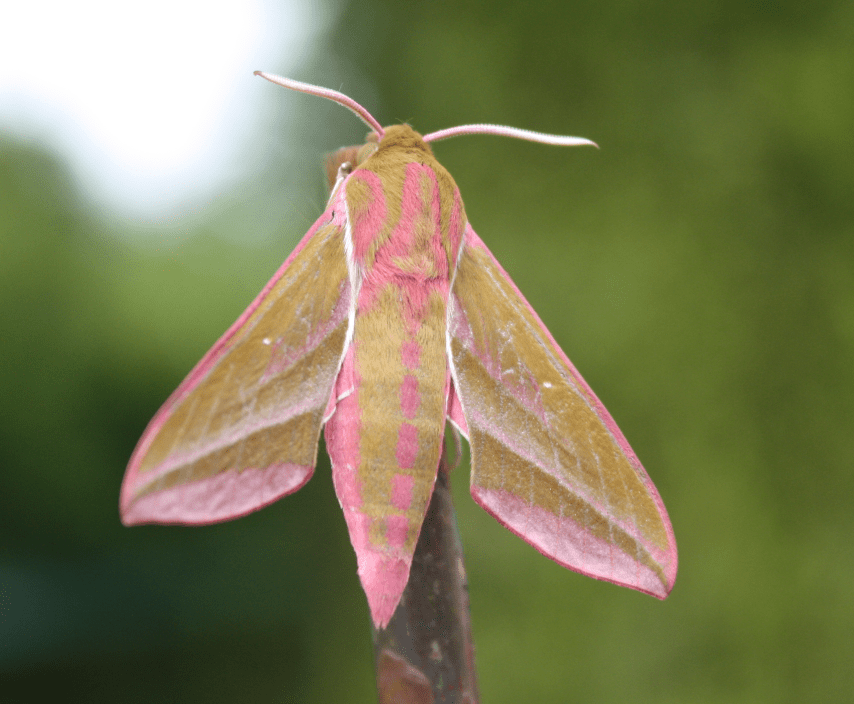
Elephant Hawkmoth, Deilephila elpenor (one of my stock photos, last night’s specimen was a little worn)
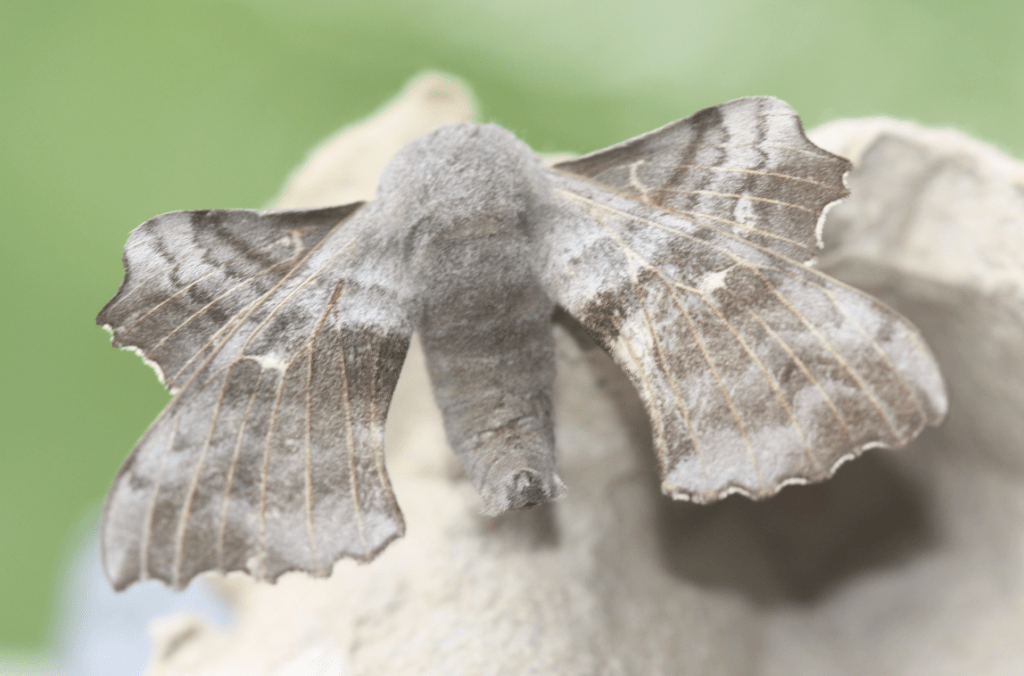
Polar Hawkmoth, Laothoe populi
It was an excellent catch. We left the trap on overnight, and Rosie collected it up early Sunday morning and brought it over to the CES site, so we could identify the rest of the moths. I spent this afternoon trawling through photographs and finalising the list. This was the list of species:
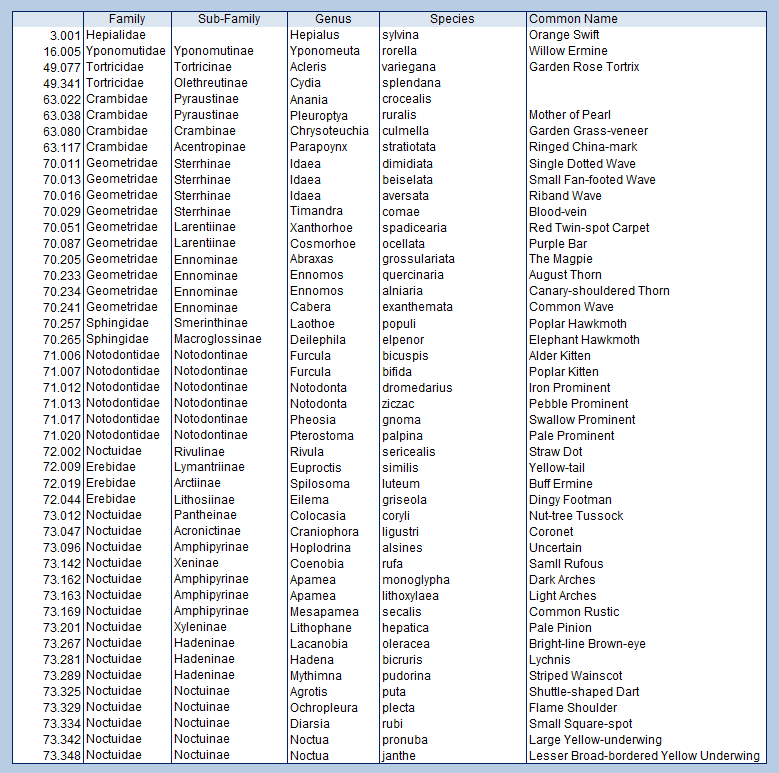
I was very pleased, as I added five species to my life list, taking it to exactly 500. Everybody with a garden should try mothing: in my medium sized garden in Purton I have caught moths from over 460 species! Those added to my list Saturday night were: Willow Ermine, Yponomeuta rorella; Anania crocoealis; Purple Bar, Cosmorhoe ocellata; Alder Kitten, Furcula bicuspis; and Small Rufous, Coenobia rufa.
I was joined for the CES session by Justine and Rosie. Justine’s husband, Lee, came along, and about 8:30 we were joined by a family from Saturday night who were excited to see the rest of the catch and who wanted to see the birds as well. As usual, I taught the girls how to properly hold and release a small bird, and introduced them to the pleasures of Blue Tit pecks!
It wasn’t the biggest catch we have ever had but, as with the last couple of sessions, larger than the equivalent session last year. CES 10 last year produced just 18 birds: Treecreeper [1]; Blue Tit 1(3); Great Tit [1]; Wren 1[3]; Dunnock [2](1); Robin [2]; Cetti’s Warbler [1]; Blackcap [2]. Totals: 2 adults ringed from 2 species, 12 juveniles ringed from 7 species and 4 birds retrapped from 2 species, making 18 birds processed from 8 species. Of the retrapped birds, 3 were also juveniles, so 3 adults and 15 juveniles processed.
Sunday’s catch was: Blue Tit [3](1); Great Tit [1]; Long-tailed Tit (1); Wren [3](1); Robin (1); Song Thrush (1); Blackbird 2[1]; Cetti’s Warbler (1); Blackcap [2](2); Chiffchaff 1; Chaffinch 1. Totals: 4 adults ringed from 3 species, 10 juveniles ringed from 5 species and 8 birds retrapped from 7 species, making 22 birds processed from 11 species. Of the retrapped birds 5 were juveniles, so 7 adults and 15 juveniles processed.
It was a very pleasant morning, even if the moth catch did outshine the bird catch, with a lot of positive interaction with the public. Start late, finish late: we shut the nets after six hours, at 13:00 and left site by 13:45. I was knackered! So I spent Monday sorting through all of the moth photos and getting the moth list together, which is why I am publishing this on Tuesday!
 Ringing In The Braydon Forest & Beyond