As it was just David and myself available this morning I planned to go to Ravensroost Wood and just set up in our usual two ride structure. I arrived on site to find that the main gate was locked with signs saying that the reserve was open, but the carpark wasn’t. That is because it was full of extracted wood. To make sure everybody understands: this was wood cut last winter, nobody has been carrying out disturbing forestry operations on the reserve during the breeding season.
The access was okay for me: I have the key for the outer gates and the combination for the inner gate padlock and have permission to take my car onto the reserve. However, I wasn’t prepared for how overgrown the rides have become in the last few weeks. It is going to take a good few hours to sort them out, so I decided to give it up as a bad job and head for Somerford Common. I met David and his Dad, Trevor, on the way out and appraised them of the situation and we headed off.
Unfortunately, the breeze was a lot stronger than forecast, so we were restricted as to what nets we could set, trying to minimise exposure to the wind:


We had the nets open by 7:45 and started catching straight away: with our first Robin of the morning. Robin became our biggest catch of the day, with five of them in total, all juveniles.
Weather wise, it was a strange morning: it was cold, then it was warm, then cold, then warm. At 9:00 we had a period of very light rain: that mizzle that soaks you without you noticing it, then it stopped, then just after 10:00 it started again, and lasted until 10:30 and stayed stopped. It did mean that we had some hiatus between rounds, and spent some time processing birds under the car’s tailgate. However, it really was a lovely session. Most rounds were just one or two birds but, with just two of us processing, that was fine. Two of the rounds, at 8:45 and 10:00, gave us six each and the 10:00 round was my favourite: three juvenile Marsh Tits in net 2. These are our first juveniles of the species this year:
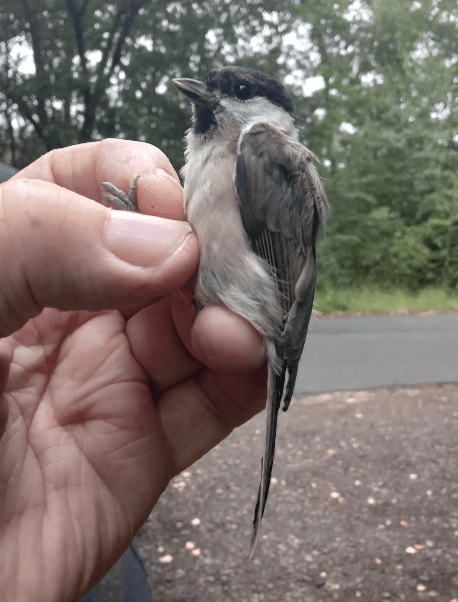
Juvenile Marsh Tit, Poecile palustris, looking about as comfortable with the weather as I was!
We didn’t have a huge catch and, similar to Wednesday’s catch, mainly juveniles plus a single recapture. The list for the session was: Treecreeper [1]; Blue Tit [1]; Great Tit [1]; Marsh Tit [3](1); Wren 1[2]; Robin [5]; Blackbird 2; Blackcap 1[1]; Garden Warbler [1]; Chiffchaff [2]; Willow Warbler [2]; Goldcrest [1]; Bullfinch 1. Totals: 5 adults ringed from 4 species, 20 juveniles ringed from 11 species and 1 retrap, making 26 birds processed from 13 species.
Our one retrap, Marsh Tit AKP6754, was ringed in December 2020 and has been caught on another ten occasions. Mainly it has been caught at the feeding station in the winter. This is the first time we have caught it in the early autumn. Interestingly, it was caught in the same net as the three juveniles. I wonder if they were related.
We are having a decent catch of juvenile Willow Warbler this year. Lots of very yellow individuals coming through. Unfortunately, the camera phone doesn’t do its colouration justice.
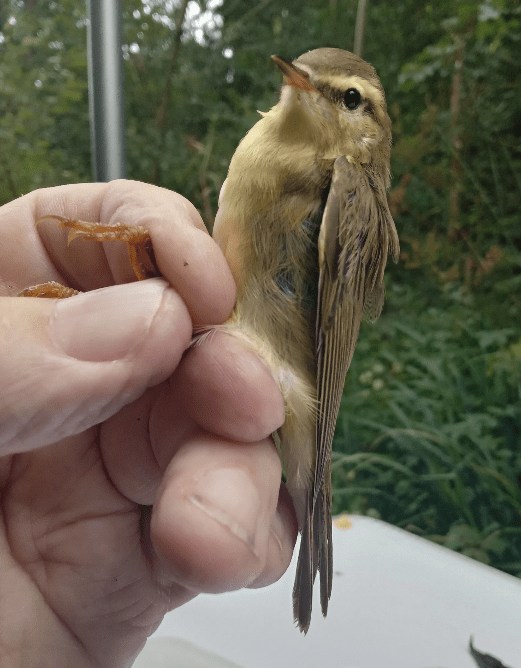
Juvenile Willow Warbler, Phylloscopus trochilus
I am pretty happy that in a restricted session, affected by the wind, not so much the rain, that we got a reasonable catch of birds but from an excellent variety of species. Ironically, the one species that we didn’t catch, but which made its present felt all morning, was Nuthatch. If they weren’t calling to each other then we had that slow steady knocking as they seek for food (or is it their Morse code?).
We did spend a lot of time watching birds flying over the top of the nets. I think I might have to try putting an extension on the nets, to raise them by another metre or so, and see if that makes a difference.
We started packing up at 11:15, stopping off to process a couple of birds that came into the nets whilst we were doing so. With Trevor’s help, we had everything down and packed away soon after midday.
 Ringing In The Braydon Forest & Beyond