With most of my team away or otherwise engaged, David, Rosie and I went to the Firs this morning, meeting at 7:00. Rosie had to leave for work at 9:00, so the rest of the session would be just myself and David.
Rosie and her team have done a great job opening up the central glade, following on from the Chalara Ash Die-Back remediation work. We had an encouraging session last time we went: 55 birds from 11 species and I was hopeful that we would have something of a repeat. This time I added two new nets, to take advantage of some of the new opened areas. I kept it to two because I knew we had only a small team out and I like to ensure we are in control. Next time I have a large team out I will try a few more net positions. This is what we set:
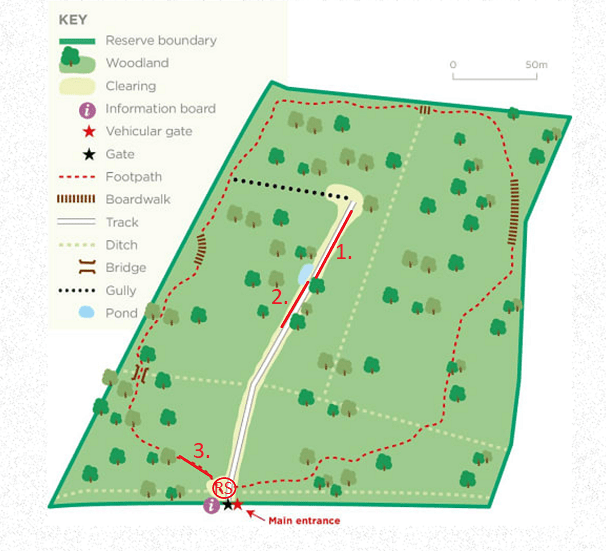

This map is courtesy of the Wiltshire Wildlife Trust. Net ride 3 was the test net set.
We had the nets open by 8:00, extracting a Robin that flew in as we were opening up. I put on lures for migrant birds: Blackcap, Chiffchaff, Willow Warbler, Spotted Flycatcher and Redstart. We missed out on the last two.
Our first round proper produced a decent haul of 27 birds from 10 species. We processed them and then Rosie had to leave to set up her work party at Blakehill Farm. The next round was a bit smaller, 11 birds from 7 species. We kept extracting and processing until 11:00. When we went to do the penultimate round we found the nets were very full: 45 birds from 13 species. I decided that we would shut the nets as we emptied them, as this would give us more than enough for one session. This last round was when we had the biggest fall of Blue and Long-tailed Tits. We had extracted a number up to that point but this time was significant 15 Blue Tits and 10 Long-tailed Tits.
The catch for the morning was: Nuthatch 3(1); Treecreeper 1; Blue Tit 9[18](5); Great Tit 4[6](1); Marsh Tit (2); Long-tailed Tit 1[11](1); Wren 2[2](2); Dunnock [1]; Robin [9](1); Song Thrush [1]; Blackbird [1]; Blackcap [6](2); Chiffchaff [3]; Willow Warbler [3]; Goldcrest [1]; Chaffinch [1]; Goldfinch 1. Totals: 21 adults ringed from 7 species, 63 juveniles ringed from 13 species and 15 birds retrapped from 8 species, making 99 birds processed from 17 species. Of the retrapped birds 9 were also juveniles ringed in the Firs.
Why is this so memorable? The first thing is that this is the second largest catch my team have ever had in one of our woodlands. The largest was in November 2013 (103 birds from 11 species), but that was with a feeding station set up, this was purely down to the natural attraction of the site. I think the key attractant was the abundance of blackberries: large, juicy and plenty of them. This seems to be the result of the works that have been carried out in thinning the wood and strimming of the central glade. They have certainly never been that abundant in my memory.
The Goldfinch was the first that we have caught at the site since March 2017, and only the fifth for the Firs:
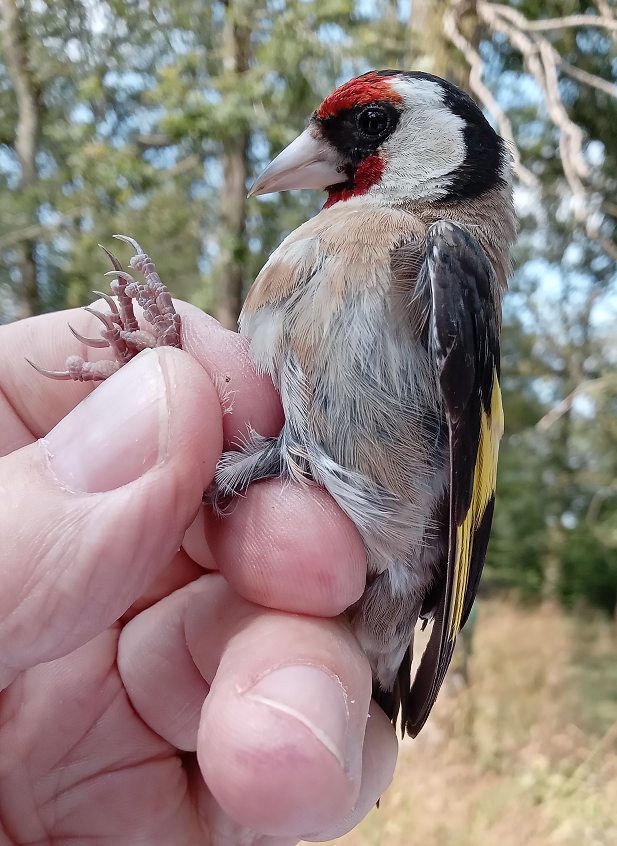
Goldfinch, Carduelis carduelis
That was lovely but alongside that we caught three Willow Warblers. Prior to this session we had only caught two in the Firs: a juvenile in September 2019 and an adult in April 2021. One of our Willow Warblers caught today had dark legs, so often I hear “It’s a Chiffchaff, it has dark legs”, life just isn’t that easy:
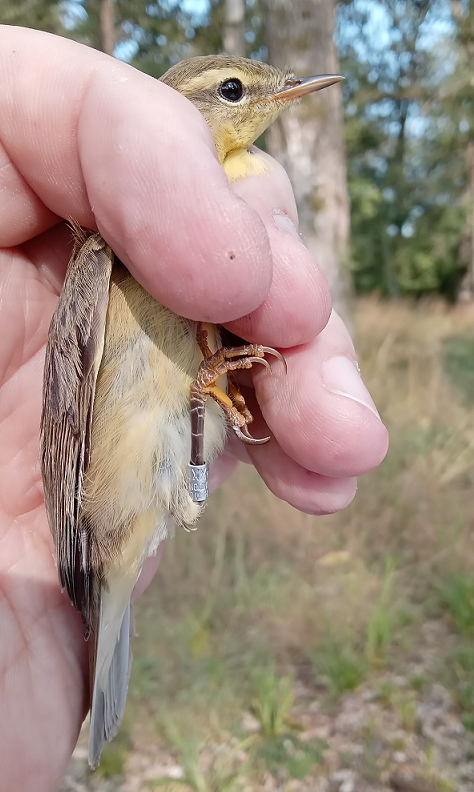
Willow Warbler, Phylloscopus trochilus
After the processing of the 45 birds in that last round we were ready to pack up and head home. With the help of David’s dad Trevor, it didn’t take long, apart from the fact that I managed to drop a part of a net I was taking in onto a few of the left overs from the strimming of the bramble. The brambles at the Firs are particularly vicious, for every prickle you have on a standard bramble these things have six, closely packed together. Still, I took down two nets and they took down all of the others: swings and roundabouts!
The new net ride did well, producing two Nuthatch and the Treecreeper, along with its fair share of Blue Tits and Robins.
So, it was a really good session. I was particularly pleased with the variety: 17 species. However, it was hard work when there was just the two of us.
 Ringing In The Braydon Forest & Beyond