Today we carried out a scheduled ringing demonstration for the Swindon Wildlife Group at the Wiltshire Wildlife Trust reserve at Blakehill Farm. We decided upon setting up on the Chelworth side of the reserve, setting nets on the plateau and along the perimeter track hedgerow. As usual, the event was sold out. Nobby, the neighbouring landowner, once again allowed us to use his field for attendee parking. He is a good man!
I was joined for the morning by David and Sarah. Laura and Adam came along for the first couple of hours, but had to leave about 10:00. We set the following nets:
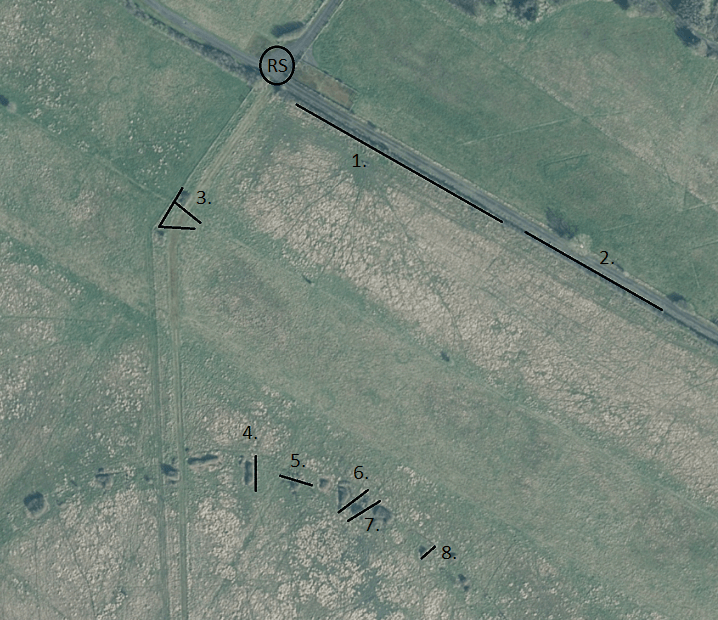
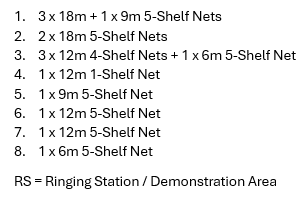
While we were setting up net 7 we caught our first bird of the morning: a Whitethroat flew into it whilst I was still playing the net out from the bag. I got David to hold the net taut whilst I extracted the bird: it can be a difficult thing to do, with lots of net wrapped around it, so I took the responsibility and, I am pleased to say, no problems. I didn’t set up and open ride 2 until 11:00, for reasons explained below.
Unfortunately, it was a really quiet morning. The site can be like that. It seems that our usual passage migrants are late arriving this year. Catches in the first week of September can vary between 21 on 1st September 2021 and 79 on 6th September 2017. The difference seems to be based on the date of arrival of the Meadow Pipits to the site. Robin Griffiths, the event organiser, saw a single Meadow Pipit flying across the plateau, but we did not catch any. Hopefully they will arrive soon: the crane-flies are emerging and that seems to coincide with Meadow Pipit numbers increasing.
The attendees arrived for 9:00 and I had a couple of birds to show them. As usual, I started with an overview of the ringing scheme and how the data can be used to identify individual birds, illustrated with our long-distance Blue Tit (second longest recorded movement of a Blue Tit within the UK) and our long-lived Goldcrest (the oldest known individual of the species) before processing the two birds. It was a nice pair to start with: a juvenile male Reed Bunting and a juvenile Whitethroat. I enjoy showing people little things, like sexing a juvenile male Reed Bunting on the somewhat hidden white collar developing at the back of the neck and, as in the case of the Whitethroat, the dandruff effect as the keratin sheath, or pin, of the feathers disintegrates.
Again, as usual, once I had processed the birds, I taught two of the children how to safely hold a bird in the ringer’s grip and then release it, whilst doting parents took their photos (we are talking seconds of time, not minutes). “Get children involved early” is my motto! In the end all of the children got to hold and release two birds, and a number of adults also got some training.
The patience of the audience was much appreciated. After we processed those two birds at 9:00, we didn’t have anything else to show them until 9:45, whereupon we caught two Chiffchaff, and then another one at 10:00. That was it, then, until 11:15. To fill the time we spent a while showing the people around the nets and how we set them. I decided to set up some additional nets along the perimeter track, i.e. ride 2. Of course, I should have done it earlier, as it immediately caught a Blackcap. Whilst I was checking ride 2, David and Sarah were checking the other nets and they came back with the prize catches of the session:
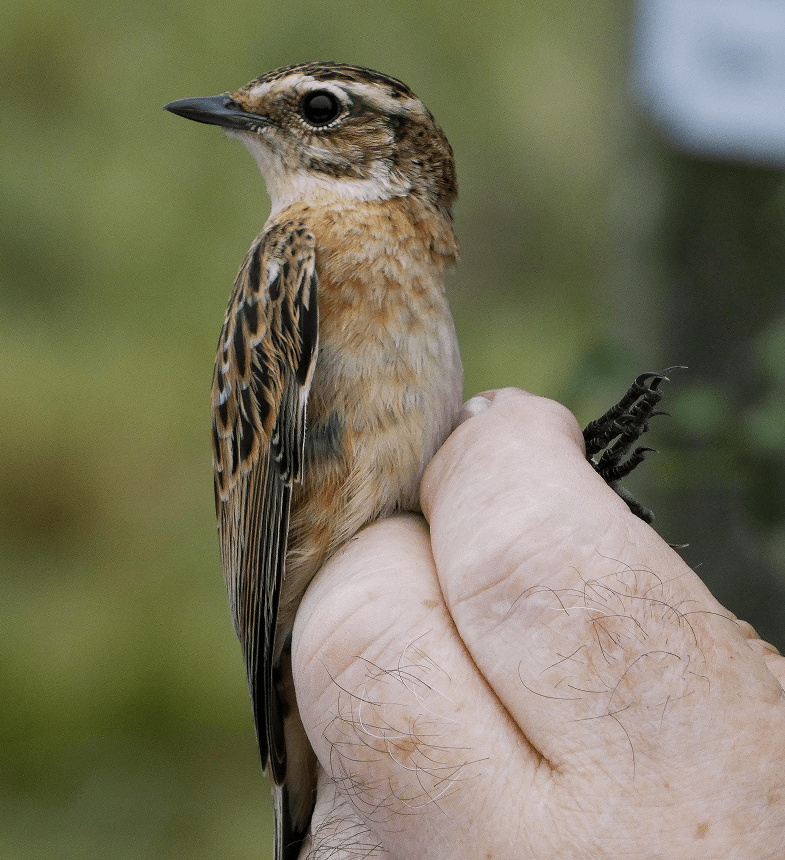
Juvenile Whinchat, Saxicola rubetra (Photo courtesy of Kathleen Gillen and reproduced with her permission).
After a fabulous catch of them in September 2021 both 2022 and 2023 were blank years, not Septembers, blank years, so to catch three in one session was lovely. Two of them were caught in ride 5: a 9m net that goes through a narrow cut between bramble on the west and blackthorn on the east. It has been a bit quiet of late, but this sort of catch is why I set this net – despite the dangers of the net being savaged on either side if the wind gets up. I gave one to each of David and Sarah to process (normally I do all of the processing at ringing demonstrations, and none if I have trainees with me on our normal sessions). That was David’s second and Sarah’s first.
Our last round was at 11:45 and we shut the nets as we checked them. We caught another three Chiffchaff. One of the Chiffchaff was having an identity crisis: emulating a Wren. It had crawled mostly through to the other side of the net from where it entered, span itself in the net over a dozen times and then got its head stuck through another part of the net. Definitely too much of a problem for Sarah, who is very early in her ringing career and who discovered it, so she called me over to extract it. That is my cardinal rule for trainees: if you are having a problem call me over. It is why we have a great record on keeping our catches alive, well and undamaged.
Again, we shared the processing. That was the end of the demonstration and the attendees left soon after midday and we started to take down. With David’s dad, Trevor, joining us, we split the take down and expected to get it done in half the time. Only when Sarah and I got to ride 5, we found that a Blue Tit had managed to get itself tangled into the net. It does happen occasionally that they get caught in a closed net, but that is usually in the morning when it is still a bit dark, and they probably haven’t fully woken up yet! For the same reason that I took the first Whitethroat out, I extracted it. Sarah lost the toss and processed it. By the time we had finished taking down and packing away it was close to 13:00 hours.
The list for today was: Blue Tit 1; Whinchat 3; Blackcap 1; Whitethroat 2; Chiffchaff 6; Reed Bunting 1. All birds caught were juveniles and none were retraps, so the total was 14 birds processed from 6 species.
Part of what helped keep everyone occupied and interested was the other birdlife flying around whilst we were there. At one point we had some large groups of Swallow and House Martin flying around. Unfortunately they stayed high mainly. I put a Swallow / House Martin lure on in the Mipit triangle, and they certainly grouped over and above the nets but they just never came down enough to get caught. The most surprising bird we saw was a Swift. After a group discussion, we all agreed that they left the local villages at the end of July, and to see one solitary Swift fly over the plateau was most unusual. Robin did catch sight of a Meadow Pipit flying close to the Mipit triangle. Let’s hope that is the start of their arrival and next session we can catch a bundle.
The most frustrating species seen today was Stonechat. Robin monitors the breeding birds at Blakehill Farm (amongst a number of other sites) and is aware of two successful nesting attempts there. That in itself is good news, as it is unusual and it would be great to see that happening on a regular basis. Not quite so good: whilst Sarah and David were closing the outer nets they saw at least four of them sitting atop the bushes and flitting around but never getting into the nets.
Alongside these were a Great Spotted Woodpecker, a couple of Robins, a Carrion Crow, some overflying Lesser Black-backed Gulls and a Kestrel that was seen hunting successfully on the plateau.
Whilst we were setting the nets up for the Mipit triangle we also had lovely views of a Hare running around the plateau.
So, I was disappointed that we didn’t have more to show the people, but they were all lovely and thanked us profusely for an enjoyable morning. I am not sure why I feel responsible for the weather, the number of birds caught etc. They are all outside of my control, but I do. Anyway, Whinchats!
I worry about my brain: just changed the month to September from August having published this yesterday and have 80-odd people wondering what I was wittering on about!
 Ringing In The Braydon Forest & Beyond