This was my fifth visit to the Firs since it was reopened to our team for bird ringing, after the forestry operations. The third visit, at the end of July, gave an encouraging catch of 55 birds, last visit, in the middle of August, gave an astonishing catch for this site of 99 birds. Having worked Webb’s Wood on Saturday, Red Lodge a couple of time recently, all with disappointingly small catches, and unable to get into Ravensroost Wood (Wednesdays are reserved for their volunteer group outside of the breeding season) and the weather forecast for it to be dry but breezy, I decided to have another go at the Firs. The siting of the nets down the central glade make it relatively windproof when the wind is coming from the east or west. Today’s was a westerly. I was joined by Miranda and Laura for the morning at 7:00 and we set the usual central glade nets: one ride of 3 x 18m 5-Shelf nets on the western edge of the glade, followed on by 3 x 18m + 1 x 12m 5-Shelf nets on the eastern side of the glade, essentially making a single net line of 120m. The nets were open by 8:00.
It started with a single Robin that flew in before we had opened the nets. You can normally guarantee that any bird caught before the nets are open will be one of Robin, Blackbird or (horror of horrors) Wren. Thereafter, we had birds arriving regularly throughout the morning, until we closed up at just after 11:30. It was another encouraging catch. The Ash die-back clearance and removal of mature oaks (part payment to the contractors for the work they did (but didn’t finish)) certainly seems to have improved the catches at the Firs. The average catch at the site this year has gone to 56.6 birds per session. When you compare this with previous years, all of which would have had at least three sessions fuelled by the provision of supplementary feeding, whereas this has had none in 2024, it is clear that the work in the wood has helped improve the catch, presumably because of the changes to the habitat. Nor should one overlook the excellent work that Rosie and her team have carried out opening up the central glade: the proliferation of blackberries has to be a contributing factor.

Only 2018 and 2019 come close, and they had big overwinter catches.
On the subject of those brambles producing those blackberries: they have to be the worst in the world, with the heaviest density of prickles I have ever come across. You really have to keep your nets well away from them, otherwise it can be disastrous. I have had one net completely destroyed by them: just impossible to extract after the wind changed direction and it got so badly ensnared I could only rip it out: just a mere £110 down the drain.
The list for this morning was pretty much what one expects in a woodland catch: Treecreeper 2[1]; Blue Tit 8[7](6); Great Tit 1[3](5); Marsh Tit [1](1); Long-tailed Tit {2}(3); Coal Tit 1; Wren 1(2); Robin [4](1); Blackcap [1]; Chiffchaff [9]; Goldcrest [2]. Totals 2 birds ringed unaged, 13 adults ringed from 5 species, 28 juveniles ringed from 8 species and 18 birds retrapped from 6 species, making 61 birds processed from 11 species. Of the retrapped birds, 7 were juveniles and the Long-tailed Tits could not be aged.
I did have the opportunity to show Laura and Miranda how to definitively age Treecreeper, as we had two adults and a juvenile:
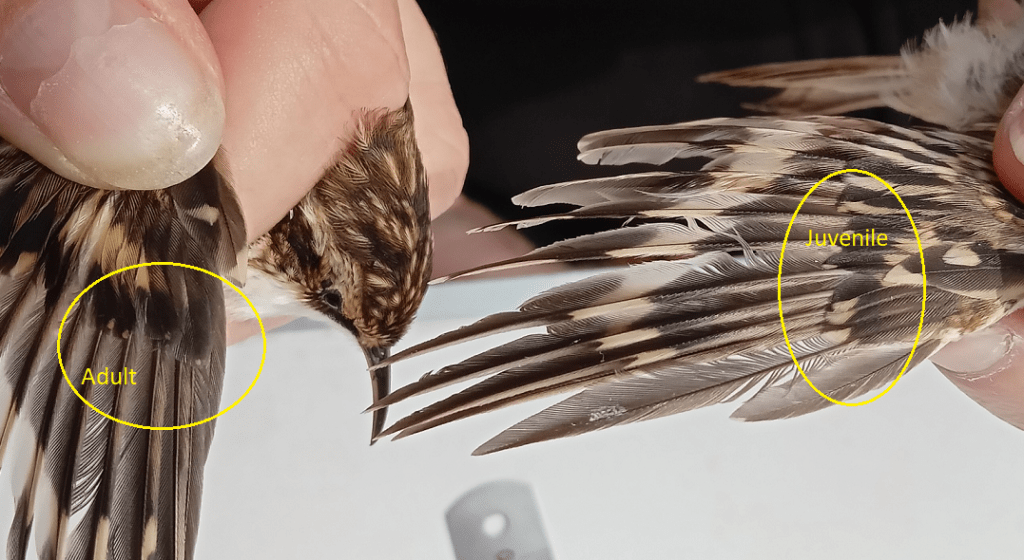
Treecreeper, Certhia familiaris. The difference is in the primary coverts. An adult has either small or missing pin-prick spots at the tips of the primary coverts, whereas juveniles have larger, tear-drop shaped, spots.
If there was any disappointment in the catch, it was the failure to get any of the Nuthatch that spent the morning calling and knocking all around us. Also, there are at least two Green Woodpecker territories in the Firs but I have never been able to entice them into the nets.
With the wind getting very much stronger, and the nets starting to billow, we shut them at 11:40. took down and were off-site by 12:30 after another very satisfying session.
 Ringing In The Braydon Forest & Beyond