With this weekend and next week looking like a complete washout, and not wanting to spend all of my spare time mending nets, I decided to have a look at the catch ratios of some of our resident species. Firstly I looked at one of my favourite birds: Nuthatch. We hear them all of the time when in the woodlands: if they aren’t calling or singing you can hear them tapping away in search of food in the treetops. One key thing about this species: we never lure for it, so catches are based purely on availability at the site.
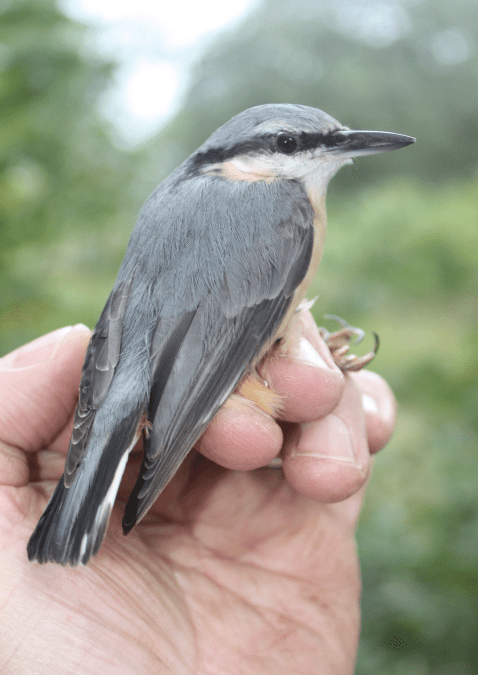
Nuthatch, Sitta europaea
The first thing I did was count up how many sessions I have actually run within the forest woodlands up to the end of 2023. I decided to look at two elements: numbers ringed and the number of individuals caught. However, as well as doing the total numbers by year, I also decided to look at how that breaks down by session. Obviously, for most species that is going to be fractional, but it is more representative of the status of each species, the higher the catching rate, logically, the more common the species in this habitat. Although I have included some figures for 2024 for discussion purposes, I have only graphed for the full years 1st January 2013 to 31st December 2023 to eliminate any seasonal variation not covered so far this year.

Because of the difficulties of ageing Nuthatch in the latter part of the year, I have not carried out any age analysis.
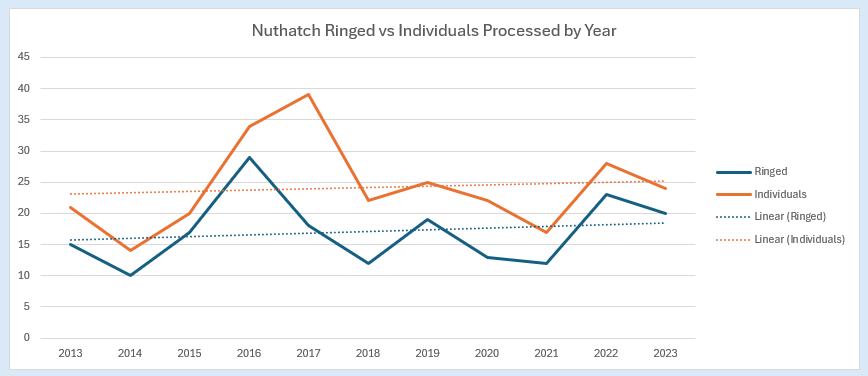
As you can see from this graph, there was a peak catch in numbers ringed in 2017 and, probably as a result, individuals processed in 2018. It does show a general increasing trend across the years. When you look at the trend based on the numbers caught and processed by session, the increase is somewhat more pronounced. Not only that, but by assessing the catch as a factor of the number of sessions carried out, the picture is really rather different. Particularly if you look at 2022 vs 2023: in actual numbers there is a decrease in both numbers ringed and individuals processed but, as a proportion of the the sessions run, 2023 was an improvement on 2022.
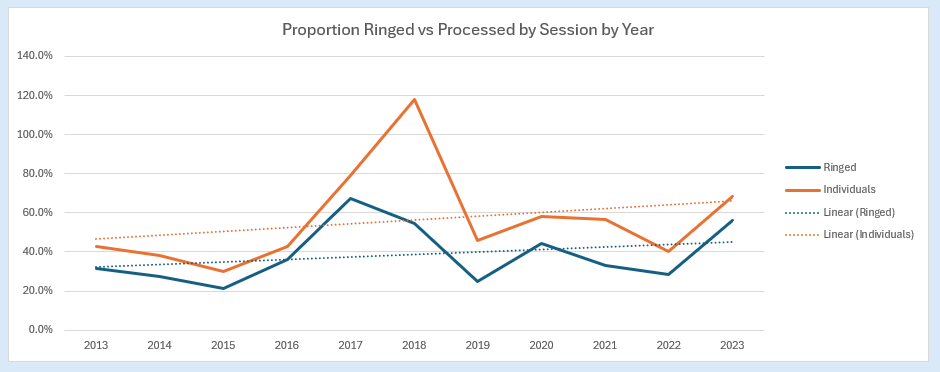
Equally, the number of individuals processed in 2018 was, remarkably, over one Nuthatch processed per session on average. Because of the peaks in 2017 and 2018 I redrew the graphs excluding those peaks: it made no difference to the overall trend lines.
So far in 2024 we have run 37 sessions in the Braydon Forest woodlands and have ringed 20 and processed 24 individual birds, i.e. a proportional rate of Nuthatch being ringed in 54.1% of sessions and individuals processed in 64.9% of sessions: very close to the situation in 2023, so far. However, August was astonishing with 13 ringed and two retraps, a total of 15 individuals.
The other thing that I looked at was whether there is any particular difference in the sexual balance.
Female:

Male:
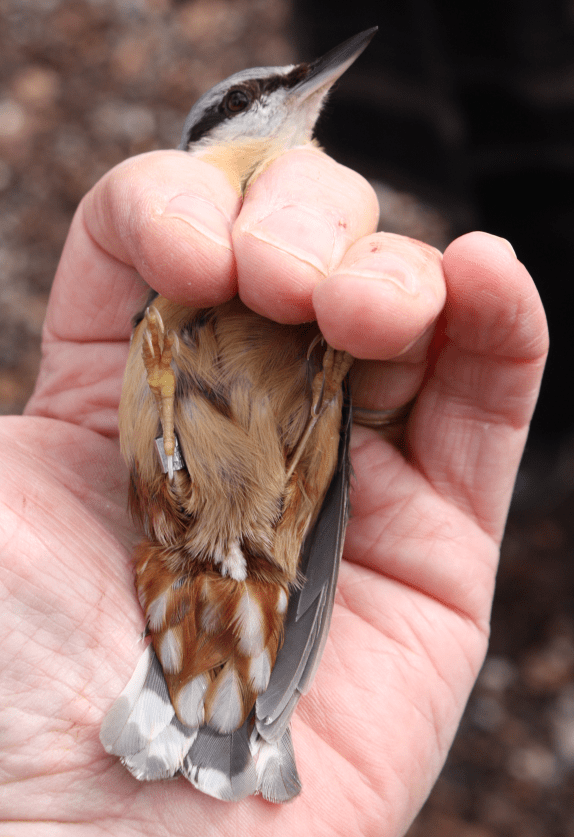
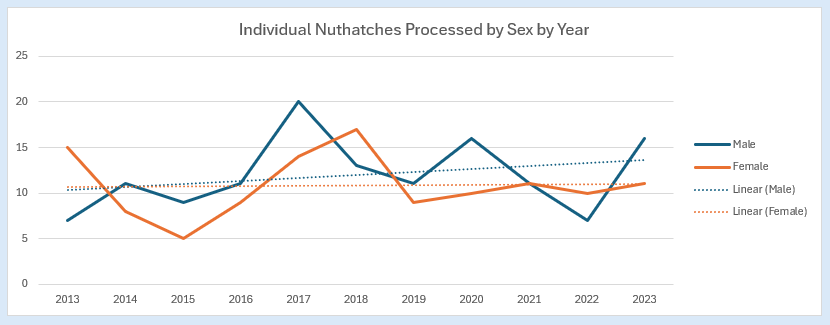
As you can see, the numbers are up and down, with a slight increase in the number of males but relatively static for females. When you split that out by session:
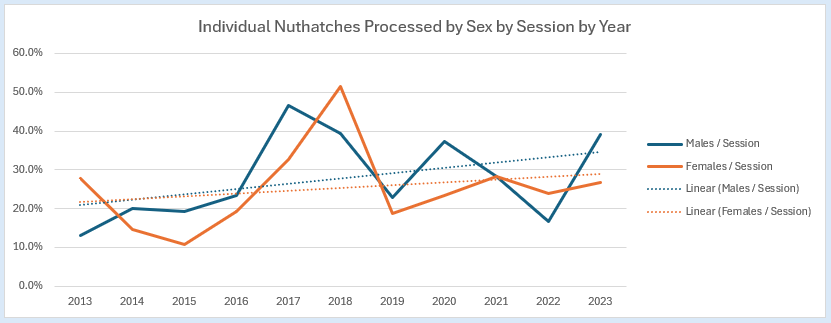
So, by session, both are showing an increasing trend across the years, but the peaks and troughs are a little more pronounced.
The final thing I looked at was the distribution over the course of the year by month. Clearly, like most of our woodland birds, they take advantage of the winter supplementary feeding, which I provide between October and February, depending upon the weather conditions. Taking that into consideration, the results are still quite interesting:
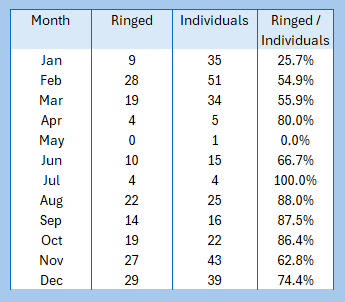
As with most of our woodland catches, they are low between the end of March and the end of July: i.e. the breeding season before the youngsters have fledged. I was surprised to find that we have never ringed a Nuthatch in May and that we have only ever caught a single individual in 11 years. For the record, it was the same in May 2024: no Nuthatch, but lots of song and calling! I have looked across the entire West Wilts Ringing Group’s records over the period I am covering in this report. Outside of the Braydon woodlands, there have only been five adult Nuthatch ringed in May across all of our sites: one at Job’s Mill, Warminster in 2017; two at the WWT reserve at Biss Wood, one in each of 2022 and 2023 and two at Lower Moor Farm in 2023. Equally, only four have been retrapped in May: the Job’s Mill bird was recaptured the following year, two were caught during my Help4Heroes sessions at Tedworth House and one in the Firs. Definitely the quietest month for the species.
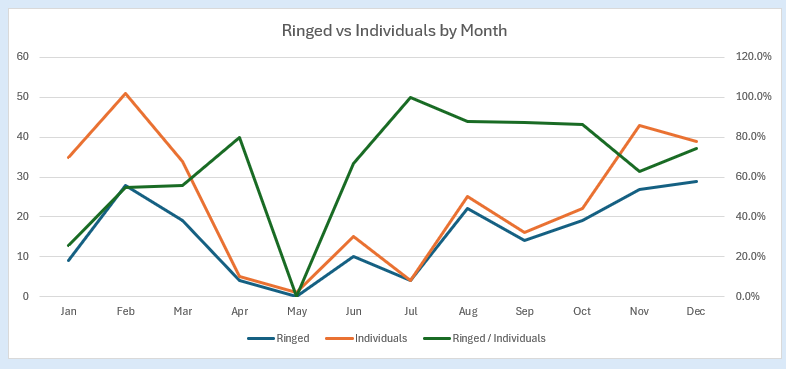
I think the surprising thing for me is that proportion of birds ringed in April is at 80% of the small number caught, before they disappear completely in May. Clearly June, July, August and September should be boosted by the newly fledged birds but April? The picture is rather unclear, as juveniles do not show up as a huge percentage of the catch in the period where they are identifiable (i.e. June to September inclusive), and in August and September there are a significant number that it is unreliable to try and age as they have completed their post-fledging / post-breeding moults and now adults and young have identical plumage. The table below shows the difficulty of getting an accurate picture of the situation:

This is the first of a series that I plan to carry out whilst the weather is as awful as it is forecast to be for the next week. (Be warned.)
 Ringing In The Braydon Forest & Beyond