As with the previous post on Nuthatch, I decided to have a look at the catches of Treecreeper within the Braydon Forest woodlands over the last 11 years to see if there was any obvious trend in numbers ringed and processed.

As with the Nuthatch catches, I have not included the 2024 data in the graphs, to rule out seasonal discrepancies.

Like the Nuthatch, there are multiple peaks and troughs. Unlike them, the trend is downward, dropping from 24 down to 14 individuals, and from 20 to 13 birds ringed by year. The sessional analysis also shows a decline, but it is less pronounced than the bald numbers would indicate:
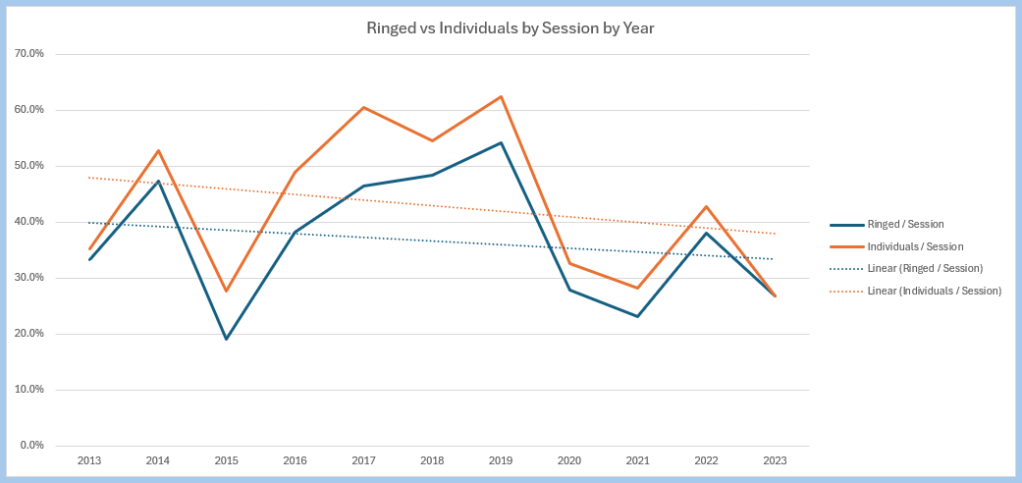
The number of birds ringed has decreased from 40% of sessions to 34%, whereas the number of individuals processed by session has decreased somewhat more, from 48% of sessions to 38%.
When we look at the juvenile recruitment into the population it is as volatile as that of the species as a whole. The data used for the following table and graphs is based on the BTO age codes of 3J (full juvenile plumage); 3 (completed post-fledging moult) and 5 (birds fledged in the previous breeding season).


Although the figures do follow similar paths, the reduction per session is considerably lower than it is in the straight number count. The reduction per session has gone from 14% of sessions to 12.5% of sessions, whereas the actual number of juveniles ringed per year has reduced from 14 to 8 on average.
I decided to have a look at whether these changes varied across the woodland sites. Looking at the entirety of the catch (juveniles and adults) gave the following results by site by year:

I have graphed these individually, otherwise it is too difficult to look at the site trends.
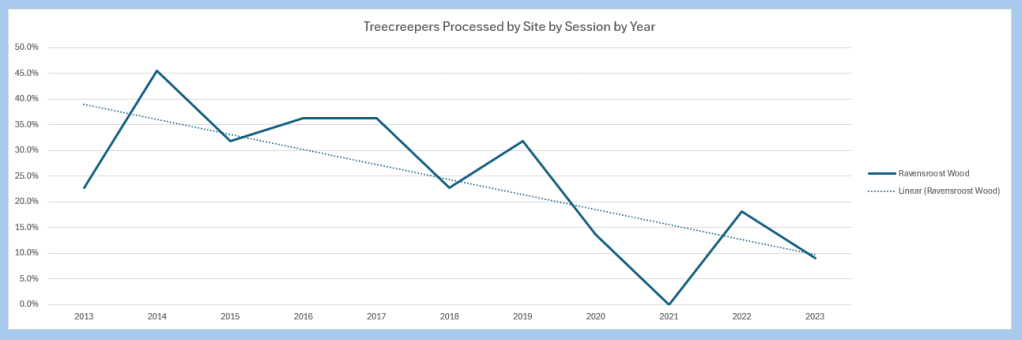
Ravensroost Wood:
Red Lodge:

Somerford Common:

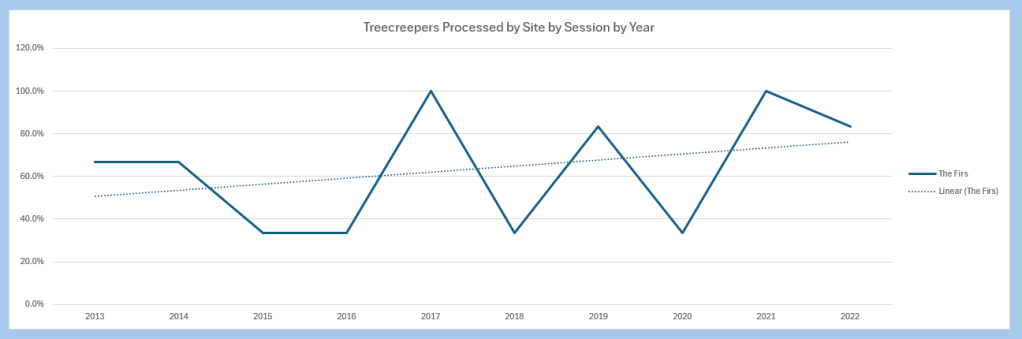
The Firs: note that this only includes data up to 2022, as the wood was closed between October 2022 and February 2024
Webb’s Wood:
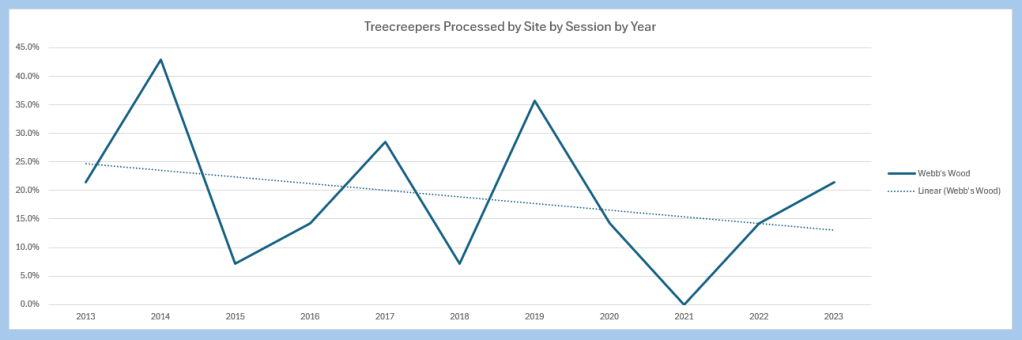
It is clear that number of individuals is full of peaks and troughs in every site. When the data is not particularly numerous, that is always going to be an issue. A good year or a bad year can have an exaggerated impact on the overall trend. Despite that, the catch in Ravensroost Wood shows the steepest, most obvious decline, particularly exacerbated by the reduction in the last three years. Why that should be, I have little idea. There were significant forestry operations over the winter of 2022 / 23, but that doesn’t correlate with the steepest decline in their numbers. 2021 was obviously the worst, but also for Red Lodge and Webb’s Wood.
Red Lodge shows the impact that four good years can have on the overall trend line if it sits in the middle of a small data set. For fun, I moved the four years to the front and to the back and redrew the graphs:

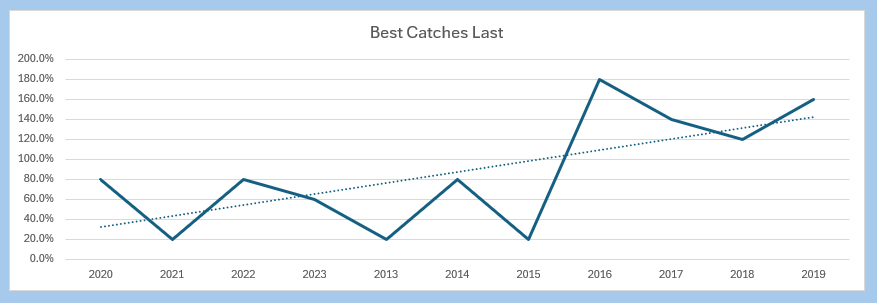
Similar effects would be had if I moved the three bad years on Somerford Common. That is the issue with data that is this volatile and with such small sample sizes. If 2024 turns out to be a good year for Treecreepers it could rebalance some of the trendlines.
What is undeniable is that there is a definite shallow decline trend in the catch of Treecreeper within the woodlands of the Braydon Forest.
 Ringing In The Braydon Forest & Beyond