This was my first visit to Lower Moor Farm since the last CES visit at the end of August. With the odd one being in the area, and one having been ringed nearby, I rather hoped that I might get a repeat of eight years ago, when I caught and ringed only the second Yellow-browed Warbler for Wiltshire. They have become much more regular on migration at coastal sites but are much more scarce inland.

Yellow-browed Warbler, Phylloscopus inornatus
Oh well! We didn’t catch one but it was a lovely session regardless. I was joined by David and Miranda for the session. I don’t usually do Friday sessions but at the beginning of the week the weather forecast was dire for the whole week, except today and Sunday. As you might have noticed from the last blog post: it changed, and we got out on Wednesday. Originally we were going to go for Somerford Common today, but the amount of standing water at Blakehill Farm on Wednesday suggested that any of the woodland sites would be a quagmire, so I changed the location to Lower Moor Farm.
We set the following nets:

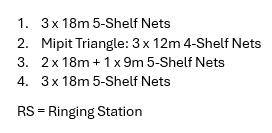
We all woke to find frozen windscreens on our vehicles. Is Autumn over already? As it is the one site where there is seating available, in the picnic area where we set the ringing station, because I am a thoughtful trainer (whatever others might say about me) I took three seat cushions with me, so that we could all it without getting frozen or wet backsides whilst processing.
We met at 7:30 and started putting up the nets. For some reason, this morning it turned out to be a real pain and took far more time that usual. They were finally opened by 9:00, but we did start catching straight away: a Wren for openers. It is surprising just how often the first bird out of the net is either a Wren or a Robin. I might do some statistics next time I have nothing better to do.
It was a nicely busy session, and we had a lot of interaction with the general public, all of which was positive. A lot of people were happy to get the opportunity to see a good variety of birds up close and get a few photos. The weather warmed up quite quickly and it was a very comfortable temperature to work in.
There were two highlights: Meadow Pipits and the reasons behind the punning title. Back in September 2014 we caught our first ever Meadow Pipits at the site, with our Mipit triangle set in the same place on the location photo above, as we have done ever since the first successful effort. However, we didn’t catch another on the site until we caught one in September 2020. We caught them in the September of each year since, until this year, but that wasn’t surprising, as we didn’t have a session there last month. Today we caught one at 10:30. As I have done a few at Blakehill recently, and David and Miranda haven’t made those sessions, I got them to draw lots for the right to process it. David won. Fortunately, at 11:00 we caught another two, so we all got to do one.
The real highlight though was the Long-tailed Tits: 21 of them. We caught three in the first round, then no more until our last three rounds between 11:00 and closing up at 12:00. It was also a nice catch of Goldcrest. Our largest single catch of them was nine back in October 2016, since then we have had several catches of six in a session, which we matched today. These two species were the biggest hits with our transient audience. I think we explained the difference between Goldcrest and Firecrest at least three times.
Our list for the morning was: Treecreeper 1; Blue Tit 1(1); Long-tailed Tit 16(5); Wren 2(3); Dunnock 2; Meadow Pipit 3; Robin 1(1); Blackbird (1); Blackcap 1; Chiffchaff 1; Goldcrest 5(1); Bullfinch 1. Totals: 34 birds ringed from 11 species and 12 birds retrapped from 6 species, making 46 birds processed from 12 species.
So far this month we have caught two Blackcaps: one on Blakehill Farm and one this morning. They weighed 17.7g and 17.5g respectively. If they were intending to migrate south for the winter I would have expected them to weigh over 20g, so I suspect that they are arrivals from Central Europe, to overwinter in the UK. I am not aware of any evidence of our summer visitor Blackcaps staying on for the winter, as Chiffchaffs are now known to do. It is a relatively recent phenomenon, proven by ringing recaptures, and a change from one of their previous migration routes, thought to be due to the garden bird feeding habits of the British population.
Miranda had to leave before the last round, she was spending the rest of the day setting up bat detectors for the wildlife group she is very active with in the Marlborough area (I suspect she is the driving force). David and I did the last round at 12:00, shutting the nets as we went, extracting the last few birds and processing them before taking down and packing away. We got away from site at about 13:00, after a very satisfying session.
 Ringing In The Braydon Forest & Beyond