As a group we catch only about 80 Yellowhammer each year. Jonny Cooper has added a few new farm sites over the last couple of years, which will boost numbers for the future, and I have a farm to the south of Marlborough that, when I can get to it, is also a regular site. However, to date the key site has been out on the Salisbury Plain Training Area, on the Imber Ranges. It has produced 60% of our catches of the species.
October is always the best month for catching them. However, this October produced only three in three visits. On average the site gets four visits every October, with two minimum and five maximum.
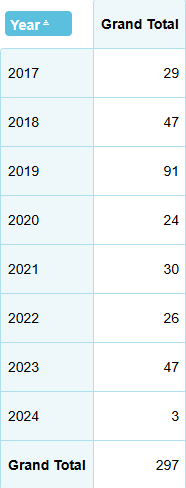
With the exception of the spike in 2019, it is a fairly consistent figure until you get to this year. I have spoken with the ringer who runs the site and he is absolutely bemused by the situation. The habitat has not changed, there have been no additional military exercises in this part of the SPTA this year. It is outside of the impact ones, so there shouldn’t have been more disturbance than usual. Definitely odd for a relatively sedentary resident species. The impact has been to make 2024 significantly the worst year for the species since this site was regularly monitored:

I had a chat with my friend, nest finding and monitoring expert, and delightfully named, Jack Daw, about what he had found this breeding season on the eastern side of the Plain. His report was that quite a few of the usually occupied territories were empty of Yellowhammer nests. Some nests that he found were predated, and three youngsters fledging was a good result. He also found a dearth of singing males on patch.
I also had a chat with Graham and Phil Deacon of the North Wilts Ringing Group, who work in the West Down area of the SPTA. They catch very few, as the habitat in their part of the Plain does not have habitat particularly suitable for the species, so don’t really have data for comparison.
It will be of interest to see how things finish up by the end of the year and what happens in 2025.
 Ringing In The Braydon Forest & Beyond