Back in October 2013 and 2014 I was lucky enough to spend two sessions with the Wash Wader Ringing Group. They were great sessions and enabled me to get experience of cannon netting and extracting birds from mist nets in the dark. It also enabled me to ring a good range of waders: Black-tailed Godwit, Dunlin, Knot, Redshank, Sanderling and Turnstone. Since then I haven’t managed to get back there, for a number of reasons, until this November. I thought it would be a nice start to the week of my seventieth birthday to treat myself to some more waders. Since I last went the ringing group has become a registered charity, and are now the Wash Wader Research Group.
Headquarters is just to the west of Kings Lynn. My first major mistake was the route I decided to take: M4-> M25-> A1(M) -> A47-> A17. Thanks to roadworks and snarl ups on every single road, it took me six and a half hours to make a three and a half hour journey. I left at 11:00 and arrived at 17:30. The plan for the weekend is usually, arrive Friday and get settled in. Possibly do an evening catch. A group of experienced observers visit the possible sites to evaluate what activities can be carried out where. On the previous sessions I attended, Saturday was cannon netting in the morning, mist netting in the afternoon / evening, dependent upon the high tide times, with Sunday being spent resighting colour-ringed and leg-flagged birds, before people depart after lunch. This weekend was somewhat different: none of the sites had enough birds to warrant cannon-netting and the tide times meant that we would be out mist netting Saturday late afternoon into the night.
Saturday morning I went with Louis, another member of the group, to carry out resighting of Turnstone on the shoreline at Hunstanton:
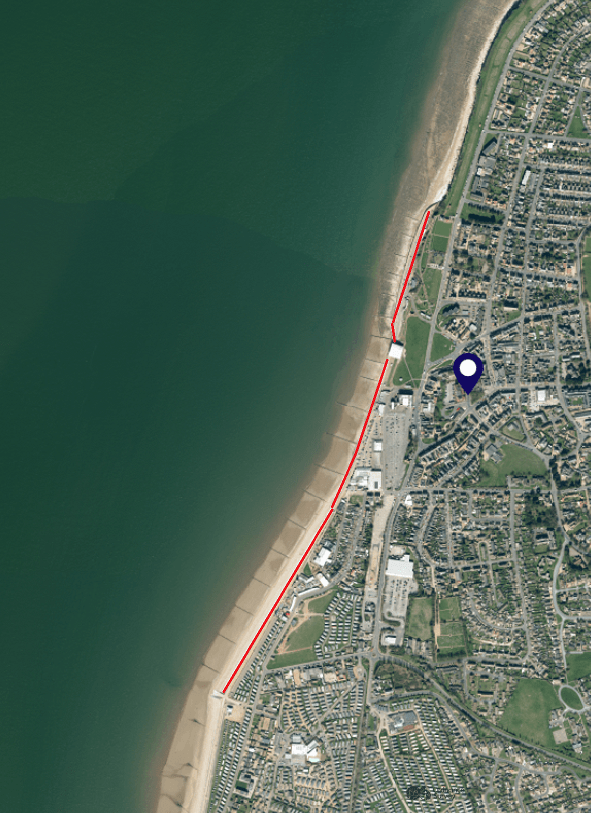
We walked as far as we could northwards, until the path was closed, with lots of warnings about falling rocks from the cliffs. You can see the buildings above those cliffs, I wonder how long they have got? One of the difficulties of sighting birds in somewhere like Hunstanton is that local dog owners like to let their dogs off the lead for their exercise, which flushes the birds. That morning we were lucky: the tide has only just started going out, the key area was mainly very rocky with a thin dribble of sand, and there was more than enough room for the birds but, apart from the southern end of our walk, where it widened out to a proper sandy beach, not enough for the dogs to disturb them too much. There were only a couple of dogs out. On request, one woman kindly kept her dog off the beach until we had managed to survey the group of Turnstone there.
Louis and I had a pretty good session and managed to identify 14 colour ringed Turnstone in amongst a significantly higher number of unringed birds. There were a lot of Oystercatcher, making a lot of fuss all along the beach area, a few Redshank, and we had a fly by of three Little Egret, a couple of Brent Geese were on the water and even two Swallows were seen flying along the seafront.
Once we had finished there we drove down to the south end of Heacham Beach:
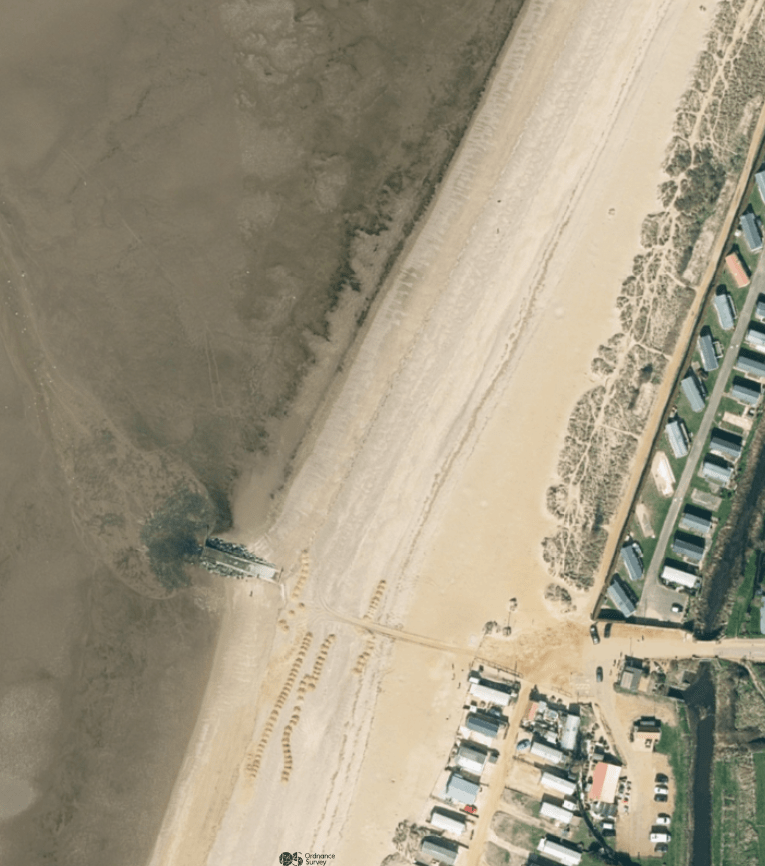
We started off on the outflow structure that you can see to the middle left, scoping the birds out on the mud. Another of the team, Lynne, joined us and we spent the next hour or so looking at the birds along the water line: primarily looking for leg-tagged Bar-tailed Godwits, plus anything else we might find. There were a lot of birds out there. As well as the Barwits there were a good number of gulls: Herring, Black-headed, Greater Black-backed; plus a good selection of other waders: Knot and Sanderling. Louis and Lynne took a walk along the beach and out onto the mud to try and get some tag data. Louis managed to identify three birds from their colour rings / tags.
One was a Bar-tailed Godwit that was ringed at Vinkenbaan Castricum, a bird ringing station in the Netherlands. This bird was ringed in April 2023 and has been observed in the Snettisham / Heacham area on five separate occasions, until this sixth observation. It seems to be commuting from one to the other on a regular basis, as each sighting alternates from the previous.
The second had a somewhat longer journey: having been ringed back in May 2018 near the village of Kościeszki in Poland, and seen by Louis on Saturday. It has travelled a distance of 1,630km due west to get to Heacham.
Thirdly was a Herring Gull that was ringed by the now, sadly defunct, North Thames Gull Group. I did several sessions with them on the rubbish dumps at Rainham Marshes and Pitsea between 2015 and 2018. This bird was ringed on 25th April 2017 at Pitsea Landfill – unfortunately not by me.
Unfortunately, my hip gave way and I was in a lot of pain and more than a bit crippled, so I retired to the café and had a very welcome mug of coffee and a bacon sandwich. Unfortunately, the hip remained painful for the rest of the weekend and beyond, limiting my activity. We returned to HQ for 11:30 and breakfast (second breakfast in my case) and a debrief on what everybody had seen and recorded. It had certainly been a productive morning.
After lunch the setting team headed off to Gedney Marsh to set up the mist nets for the evening session. They are set in daylight for catching in the evening on a rising tide, as the birds move further up away from the water.
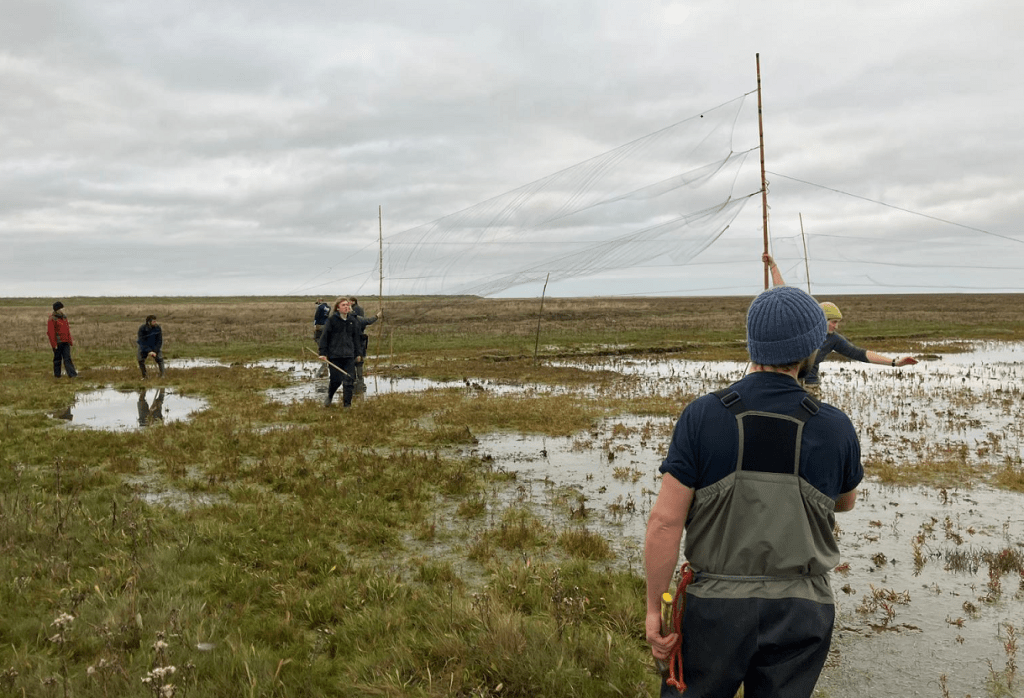
Those of the team not involved in setting up were either grabbing a sleep back at HQ or, more usefully, cooking up dinner and putting all of the equipment needed to take out to the site for the ringing and processing of the birds.
Catching is not started until darkness has fallen and the local wildfowlers have left for the evening. Because of my hip problems, I was excused from wandering around on the marsh in the dark: which probably saved me from several wet and muddy falls (my speciality). Unfortunately, that also meant that I did not get the opportunity to practise extracting waders from mist nets in the pitch dark. It is an art: especially as we do not use head torches to do so.
I did benefit from being in position to start ringing birds as the extraction team started bringing them back from the marsh. That meant that I got to ring my second ever Curlew:
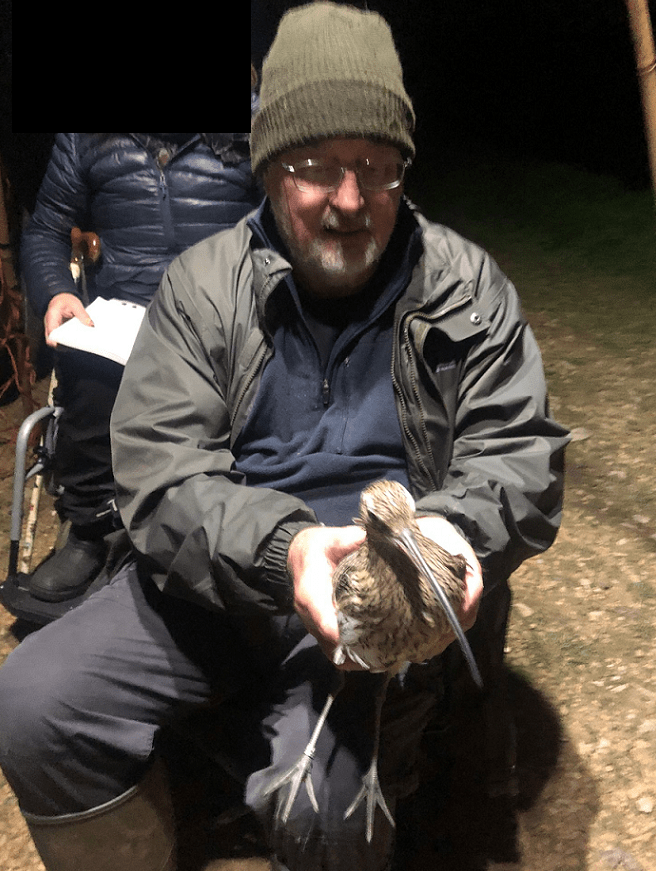
Curlew, Numenius arquata (Photo courtesy of Lynne Lambert).
Hard on the heel of this we received a delivery of 20 Redshank and 40 Dunlin, which we then started to ring. They are stored in cloth covered boxes prior to ringing, and then transferred into a clean box before being passed over for processing. Because of the numbers involved, it is a bit of a production line. A group of us were employed with ringing the birds, whilst another team carried out the processing. Processing is as follows: age; wing length; head length; head and bill length; weight. The birds are then put into another clean box before being taken out to a safe place for release.
By the end of the evening (I think) we had processed 82 birds: 1 Curlew, 21 Redshank and 6o Dunlin. Over the course of the weekend there were approximately 200 colour-ringed / flagged birds re-sighted. This also included a remarkable 17 Curlew that have been head-started from local schemes: the earliest from 2021 but birds for each year since and including 2024. I know that there were a number of other sightings of foreign and non-WWRG birds and I will look forward to seeing the official report of the weekend. Because of my health issues I absented myself after breakfast, so didn’t make any further contributions to the totals.
I would like to thank Ryan, Sam, David and Molly for heading up the whole thing, and to everyone else I met this weekend who were so friendly and so helpful. I would namecheck them all, but I would probably forget someone and that wouldn’t be right. It was a thoroughly enjoyable experience and I am looking forward to doing it again in the near future. The journey home, across country, was very much better than the journey out, taking just four hours, including a long stop for brunch.
 Ringing In The Braydon Forest & Beyond