This brief analysis covers the period from the 1st January 2013 until 6th December 2024. I will update it at the end of the year, but this is to fill in the time, as Storm Darragh has prevented any ringing activity this weekend, and you can only do so much net mending without getting really, really bored. Over this period we have caught and ringed 1,046 Goldcrests and retrapped 164 birds. As a single bird may be retrapped multiple times, this represents a total of 1,051 individual birds.
We have had some excellent results with Goldcrests, as people who have been following this blog for some time will know. The Braydon Forest has delivered the oldest known Goldcrest on record: JJP007. Ringed on the 22nd November 2015 and recaptured five years, three months and 14 days later at Porth Kellick, on St Mary’s Island in the Isles of Scilly. Not only longevity but, from other recoveries that I will come to in a short while, its journey there of 356km is a minor movement for this species. The longest known single movement of a bird of this species is 831km: a Goldcrest ringed in the Orkneys and recovered in Suffolk.
The other interesting Goldcrest recoveries that we have had were: a bird ringed on the Calf of Man on the 5th September 2019 and recaptured in Ravensroost Wood on the 3rd November 2019 (a juvenile, 59 days later, 334km); another also ringed on the Calf of Man on the 7th April 2019 and recaptured in the Firs on the 19th October 2019 (an adult, 195 days later, 337km). In reverse, we had a Goldcrest ringed in the Firs on 19th October 2019 and retrapped at the Bardsey Bird Observatory on the 26th March 2020 (juvenile, 159 days later, 236km).
It is only in writing this that I realised that the 19th October 2019 was a quite astonishing day for the Firs: one bird recovered from a long way away and another ringed on the same day that was recovered a long way away. The other thing that these four recoveries seem to indicate is that there is a western flyway for Goldcrest.
I have looked at our ringing records over this period:

You will see that I have included individuals in these figures. This was to highlight that most retrapped birds are from the local population, as highlighted by the low number of ringed recaptures from outside of the area.
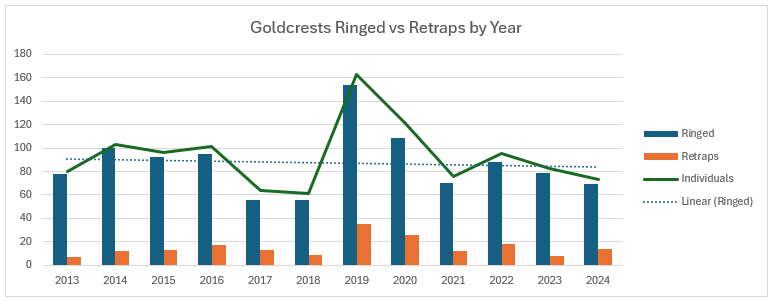
The trend line shows a shallow decline in the number of birds ringed, but if you exclude the big dip in both 2017 and 2108, plus the subsequent peak in 2020, it is pretty consistent.
The next thing I looked at was the number of birds ringed and retrapped by month:
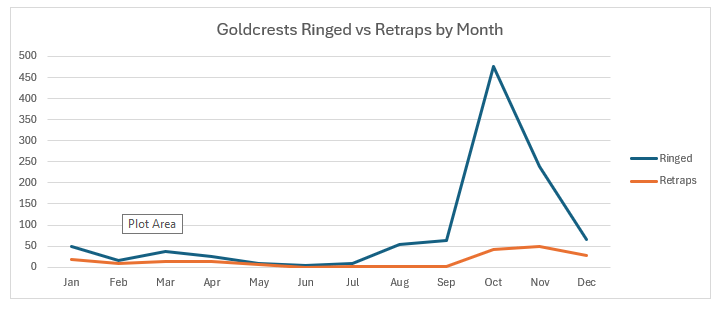

It shows pretty clearly that late autumn / early winter is the key period for the species. Looking at the data for the Wiltshire Bird Atlas, this reflects both the breeding and winter abundance maps for this species. (The link to the data can be found at: https://www.wiltshirebirds.co.uk/atlas-system.html)
As you can see from the table, there are very few birds ringed in May, June and July and virtually no birds retrapped in June, July and August.
The next thing I looked at was whether there was any difference between adult and juveniles ringed by year:

The definitions of juveniles are as follows: 3 is the BTO code for birds fledged this year that have completed their post-fledging moult. Code 3J is for those birds that fledged this year but have not yet completed their post-fledging moult. When graphed up:
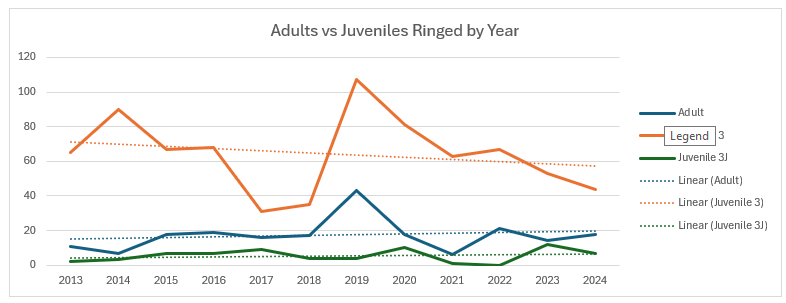
There is a small downward trend in the number of juveniles who have completed post-fledging moult but, like the overall numbers, this is no doubt down to the large fall of birds at this stage in 2017 and 2018. Those juveniles at stage 3J are those most likely to have been fledged locally and their trend is just better than static. So then I looked at the split by month:

This rather reinforces my view that most of the 3J juveniles fledge relatively locally, with the adults and 3 juveniles, at least, reinforced by birds flying through on autumn passage, with some staying in for the winter.

Finally, I had a look at the birds that had been retrapped over eight months after being encountered at our sites. Given that the likelihood is that a large proportion of our catch is made up of birds on passage, I thought I would have a look to see how many recaptures were on sites different from the first encounter:

There is just one Goldcrest that was recaptured at a site other than that at which it was first encountered. Does this mean that these birds are site faithful on migration or are they just local birds? I don’t know.
 Ringing In The Braydon Forest & Beyond