After last weekend’s horrendous weather I had hoped to make up for lost opportunities by arranging a session at Ravensroost Wood on Tuesday. I was joined for the session by Laura. We arrived on site at 7:30 and set up the following nets:
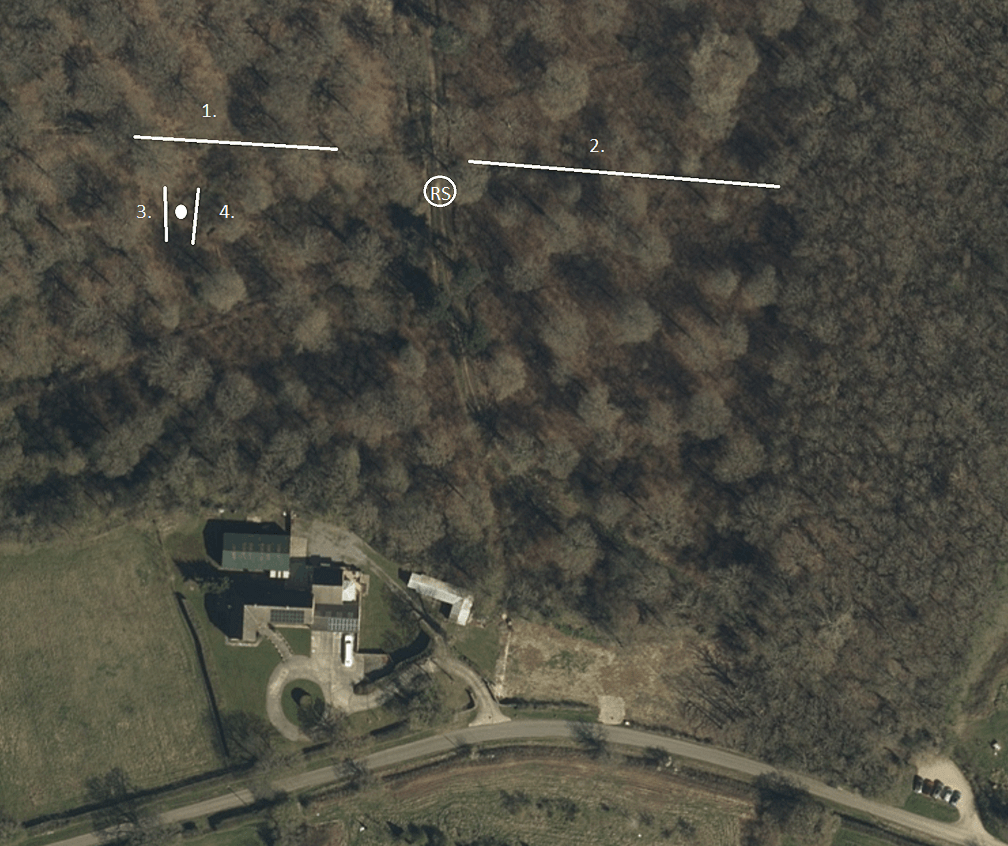

The white dot between nets 3 and 4 is the feeding station comprising a seed feeder and a peanut feeder. The feeding station was set up on the previous Wednesday but, no doubt not helped by the foul weather, it hadn’t really been found yet: just a few peanuts had been eaten and the seed feeder hadn’t been touched. I had taken feed to top up the feeders but, as they were still relatively full, at the end of our session I went off to Somerford Common and topped up the feeding station there, as we were planning to be there today.
Unfortunately, after an hour the wind got up and was blowing directly along the line of rides 1 and 2, but was also impacting on rides 3 and 4. The nets were billowing and, although the nets are tethered along the horizontal axis, there was potential for shear forces, so I decided that it was potentially too dangerous to allow birds to be caught, and we closed the nets and took down. It was doubly unfortunate as we had caught the following in the one round possible: Great Spotted Woodpecker 1; Nuthatch (1); Blue Tit 1(1); Great Tit 2; Coal Tit (1). Totals: 4 birds ringed from 3 species and 3 birds retrapped from 3 species, making 7 birds processed from 5 species. Home before elevenses!
Wednesday I was scheduled to run another session at Miranda’s house. We were being joined by new recruit Emma. Meeting at 7:30 that morning it became immediately obvious that it was a non-starter, so we didn’t even try to set the nets.
The forecast for today was rain overnight, until 7:00, easing off between then and 9:00, with it being overcast but dry, and with a light breeze thereafter. I arranged to meet Laura, Adam and Mark at Somerford Common at 8:00, thinking that it would be dry by the time we had the nets set. In the event, it was dry when I left the house at 7:30. Arriving on site I went and replenished the feeders, which were empty. I should say: the seed feeder holds four litres of seed. I use wheat-free seed mix, and there is no waste or rat-attracting spillage.
We set the following nets:

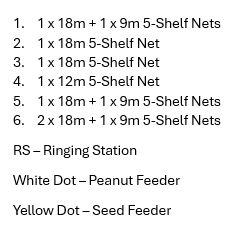
It was a good session, helped by the weather being much better than forecast: instead of being overcast, the cloud lifted and the sun came out. The breeze didn’t arrive until midday, as we were starting to pack away.
The birds came regularly and we ended up with the following list: Nuthatch 1(3); Blue Tit 10(6); Great Tit 1(8); Coal Tit (5); Marsh Tit 1(4); Robin (6); Chaffinch 1; Lesser Redpoll 5. Totals: 19 birds ringed from 4 species and 32 birds retrapped from 6 species, making 51 birds processed from 6 species.
Given that there is a cohort of academics who like to blame supplementary feeding as a partial reason for the decline of other species, due to competition from more aggressive species, particularly in my study area, the Marsh Tit, it is interesting to note that the first three birds out of my nets this morning were a juvenile Marsh Tit, which we ringed, plus two retrapped birds: one of which is five years old and the other four years old for a bird with a typical lifespan of two years. Mind, the oldest recorded from bird ringing was over 11 years old when last recorded. Perhaps the most interesting Marsh Tit though was ring number AAL0191. A key finding about Marsh Tit movements is that they are a very sedentary species and rarely move any distance from where they fledged. It is one of the factors behind their decline, as our woodlands become more fragmented and more sparse. This bird was ringed in the Firs reserve in February 2020. It was recovered there on seven occasions between then and October 2022. In October 2022, at the insistence of the owner (it is managed by the Wildlife Trust on behalf of the landowner), the Firs reserve was closed for Ash tree removal. We actually did retrap the bird in our last session prior to the closure, on the 9th October. The very next month we recaptured it at Somerford Common, some 3km away. (Confession: I hadn’t realised at the time, I only found out today because I was looking at the records for a four year old Marsh Tit.) It is clearly not as territorial as its peers: as it has also been caught in Somerford Common West, and now back at Somerford Common, each of those movements just over the 1km mark.
Nice to catch and ring another Nuthatch, it is turning into a good year for them in the Braydon Forest. we have processed the same number as in the previous best year (40 ringed and retrapped) and are two off tying with the best year for ringing the species (27 vs 29). With a bit of luck we will beat the former and at least equal the latter. It was also good to catch a Nuthatch that was ringed five years ago and has been caught every year since at Somerford Common.
Okay, the absolute highlight of the session has to be a small flock of five Lesser Redpoll. We usually catch them at this site in the January to March period, Before today we had only ever caught them in a December session in 2020 and 2023: each time it was just a single bird, so five was a really decent result. They were all caught together in the same net on the same round.
We started packing away at just after midday and, with breaks to process some more birds, extracted as we were closing the nets, and left site at about 13:15. Very enjoyable, made better by the excellent company that I am lucky enough to have in my team. We do good work and have a good laugh as well.
 Ringing In The Braydon Forest & Beyond