After several days of rubbish weather, with the last two being particularly hard, I decided to go to Somerford Common, as I have been supplementary feeding there throughout the winter: hopefully reducing food finding stress for that local population. Because the forecast was for it to be sub-zero until 9:00, I decided to get to site for 8:00, with the nets open after the temperature went above zero. I was joined for the morning by Laura, Mark, Adam and Daniel and we set the following nets:
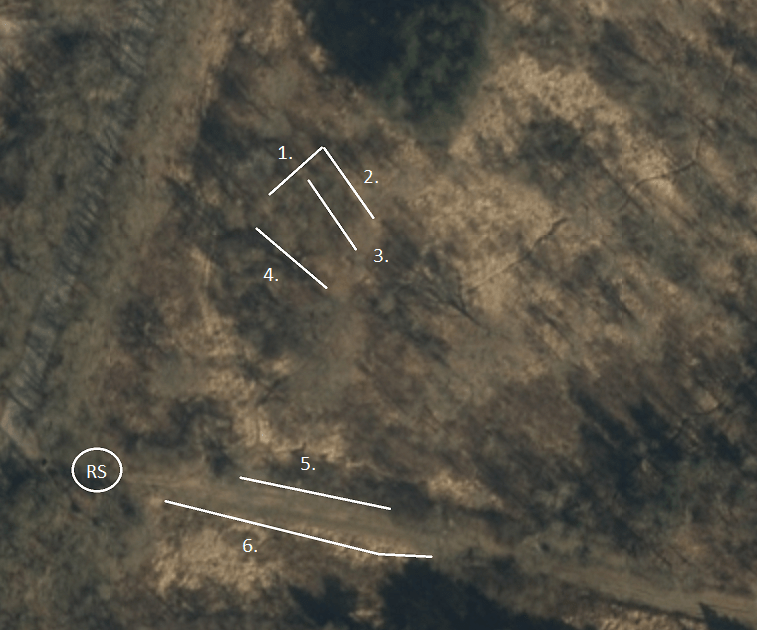

(It looks as though Ordnance Survey have updated the aerial photographs of the Braydon Forest over Christmas – goody!)
We had the nets open just before 9:00. I went round to put on lures only to find that the birds had started arriving already. So we had a good first round and then decent catches each round until 10:30. It rather died off after that and at 11:15 we decided that, on the balance between sitting there getting cold and not processing many birds and going home and getting warm, we opted for the latter. With Laura and Adam taking down rides 5 and 6, Mark, Daniel and I went for rides 1 to 4. As I started on taking down ride 4 the bird of the morning, a Jay, very kindly decided to fly into ride 2. We frequently see small mobs of Jay flying around the site but rarely catch them. One was caught here at the end of November, and that was the first at Somerford Common since February 2020. Getting a second within a couple of months was satisfying. Laura processed the bird, which managed to extract a fair degree of revenge for being caught and ringed: drawing blood from her index finger with a well-aimed lunge with its beak.

Jay, Garrulus glandarius, photo courtesy of Mark
Marsh Tit AAL0191 put in another appearance. This is the Marsh Tit previously referred to, that left the Firs in October 2022 when the disruption caused by the removal of the Ash trees, and some of the mature Oaks, started, and turning up at Somerford Common in November of that year. This bird is now over 5 years old: against a standard life expectancy of just 2 years.
The list for the morning was: Nuthatch (3); Jay 1; Blue Tit 4(7); Great Tit 1(7); Coal Tit 1(4); Marsh Tit (2); Dunnock (2); Robin 2(6); Blackbird 1; Chaffinch 1. Totals: 11 birds ringed from 7 species and 31 birds retrapped from 7 species, making 42 birds processed from 10 species.
What one recaptures can be quite odd. For example, Blue Tit AEX0595 was ringed as a juvenile in November 2021. It was then retrapped five times in the next 12 months, but not seen again for two years and two months until we caught it today. The pattern of catch does rather indicate that it is caught only when there is a feeding station present but it does make one wonder why the gap.
Unfortunately, no sign of any Redwing, Goldcrest, Long-tailed Tits, Lesser Redpoll or Siskin today.
As ever, it was a fun session, as well as having a reasonable catch. With that number of retraps, it was a cheap session for me. We had everything packed away just before midday and were away from site soon after. I have now thawed out!
 Ringing In The Braydon Forest & Beyond