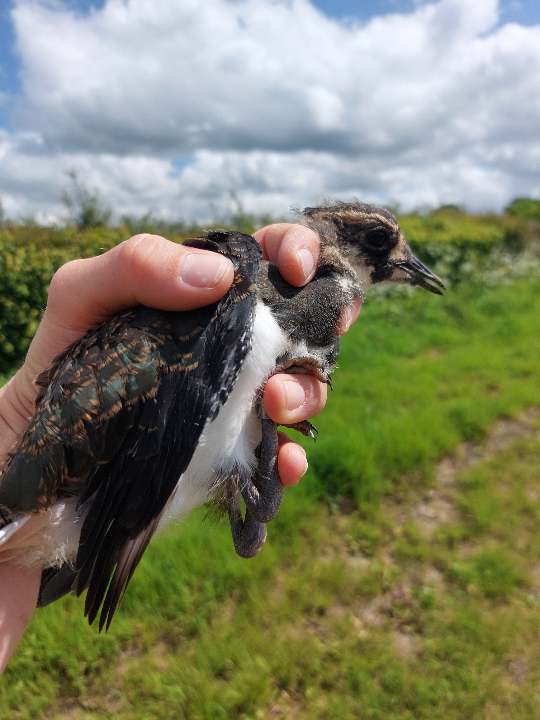
Lapwing: before this year the group had ringed 11 Lapwing chicks, all bar one were ringed on Salisbury Plain, on the edge of the training area. This year, two were ringed on the Imber Ranges, but two others were the result of a new project, being run by Jonny in his role at the Wiltshire & Swindon Biological Records Centre, supported by Aurora, and called, not unsurprisingly Project Peewit. On the back of his work with the local farmer cluster involved in the Curlew project, a similar project is now being run for Lapwing. One was ringed at one of my Barn Owl sites in the Braydon Forest and the other near Shalbourne. Here’s looking forward to many more!
Buzzard: our first ever chick ringed by Jonny at one of his new farmland sites.
Kestrel: an amazing year for us, as we haven’t, so far, targetted raptor pulli, outside of the Barn Owls we work on. This year we had 15 chicks ringed plus one adult. One adult is par for the course: in every year from 2015, excluding 2019, the group has ringed a single Kestrel. This year’s was at a site just outside Hilmarton. However, the chicks were the first for the group. Mine was a brood of five nesting in a box in a back garden on the outskirts of Amesbury. Jonny’s were, shared with Aurora and Justine, a brood of six in a Barn Owl box near Combe Bisset and a brood of four near East Grafton.

Hobby: our first ever, caught at Langford Lakes by Jonny.

Tawny Owl: Jonny got to ring his first ever Tawny Owl, at his Hilmarton site.
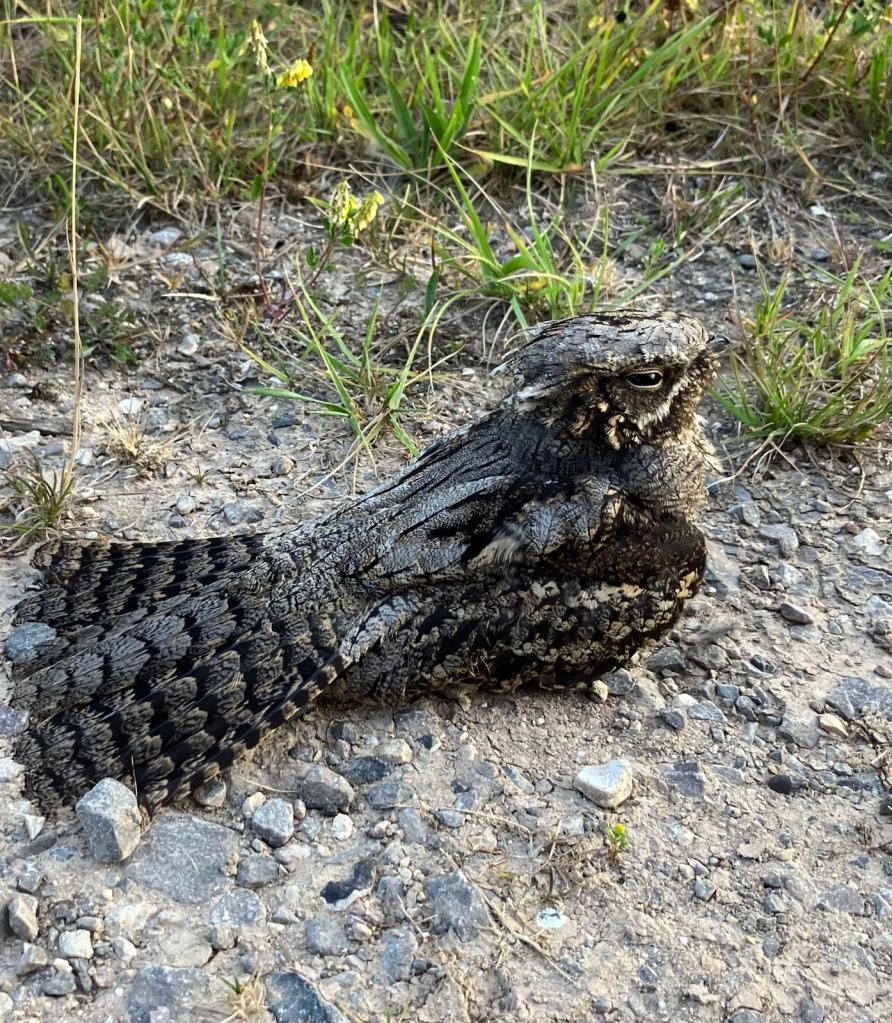
Nightjar: they have started to be caught on autumn migration at Ian and Andy’s Salisbury Plain sites: the first in 2020, three in 2022, one in 2023 and another three this year: with two a first for a new Imber Valley site:
Sand Martin: our group’s first ever catch of this species, at one of Jonny’s new sites north-west of Calne.
Carrion Crow: Only our third wild caught fledged Carrion Crow. The first was in 2017 at Lower Moor Farm, the second was at Biss Wood in 2021 and then this one in 2024 at a farm near Hilmarton.
Long-tailed Tit: our best ever year by a long way. We do recapture a lot of them, some 40% of our catches are retraps. Even so, 391 in 2024 vs 347 in 2023 vs 325 in 2022 shows consistent growth. That just under half of those ringed came from my Braydon Forest sites is very pleasing, as numbers there reduced significantly after 2016 and have been recovering slowly over recent years.
Wren: our best year for Wren, both ringed and retraps 344 (134), 30 more ringed than the previous best (2022).
Meadow Pipit: our second best year, following up last year’s 670 ringed with another 640.
Stonechat: Equal best year with 2020: 25 ringed + 1 retrap in both years. The surveying team at Blakehill are convinced that Stonechat bred there this year for the first time on record.
Whinchat: after two blank years it was good to get four back at Blakehill Farm, with the fifth caught on Salisbury Plain.
Yellow Wagtail: only our second, this time a juvenile, again at Brown’s Farm. Somewhat concerning: the tenancy agreement at Brown’s Farm was terminated in September and I have not yet been given permission to resume ringing activities there by the owners, who are going to manage it going forward.

Redstart: Since 2020 we have regularly caught five or six each year. This year it was five – but three of those were at Blakehill Farm. We only caught a total of two there between 2013 and 2019 inclusive. Then two in each of 2020, 2022 and 2023. Here’s hoping for four in 2025.
Redwing: given how much we have all been complaining about the lack of them at the end of the year, we did actually have more than last year (318 vs 294) although lower than the catches since 2018. Mind, prior to 2018 we never caught more than 132 in a year.
Blackcap: fewer than last year but our second best ever: 670 ringed and 75 retraps vs 726 ringed and 69 retraps. 2024 was 100 birds higher than 2022 and 200+ higher than any other year. This time the numbers were not boosted by new sites coming on line.
Lesser Whitethroat: our best year to date. Numbers have been increasing over the last three years. 45(6) in 2024; 39(1) in 2023 and 31(4) in 2022. This is my favourite photo:
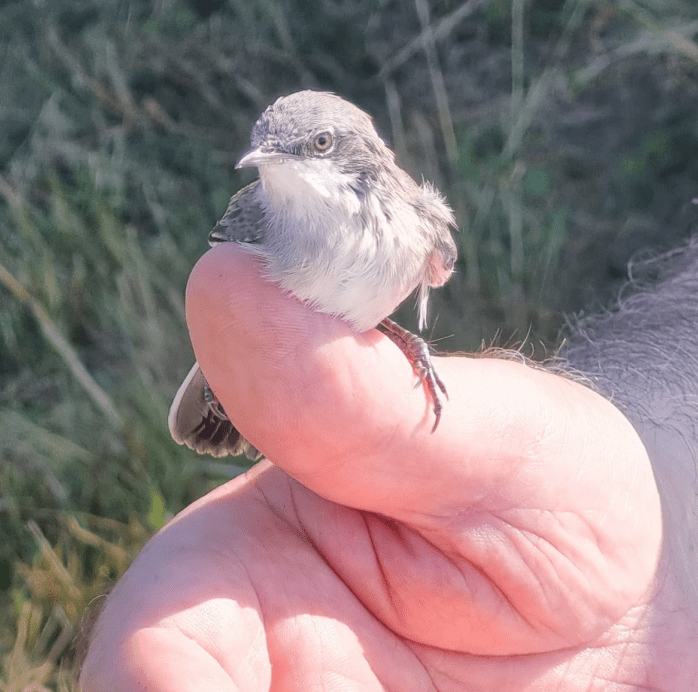
It sat there, quite happily, for a couple of minutes and flew off only when someone else decided to see if it would transfer to them. Clearly it preferred me.
Goldcrest: Although the total number processed is our highest to date at 267, 66 of those were recaptures, which drops the number ringed into second place behind the 220 ringed in 2023.
Firecrest: best ever year with three ringed: a first for Biss Wood, second for Red Lodge and a third for one of Andy’s Warminster sites.

Greenfinch: best year yet, with 195 ringed vs the previous best being 183 in 2022. The numbers do fluctuate significantly. The key factors seem to be, primarily, the catch at Jonny’s East Tytherton site and, secondarily, his Sutton Benger site.
Goldfinch: best year for ringing them (512 ringed vs 507 in 2022).
Linnet: our best year for the species since 2015. It doesn’t compare with the 108 processed then, but it is more than double that of any year since 2016. The 2015 figure came from a remarkable catch of 65 at Brown’s Farm and 42 at Blakehill: neither of which has ever produced anything like that subsequently: only two per annum during the last five years, with a blank in 2022.
Brambling: only the one, but a first for the western side of Somerford Common. They are not a common bird for us: only 14 prior to this one, 10 of those in the Braydon Forest. Only the Firs to go for the full Braydon Forest set!

Reed Bunting: best year to date, building on last year: 134 vs 103 in 2023. The key boost being in one of Jonny’s relatively new farmland sites near Hilmarton with 55, Blakehill Farm consistent with 40. Langford Lakes surprisingly low, so potential for yet more growth.
 Ringing In The Braydon Forest & Beyond