This week’s session was planned for Red Lodge. I set up a feeding station there on Tuesday morning for the first time this winter. Our last session at Red Lodge, without a feeding station, produced just 21 birds from six species, with just four Blue Tits and two Great Tits. It rather begged the question: is it the feeding station that is attracting those two species into the catching area? So, today could provide an indication of the impact.
With Saturday forecast to be drizzly and miserable, but Sunday looking dry and miserable, we decided to be miserable on Sunday! Unfortunately, that meant that several of the team couldn’t make it. However, Rosie joined us for an hour-and-a-half before heading off to work, and I had the family Childs with me for the whole session.
On arrival at the site, at 7:30, it was damp, misty and cold. However, there was very little wind to disturb the nets. We set the following:


The two seed feeders and one of the two peanut feeders, the one adjacent to ride 3, had been emptied, and the other peanut feeder, adjacent to ride 1, was half full still.
One of the nice things about Red Lodge: for the first time for what seems like an age, we were not wading through mud. The tracks in Red Lodge are all pretty solid, with either chalk or rubble bases under a top layer of soil and vegetation. It does make a bit more of an effort to get the holes in place for the poles, but it is worth it! Another nice thing about it: with the feeding stations in place it is a compact area we work in, the nets are all easily visible and we can go and extract birds as they arrive, rather than having regimented rounds that may, or may not, produce any birds!
We started catching straight away, which meant that Rosie got to process a few birds before heading off to work, and the first round was reasonably varied: Blue Tit, Chaffinch, Coal Tit, Dunnock, Great Tit and Marsh Tit. However, thereafter it was Blue Tit city, interspersed with a few additional species, mainly Great Tit, but it was a decent haul and an enjoyable session. We caught regularly all morning.
The list for the session was: Nuthatch (1); Blue Tit 22(3); Great Tit 8(1); Coal Tit 3; Marsh Tit (1); Long-tailed Tit 1(1); Dunnock 1; Robin (1); Chaffinch 2. Totals: 37 birds ringed from 6 species and 8 birds retrapped from 6 species, making 45 birds processed from 9 species.
So, clearly, if we take this as able to be extrapolated to all sessions, the feeders are a big attractant to the Blue and Great Tits, but also improve diversity by attracting in other species.
Nice to catch a couple of Chaffinch that we could put a ring on. Unfortunately, we also had one that we couldn’t ring due to the beginnings of Fringilla papillomavirus on its legs. It seems to me that it is becoming less common in our local Chaffinch population. Hopefully that is the case.
It is always nice to catch a bird that has exceeded the typical lifespan for the species. That was the case with the female Nuthatch that we retrapped. It was five years since she was ringed as a bird of unknown age. According to the BTO’s BirdFacts, based on masses of survey data, their typical lifespan is just two years, although the oldest known from ringing recoveries is a couple of days over 11 years!
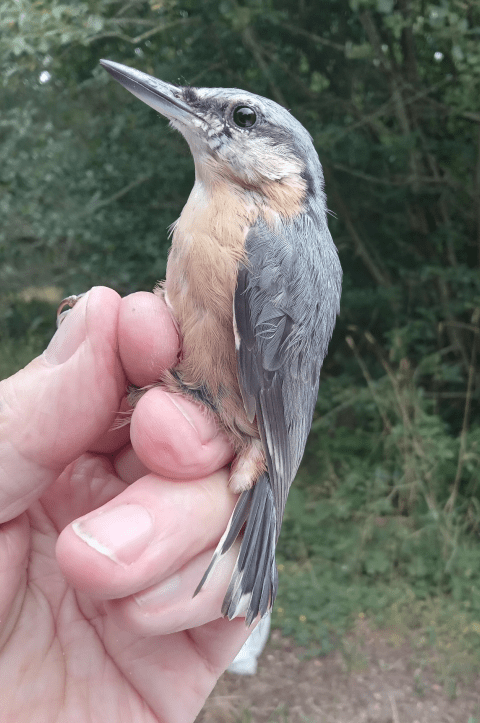
Female Nuthatch, Sitta europaea
With us all getting quite cold I announced we would shut the nets and start taking down at 11:30 so, naturally, we took another 11 birds out of the net whilst trying to get them shut. I swear that if I announced after each round that the next would be the last before we packed up, I would end up with much larger catches! Anyway, we started packing away just before midday and left site by 12:30 after a cold but enjoyable session.
 Ringing In The Braydon Forest & Beyond