The plan for Thursday was a session at Miranda’s property: our new Cleverton site. I left home at just after 7:00 and headed off for the session. Arriving at about 7:20, getting out of the car I was very disappointed to find that the forecast slight breeze was actually quite a stiff breeze blowing directly through where we wanted to set the nets. Not only that, the easterly breeze was horribly cold. It is quite open with nowhere to put the nets where they would be sheltered from the wind. Disappointed, but we both agreed that it wasn’t possible to set the nets and ensure safety for the birds. We will reschedule for the next calm day.
I returned home, via Ravensroost Wood to set up a new feeding station for the Swindon Wellbeing Team meeting on Tuesday. Surprisingly, back at home there was virtually no wind. We have had plenty of birds in the garden recently: good numbers of Goldfinch and Greenfinch, Jackdaw and Starling, Woodpigeon, Stock Dove and Collared Dove, Robin, Dunnock, Blackbird, Magpie and Wren, Blue and Great Tits. So, rather than have a completely empty day, I put up two 6m nets in an open triangle around our two feeding stations and baited two Potter traps with mealworms, hoping to have at least a few birds to process.
Naturally, all of those birds decided to be a no-show, and nothing much happened for ages. Then a couple of Goldfinch arrived, followed by two Starling and a Dunnock. I did catch a third Goldfinch but, for the first time in my experience, its legs were white, wearing mite socks!
By this time the wind that had prevented the scheduled session arrived in Purton. As I went to shut the nets I was delighted to find this sitting there:
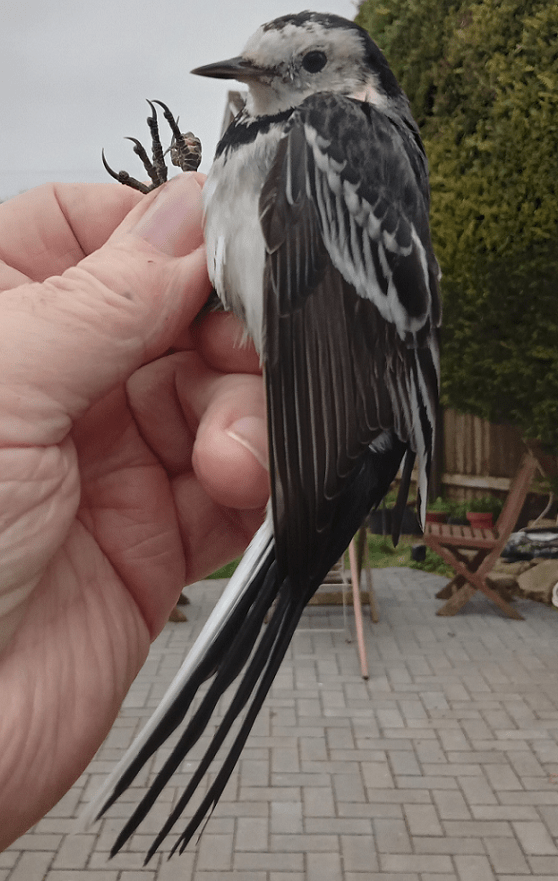
As a trainee I was lucky enough to ring a goodly number of these beauties, 29 0f them, mainly at Marlborough Sewage Works. Not only that, I was lucky enough to ring 13 White Wagtails that over-wintered at that site.
Since then I have not had a site that has areas attractive to the species. I have been lucky enough to catch two at Blakehill Farm, adjacent to the farm yard. Then, in January 2021, I caught one in my back garden, and this Thursday I caught my second for the garden. It is a first winter bird: the black bib has not developed yet and there were allow tinges on the white areas on the head and the wings were dull and not strikingly black.
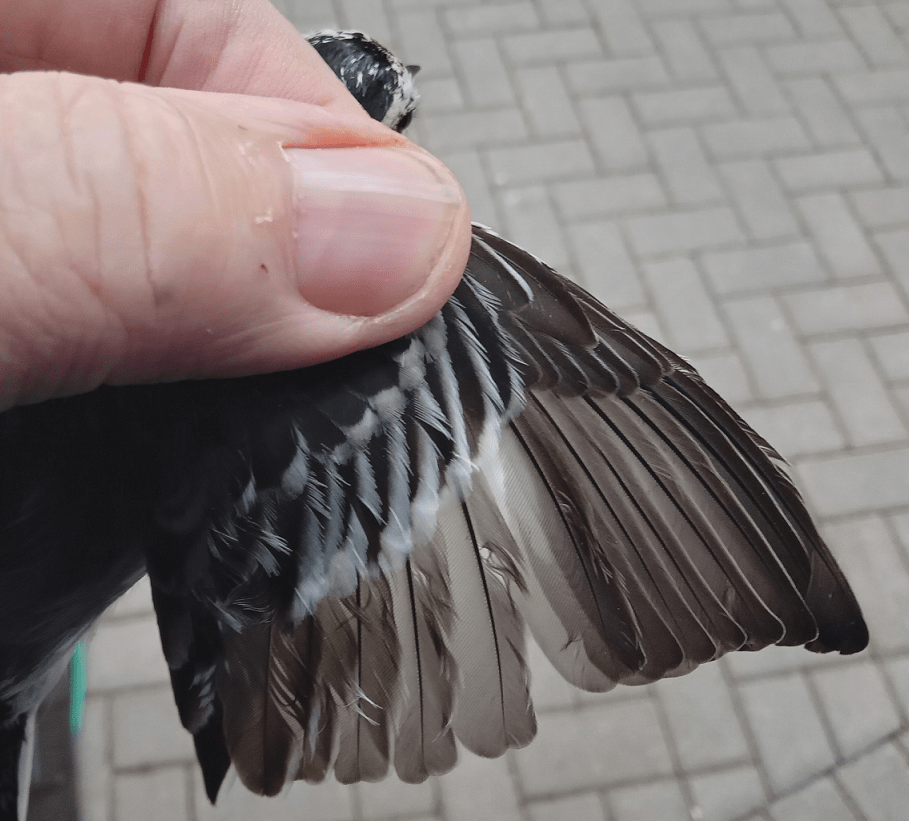
According to the bible: Moult and Ageing of European Passerines by Jenni & Winkler, this wing condition is indicative of a first year male, but I would like to recapture it later in the year before sexing it.
Anyway, after a blow out first thing, and then all of the birds disappearing from the garden, it ended up being a sweet, if short, bit of garden ringing. I must do more!
 Ringing In The Braydon Forest & Beyond