After yesterday’s high winds and torrential rain, it was rather nice to get out this morning. I had been out on Monday afternoon to top up the feeders, so was hopeful of a reasonable catch.
I was joined by Miranda for the morning and we met at 7:00. Because there was only the two of us, I restricted the nets to just those adjacent to the feeders:
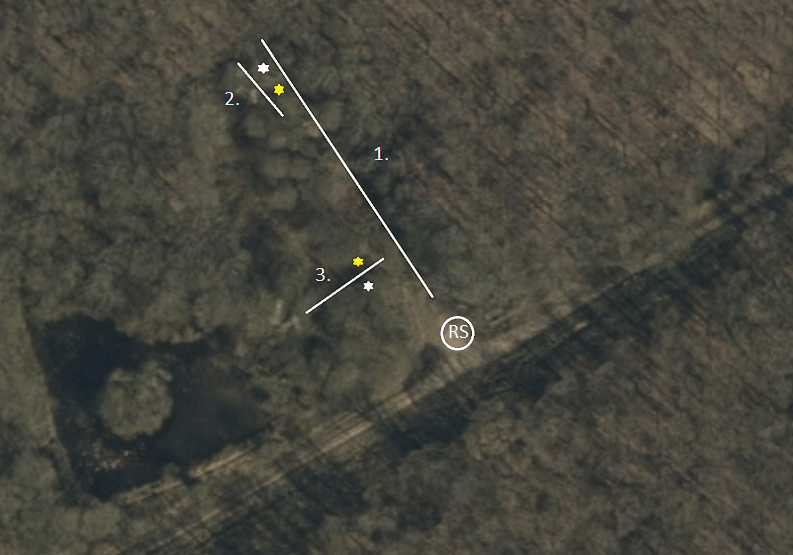

We had the nets open by 7:30 and started catching straight away. Unsurprisingly, the majority of the catch comprised Blue and Great Tits. It is what I was expecting. What I wasn’t expecting was how many were unringed. We caught 20 Blue Tits in total: 18 unringed and just two retrapped. The two retraps were ringed one year and two years ago. Then 17 Great Tits: 12 unringed and five retrapped. The oldest from just two years ago.
Also, given the number of people commenting on how few juvenile Blue Tits they are catching, it was, once again, good to see the ratio of Adult : Juvenile birds. In February, my team has ringed 84 Blue Tits at a ratio of 16 adults : 68 juveniles. 20% to 80%. Today’s session produced 3 adults to 15 juveniles: 17% adults and 83% juveniles.
What I am finding this year is how early both Blue and Great Tits are coming into breeding condition. If it wasn’t for Ellie mentioning it several weeks ago, having found a Blue Tit and a Great Tit developing brood patches, I wouldn’t have thought to look. Now that I am looking, it is surprising how many I am finding. I suppose with males setting up territories, Great Tit males seem to be singing all over the place, their testosterone levels must be elevated and that, no doubt, has resulted in the number sporting quite obvious cloacal protuberances. Somewhat more surprising, to me at least, are the number of females that we have caught that are clearly already developing brood patches. According to the BTO BirdFacts database, both Blue Tit and Great Tit first clutches are usually laid towards the end of April, with the earliest record for Blue Tit being 12th April, and for Great Tit, 10th April.
One thing it has meant is that I have been able to show Miranda what she should be looking for over the next few months as we catch more birds.
In our second round we caught a female Chaffinch: unfortunately she was suffering from Fringilla papillomavirus, so we released her unringed, thinking that was likely to be it for the day. However, at 9:40 we caught another two, then next round we caught another and, in our last round at 11:45, we caught yet another. That brings our total in Red Lodge for this month to six. Equalling our best monthly total for the site. To put it in perspective, our average catch of them is 2 per month.

So, of the five we actually caught, the only female was the only one we couldn’t process.
Another interesting catch was our sixth Marsh Tit ringed in 2025. That is the best start to the year that we have ever had! Previously we have had four, in 2020 and 2023, but the majority, unsurprisingly, are ringed in July through September, as the breeding season progresses. As for Red Lodge, we hadn’t ringed any in January and February until 2019. Since then we have had just one ringed in each year during January and February, so this is this year’s contribution to the new tradition (which was missed last year).

If you happen to be walking in Red Lodge and see a Marsh Tit with a brown ring over a pale blue ring on its right leg, it was the bird ringed today and is ring number BEH0597. Drop me a line if you see it, let me know where when, and I will be eternally grateful.
The list for today was: Great Spotted Woodpecker (1); Blue Tit 18(2); Great Tit 12(5); Coal Tit 1; Marsh Tit 1; Long-tailed Tit 1(1); Chaffinch 4. Totals: 37 birds ringed from 6 species and 9 birds retrapped from 4 species, making 46 birds processed from 7 species.
With the breeze starting to get up at 11:00 and, despite the intermittent bouts of warm sun, we were getting pretty cold, the number of birds had fallen away so we did one last round, which produced a decent round of eight birds. By the time we had processed them another five had hit the nets, so we closed them as we extracted the birds, processed them and then took down. Fortunately, with just four nets to take down, it didn’t take long to pack away, and we were off site soon after midday.
 Ringing In The Braydon Forest & Beyond