It has been a difficult week: a scheduled Tuesday session for the Swindon Wellbeing team had to be cancelled because of high winds, the Wednesday session for my team at Webb’s Wood cancelled due to rain, sleet and snow, Thursday because I wasn’t well and I finally got out on Friday, to Webb’s Wood. I would have been better off staying in bed: just nine birds in two-and-a-half hours of the nets being open. At least I was flying solo there and not wasting anybody else’s time. However, the distance between my ringing station in Webb’s and our ringing area in the Firs is under 650m! Both had feeding stations set up: but the Webb’s one has been up for six weeks and, although it had been emptied between topping it up on Monday afternoon, clearly the birds had disappeared. There wasn’t much birdsong either: two male Chaffinch establishing their territories, a couple of Great Tit doing the same and a Raven cronking overhead. My concern was would I find the same situation in the Firs? Essentially they are the same wood, split by Wood Lane.
I had taken down the feeding station at the Firs six weeks or so ago, because positioning it at the top of the hill hadn’t worked: after a week of sitting there a few peanuts had gone and no seed. To try and encourage some birds in for the scheduled ringing demonstration I set three feeders in the central glade down by the two ponds on Monday. Topping those up on my way back from Webb’s Wood yesterday, I was pleased to see that the peanut and one of the seed feeders had been emptied, and the other seed feeder was half empty. That looked promising only, since I was last there the Trust have cleared a huge amount of the bramble scrub and straggly trees down the left side of the glade to open up the area around the ponds. This has opened the glade by another 1.5m. I realised that I would have to change my net layouts to accommodate those changes and the feeders.
I was joined for the session by David, Laura, Adam and Ellie and we set the following nets:
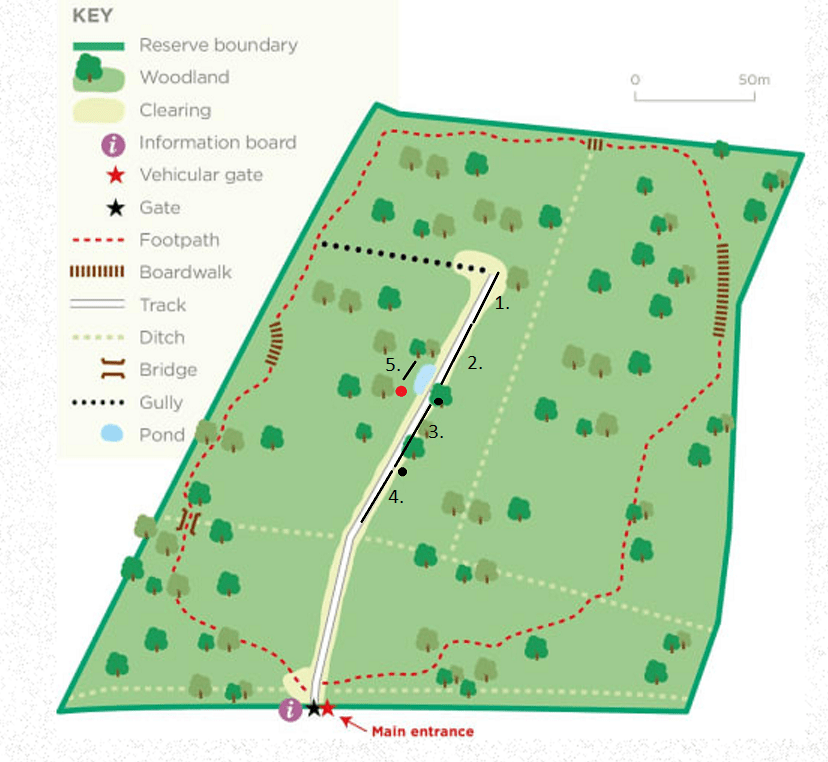
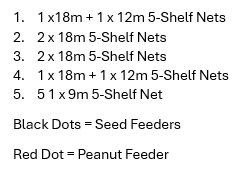
We arrived on site at 6:30 and set the nets and then set up the ringing station in the area just inside the woodland by the main entrance. Robin Griffiths, the organiser arrived just before 8:00 and the attendees were all on site by the agreed starting time of 8:30. Fortunately, we had birds already waiting for them from the second net round. Generally, ringing demonstrations are a question of me demonstrating, with my team doing all of the grunt work, extracting the birds and bringing them back to me at the ringing station. Fortunately, we managed to get a few birds in before the start, so they did get to ring a couple before the demo started. Later on in the session we had more than enough birds for me to demonstrate and for the team to get some more ringing done.
As ever, the demo was a sell out, with 20 attendees, scheduled but one was a late drop out. The weather was, on the whole, pretty good: intermittent sunshine and very little wind. It did get cold when the sun went behind the clouds, but very warm when it came out again. The attendees were a lovely bunch, very enthusiastic, all up for the challenge of being bitten by Blue Tits! (I told them I would put that into the blog.) It was great that we could provide them with a decent range and number of birds. As ever, I started by explaining about the ringing scheme, what we do, why we do it. Then I spent the time showing them birds of different species, ageing, explaining the age codes, sexing and breeding condition, weighing and wing measuring.
We had birds coming in on every round, so there was no lull in the process. What is more, apart from the obligatory Blue Tits, we were catching different species on a regular basis. The team got to process a bird that has been scarce for us so far this winter: we caught three Redwing in net ride 2. They were processed by Laura, Adam and Ellie: the first for Adam and Ellie. We catch very few of them in the Firs: just 19 in the last 10 years prior to these three, which is why I gave them to the team to process.
The list for the session was: Great Spotted Woodpecker 1; Nuthatch 3(1); Blue Tit 13(3); Great Tit 1(2); Coal Tit 2; Marsh Tit (2); Long-tailed Tit 1; Dunnock 2; Robin (1); Redwing 3; Blackbird 2; Goldcrest 2(1); Chaffinch 2. Totals: 32 birds ringed from 11 species and 10 birds retrapped from 6 species, making 42 birds processed from 13 species.
The attendees enjoyed all of the birds but the first “wow!” moment for them was the first Nuthatch. That turned into four of them, and that is exciting for me because we have only ever caught more than that in the Firs on two occasions in 13 years! The Long-tailed Tit and Marsh Tits were also audience favourites: all topped off with a beautiful, if incredibly noisy, male Great Spotted Woodpecker.
There was some excellent birding as well. First we had a Red Kite skimming the tops of the trees for a good 10 minutes or so, later that was followed by a trio of Ravens flying overhead, then we had a couple of Red Kites and Buzzards soaring in a thermal and then Red Kites, Buzzards, Ravens and at least 50 Jackdaws soaring so high up it became hard to make them out even with binoculars. We were rather surprised that there was such a strong thermal: it just didn’t feel that warm at ground level.
The session was scheduled to finish at 11:30 and the birds played ball: I sent the team off to do a last round and close up the nets and they came back empty handed. We said our goodbyes to a very appreciative audience, most of whom were asking when the next demo would be (5th October at Blakehill Farm) and we then started to take down and pack away. It didn’t take long and we were off site by 12:15. I would like to thank the Swindon Wildlife Group for their continuing interest and support.
 Ringing In The Braydon Forest & Beyond