I am pretty happy with the responses to my post “When Science Imitates Religion”. There are some follow ups to do though, so, I am sorry but there will be a few more blogs on this topic.
The first reply I got was from one of my ringing team: David Williams. David is a recent graduate from Aberystwyth University. He graduated with a first-class honours degree in Zoology, and won a University prize for being top of his cohort. He has been ringing with me since he was a teenager, back in 2017. This is his analysis:
I’ve read the blog piece 
 , and the below quote, which I think every academic should have displayed prominently in his or her office, comes to mind:
“In general, we look for a new law by the following process. First, we guess it. Then, we compute – well, don’t laugh, that’s really true. Then we compute the consequences of the guess, to see what, if this is right, if this law that we guessed is right, we see what it would imply. And then we compare those computation results to nature. Or we say, compare to experiment or experience. Compare it directly with observation, to see if it works.
If it disagrees with experiment, it’s wrong. And that simple statement is the key to science. It doesn’t make any difference how beautiful your guess is, it doesn’t make any difference how smart you are, who made the guess, or what his name is. If it disagrees with experiment, it’s wrong. That’s all there is to it.”
— Richard Feynman, “Seeking New Laws”, The Character of Physical Law, lecture series, Cornell University, 1964
As I understand it, the Broughton–Lees–Shutt hypothesis is that a) feeding birds in your garden causes the populations of Blue and Great Tits to increase (because these species take full advantage of bird feeders), and b) this leads to the subsequent decline of Marsh and Willow Tits (because they’re outcompeted, for both food and nest sites, by the increasing Blue and Great Tits).
As you pointed out in the blog piece, it would be almost impossible to test this by controlled experiment (like most things in vertebrate ecology!), so we have to make the best we can of observational data…
There’s probably a good dissertation (or maybe even a PhD thesis) in this, but, as I see it, the most salient points are:
a) Feeding birds in your garden causes the populations of Blue and Great Tits to increase
Sadly, there doesn’t appear to be any publicly accessible data on bird feeding rates; we know people have fed birds in this country since late Victorian times, but the only data I can find is a study by Plummer et al. (2019), who estimated the size of the British bird food industry by looking at the amount of advertising for bird food in Birds magazine! Their results suggest that bird feeding has increased exponentially since the 1980s:

How does this tie in with Blue and Great Tit populations? According to the BTO’s BirdTrends report (BTO, 2024), both Blue and Great Tits increased steadily, with occasional dips, from “the dawn of time” (ca. 1960s) to the late 2000s, but have since declined slightly:
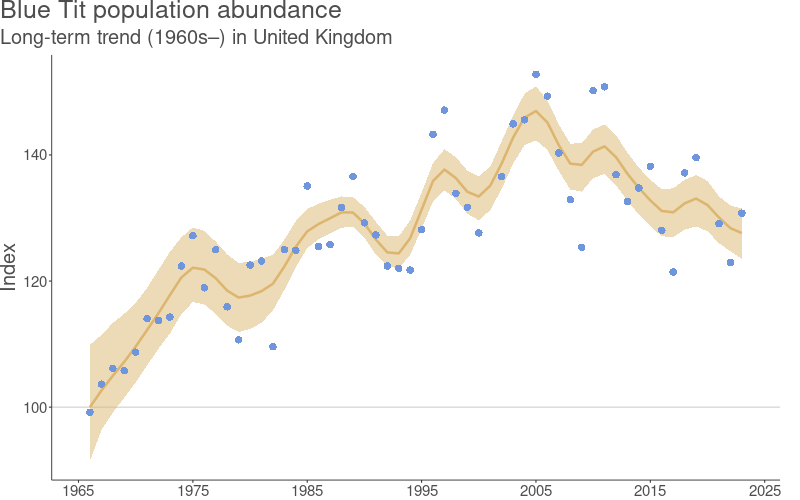

So, the increase in Blue and Great Tits had started at least fifteen years before the bird food boom…
b) The increase of Blue and Great Tits leads to the decline of Marsh and Willow Tits
Again, referring to BirdTrends, Marsh Tits have declined steadily, while Willow Tits were actually increasing until the mid-70s, before their cataclysmic decline:
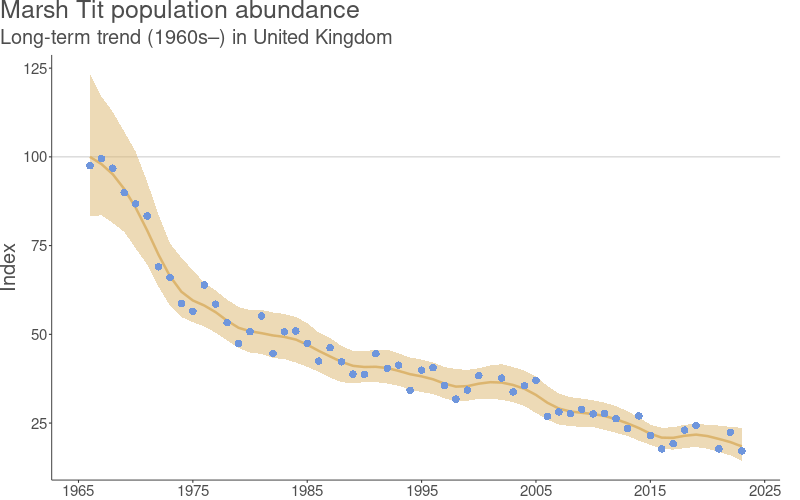
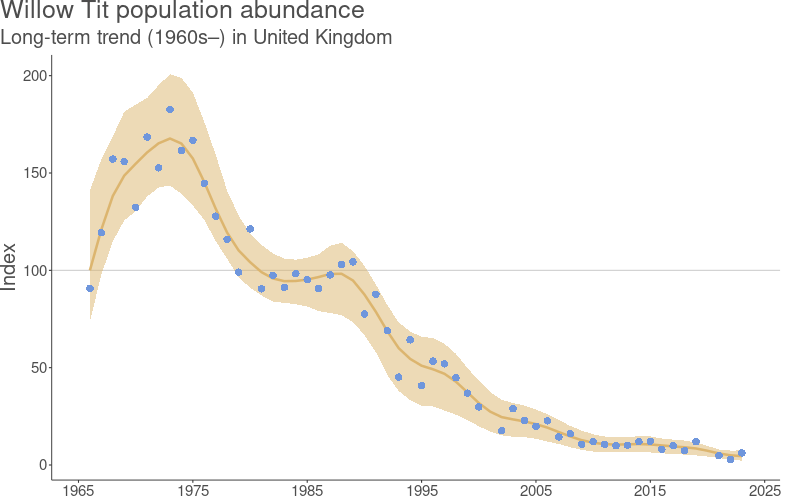
We’d need to look back into “prehistory” (from the BTO’s point of view!) to ascertain what’s really going on here, but I can see two things which don’t support the Broughton–Lees–Shutt hypothesis:
- For about ten years (1965–75), Willow Tits were actually increasing at the same time as Blue and Great Tits!
- The populations of Marsh and Willow Tits haven’t rebounded in response to the recent decline in Blue and Great Tits – while this doesn’t rule out a role for Blues and Greats in Marsh and Willow decline, it does suggest that something else (almost certainly habitat destruction) is the major limiting factor for Marsh and Willow Tit populations.
Why are some people so prejudiced against bird feeding? I just don’t understand… 
Back to me: I love David’s approach to this. I note that he didn’t mention the recent declines in both Blue and Great Tit numbers shown by the BTO BirdTrends graphs. It seems that they both hit a peak about 2005 and have been steadily declining ever since. That is something that is also supported by the data for the Braydon Forest.
In my next piece I am going to look at the attempts to blame the spread of Trichomoniasis in Greenfinch and Chaffinch on garden bird feeding. As a taster: are you aware that signs of Trichomonas infection have been found in Tyrannosaurs? Let’s face it: birds are modern day Saurischian dinosaurs! Tyrannosaurus was a Saurischian dinosaur. I do love a link!
 Ringing In The Braydon Forest & Beyond