A bit of Shakespeare to start this blog piece: “Oh what a tangled web we weave when first we practice to deceive!”
I was joined by Laura and Ellie for this morning’s session at Blakehill Farm. The last couple of hundred metres of hedgerow that I would usually set nets along has just been laid. It was desperately in need of doing – but it certainly won’t be hosting too many birds in the next few months. Because of that, we decided just to set nets on the plateau.
I arrived a bit early and drove out onto the plateau with the nets and poles ready to set up. I had fantastic views of two Hares running away from me as I crawled along the track. Once I had parked up, I had nice views of a Curlew flying across the centre of the plateau, calling as it went. We heard that call a lot this morning. I also had a Raven kronking away overhead. When joined by Laura and Ellie, we had superb views of a Barn Owl quartering the ground for the next ten minutes or so. The plateau was alive with Skylarks: with them chasing each other all over and then catching the escalator up to sing their songs.
We set the following nets:

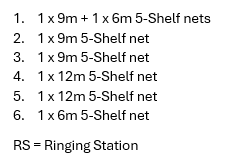
We had the nets open by just before 8:00, and did our first round at quarter past. It was an excellent first round: five Linnet, three Reed Bunting and a Dunnock. So, why the Shakespeare quotation at the start? Because, with the exception of a Willow Warbler at 9:20, that was it! The total list for the day was: Dunnock (1); Willow Warbler 1; Linnet 5; Reed Bunting 1(2). Totals: 7 birds ringed from 3 species and 3 birds retrapped from 2 species, making 10 birds processed from 4 species.
So, we had a lovely time, with excellent weather and lots of wildlife to see: we just didn’t catch them! However, it was pretty rewarding to catch our first Reed Buntings, Linnets and Willow Warbler of the year. Blakehill Farm, on the Chelworth Industrial Estate side, is my most regular site for Reed Bunting and it was one of my target species for the morning.
The Linnets were a lovely catch. Since 2019 we have annual totals of 5, 2, 2, 2 and 2 Linnets across the farm. To catch five in one session in March is remarkable.

If you look, you can see the pink blush on the chest. It is a clear indicator that it is a male. There are other indicators that you can use with birds in the hand. One involves looking at the wings, much easier is looking at its cloaca: this bird had a very obvious cloacal protuberance, i.e. it is a male coming into breeding condition.
As for the Willow Warbler, we don’t catch many on the plateau, or in that hedgerow, come to that! We have had a total of 17 since we started working at Blakehill in 2015. This is only our second Spring catch there: the first being in April 2019. 2020 was our best year for them: five caught in June, so probably breeding, and three caught in August, possibly on autumn migration. Take those eight away and you can see how scarce the are at this site. It is the earliest catch my team has ever had for this species at any of our sites, by four days. The only others were two caught at Lower Moor Farm on 30th March last year. Looking at the group records as a whole, there were only another two caught in March: one at Langford Lakes on 30th March 2023 and, the earliest of the lot, at a farm just outside the village of Alderton on the 21st March 2024. So very uncommon in March.

It was a feisty critter and didn’t want to pose for photographs, hence just a controlled head shot of today’s bird.
Having had no birds in three separate rounds, we decided to call it a day and closed the nets and took down. We left site by 11:30. It would have been nice to have had more birds, but it was still a lovely session.
 Ringing In The Braydon Forest & Beyond