It was just David and me on site this morning. I have been testing the site in the run up to the start of the CES season. The CES catch has been steadily declining, as you can see from the table and charts below:


The fall in the numbers coincides with declines in the number of species caught each year:

The simple fact is that this is entirely the point of carrying out a CES. The question for me is whether the return is worth the effort put in. Is it worth continuing with? What I decided to do, in the run up to this year’s scheduled CES season, was to test the site, see whether there are any early signs of improvement after the Wiltshire Wildlife Trust carried out some remedial work along and around the rides. My last visit, on the 28th March, produced 23 birds, which included five Redpoll, on outgoing Spring migration, heading north, as is the tendency of this species in north Wiltshire. Today I was looking to see whether the incoming Spring migrants had arrived and what impact that might have had.
The biggest misses for me are: the loss of Lesser Whitethroat: in double figures up to and including 2019, none since; Sedge Warbler, always a few on passage until 2018, none since; Reed Bunting, between five and eight every year until 2019, only two singles in 2022 and 2023 since. Even Chiffchaff, with three figure catches between 2015 and 2019 inclusive, down to 50 and 45 catches in 2021 and 2022, then just in the 20’s for 2023 and 2024.
Today we set the standard CES nets, with a slight modification, for the three rides in the Wildlife Refuge, plus one extra net, to see if it added anything of value to the catch. It is important to me, as their trainer, to ensure that our sessions produce enough birds for the trainees to get sufficient experience. Ideally I want them to have 15 to 20 birds minimum in a session, especially at this time of year when they are working on sexing birds and looking for brood patch development in females. If I can provide that by setting my standard CES nets, plus a couple of extra nets, then there is a reason to continue with CES. If not, then I think I will need to retire it.
We met at 6:30 to set our nets. Net ride 1 looked like this when we arrived:
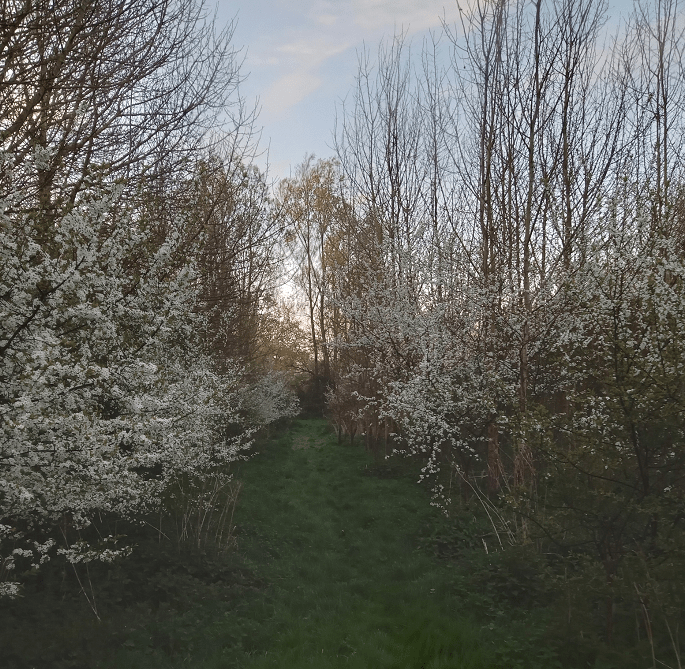
I have never seen it so lush with flowering Blackthorn: it is clearly benefitting from the work that Jonathan (the farm manager) and his team and the estates teams have put in to improve the habitat. What would it mean for the catch?
The nets were set as follows:

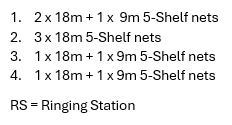
After a bit of faffing around with rides 3 and 4, due to the need to tame a few brambles that were insisting on becoming involved with the nets, we had them open by 7:45. The first bird hit at 8:15 in ride 2: a retrapped Wren. The next bird hit at 8:45: this was a Cetti’s Warbler ringed as of unknown age, in May 2020. So it is at least six years old. Clearly this bird, a male, has its territory in the area where rides 1 and 2 overlap as it has been caught in that area another 11 times since it was ringed.
As you can probably guess from the title: it really was a bad session in terms of numbers. We caught: Long-tailed Tit 1; Wren (1); Dunnock 1; Cetti’s Warbler (1); Blackcap 1(1); Chiffchaff 1(2); Goldcrest (1); Bullfinch 2. Totals: 6 birds ringed from 5 species and 6 birds retrapped from 5 species, making 12 birds processed from 8 species.
The only positives were 1) the Bullfinches: definitely a pair. They were taken out of the same net in ride 2, where they were close together. After processing we released them together and the flew off together into the same tree, where they shook themselves down before heading off together. 2) the Cetti’s Warbler and 3) David got to see some very clear stage two brood patch developments. (I could add “4) no Blue Tits!”)
It was a lovely morning: the weather was fabulous and we had lovely conversations with a lot of people, just a shame that we didn’t have the birds to make it an excellent morning. We closed the nets at 11:45 and took down, getting away from site at about 12:30. I will try another session in two weeks before making a final decision on whether to carry out the CES this year or to lay it to rest.
 Ringing In The Braydon Forest & Beyond