I have threatened to do this post for a long time, so it is time I pulled my finger out and got on with it. One of the good things about Blue and Great Tits for ringing is the volume of data it provides. The downside is the volume of data it provides or, to put it another way, just how many pecks one endures whilst extracting and processing them, particularly from Blue Tits: the most feisty birds you can find. This first part is focussed on Blue Tits: the most data and the most retraps to evaluate.
This is the Braydon Forest, with my sites identified:

These are the Braydon Forest sites:
- Blakehill Farm
- Red Lodge
- Ravensroost Wood
- Somerford Common West
- Somerford Common
- The Firs
- Webb’s Wood
- Purton (home)
These are the distances between the sites:
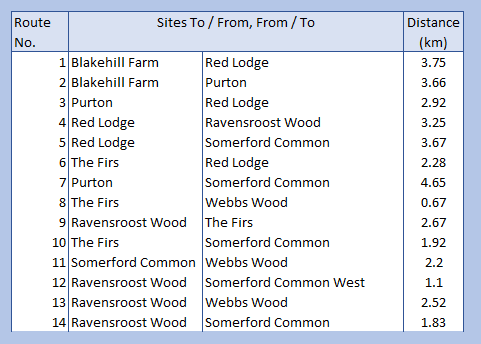
Since I took over ringing in the Braydon Forest, in August 2012, I and, later, my team had ringed 4,955 Blue Tits up to the end of 2024. We have recaptured birds on 2,086 occasions. i.e. 42% retrap rate. In all of that time we have recaptured just 91 birds in sites other than that at which they were ringed. Putting that another way, of 4,955 Blue Tits ringed only 1.8% have been caught moving site.
The following table shows the number of recaptures for each of the routes identified:
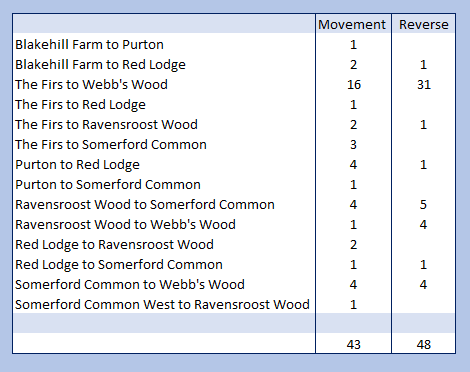
As is clear to see, the vast majority of movements, 51.6%, are less than 6o0m. There is only one movement of over 4km. Hardly the wide-ranging species some would have us believe. I would love to see other people’s data, to see if this is unique to this area.
In addition to these movements, we have had some movements into the Forest from elsewhere, that we have recaptured, plus others that have moved out of the Forest and been recovered elsewhere:

Only four birds ringed within the Braydon Forest have been recaptured or, in the case of the Echo Lodge bird, reported as dead. The key inward recovery was AVF6109, ringed in Fort Augustus in the Highlands: the second longest known movement within the UK. Putting it into perspective: we have recaptured just three birds that have moved more than 50km into the Braydon Forest (o.14% of the birds recaptured).
None of the birds that have been recovered having been ringed in the Braydon Forest has moved more than 10km from their ringing site.
 Ringing In The Braydon Forest & Beyond