Quiet time: no lures now to attract the birds. All on territories, some migrants still to arrive but plenty in the country, plenty having established their territories, singing away, and plenty already ready to breed, if they haven’t started already. So it is a case of setting the nets and hoping they find their way in.
It is also time to get up early. I have to admit, I have no roost sites and I am quite pleased that I do not have to get up before dawn to get everything set up to catch them leaving. Today David, Ellie and I met at Webb’s Wood at 6:00 and set the following nets:

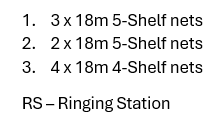
Whilst we were setting the nets the sheer volume of birdsong was lovely. The most prominent in the mix was Willow Warbler. Somerford Common is usually our best bet for this species, and has started out well this year, but really nice to hear them in Webb’s Wood. Plenty of Chiffchaff and Blackcap calling as well, and a completely tuneless Song Thrush. Also, all morning we had Jackdaws jacking, Ravens cronking and Carrion Crows croaking!
We had a Blackbird get into the nets in ride 1 before they had been opened and round one produced six birds: a false sense of optimism ensued! After that we had small catches most rounds, and finished on a nice round 20. Given that our last session at Webb’s, with lures galore, produced 28 birds from 11 species, 20 isn’t too bad, given the lack of lures and the small number of nets.
There was an usual element to our catch: we caught and ringed four adult Blackbirds in one session. I have caught four before, but not for five years and never before in Webb’s Wood. We also caught only our second ever Garden Warbler for Webb’s Wood: the first one was caught there 11 years ago.
The list for the morning was: Blue Tit 1(1); Wren 3(2); Robin (1); Blackbird 4; Blackcap 4; Garden Warbler 1; Chiffchaff 2; Willow Warbler (1). Totals: 15 birds ringed from 6 species and 5 birds retrapped from 4 species, making 20 birds processed from 8 species.
Thirty percent of the catch was female. They were all showing well-developed brood patches. Two of the Blackcap were female and had finished defeathering their brood patches (stage 2 in the BTO recording system). Also, two of the Blackbirds were female, as was the recaptured Blue Tit and one of the Chiffchaff, and their brood patches were engorged with blood vessels (stage 3), indicating that they were actively brooding either eggs or chicks.
It was sunny and warm but, unfortunately, there was also an annoying breeze that seemed to swirl all around the nets, which might have had an impact on the catch size, making the nets more visible. Fortunately, when affecting rides 1 and 2 it wasn’t affecting ride 3, and vice versa, so it was manageable and, more importantly, safe for the birds. Anyway, after a couple of empty rounds, we shut the nets at 11:30 and took down. With David’s Dad’s help, we had the nets down and everything packed away before midday, and were off site quickly. A quiet but very pleasant session.
 Ringing In The Braydon Forest & Beyond