After one of the most frustrating end to the month of my bird ringing career it was great to be able to get out again. My last session was on 22nd May at the Firs: just 19 birds, but some good catches including the first juvenile Chaffinches of the year. On the 23rd, whilst box checking in the Braydon Forest with Ellie, my car decided to recreate the same fault as it had the week before, with the clutch pedal falling to the floor. So I contacted Green Flag: same fault so £150 to recover me – until I told them where I was. They then added another £300 to the cost because, being in the middle of a field, they would need to send “specialist equipment”: which equated to a 4×4 with winch to pull me out of the field so it could be put on the recovery lorry. I pointed out that, in the heat, this field was a harder surface than most asphalt, but they were insistent, so I contacted a local lad, Quick Time Solutions if you are in the area in need of assistance, who did the whole recovery for the £150, no fuss, no bother. My local mechanic came out and topped up the fluid reservoir, bled the system and went off. Saturday morning I went out to test it: pedal straight to the floor! This time it required a new gear box and all the trimmings: the cost more than the residual value of the car! So I now had to hire a car and go shopping for a new one: which I will pick up on Monday. Fortunately, my frustration was mitigated by the simple fact that the weather was far too windy for me to set any nets, so I wouldn’t have got out ringing anyway. Which brings us to Saturday.
I was scheduled to spend the day on Salisbury Plain with Dick and Jon of the Salisbury Plain Raptor Group as part of the training requirement for the T-permit holders in the group. Their trainee had to drop out so there was a spare place in the vehicle so, alongside the three of us, we were joined by Ellie from my team. She hasn’t been ringing long and certainly has no experience of handling birds of prey, let alone climbing high ladders up to trees etc. An opportunity for a fairly steep learning curve.
Ellie and I left my place at 7:15 to get to Westdown Camp for 8:30, and arrived about 50 minutes later. I really must get the timing right. Anyway we were all packed up and ready to head off bang on time, to check a load of boxes to see what was happening. It is an incredibly late start to the breeding season for both Barn Owls and, somewhat less affected, Kestrels. There is one good thing about that: most Jackdaws will have fledged their one brood by the end of this month, so some boxes can be cleaned out and available for Barn Owls and Kestrels to get on with their breeding season. The issue is reportedly the lack of availability of voles due to the hot weather and a lack of growth of the grass that voles and mice need to provide them with nesting space and to hide from predators. From what we were seeing, that is pretty much how it is everywhere at the moment. Even the short period of rain doesn’t seem to have helped with that.
We visited 25 boxes yesterday. That included a temporary Tawny Owl box in the training village that Jon works in. It is a good story: he found a Tawny Owl chick on the ground outside one of the barns in the village. He put the bird on the roof of a shed inside the barn, for mum to come and find him. For those that don’t know, once Tawny Owls get to a certain stage they do a thing called “branching”. Essentially, they leave the nest and go for a wander, which was almost certainly what this had done. When Jon found it, its belly was empty, so he went off to find some roadkill to give it to eat. It just shows how scarce food has become: he couldn’t find any, so went to the local butcher’s shop and bought the bird some steak! He also put up a temporary owl box for it roost in, whilst waiting for it to be found. It was fed for four or five days by Jon and is doing well. So we went to ring it, only to find it had branched out again. We went searching and Jon eventually found it sitting in a shady nook behind a steel girder in the barn. We could hear mum calling from just outside the barn, and there is evidence that she has found it and is now bringing food! That’s a relief.

This chick is actually the first one we found and it became the first Tawny Owl that Ellie has ever ringed. Jon was extremely good at showing Ellie how to hold it in the right position for ringing, what measurements to take, and the current state of development of the primary and secondary wing feathers. This first Tawny was actually found in a Barn Owl box, which is a little unusual, but the side inspection panel on this box had come open which might have had an influence on the parent’s choice. The hatch was left open so we didn’t confuse the parents returning with food.
Over the course of the day we checked 11 Barn Owl boxes: 2 had Barn Owl pairs, plus one with a roosting male. Hopefully that means there is a female nearby. As well as all of that, there were two BO boxes with Jackdaw nests, if you can call the absolute stacks of sticks a nest. Both had chicks, both were so stuffed with sticks that the chicks, who look like they will fledge in the next week or so, couldn’t actually stand upright. Jon removed a couple of layers so that they could be a bit more comfortable in the box. In one of those boxes, which had three chicks, he also found two cold eggs. He made the mistake of opening them to find out what stage they had failed at. Suffice to say, the smell of hydrogen sulphide was pungent and much hand cleaning was required.
We also found three Grey Squirrel drays in BO boxes. They were removed and the nest box cleaned out, hopefully for use later on in the season. Two of them held Stock Doves. Both were a bit sad, actually, one was tragic. One had two cold, almost certainly infertile, eggs. The eggs were left in place, just in case they have only just finished laying and the female hasn’t started brooding them yet. Both parents had flown off from the box before we approached it. The other one was tragic: there was a dead adult in the box and the eggs had been cracked open and eaten. The nature of the predation suggests Stoat or Weasel.
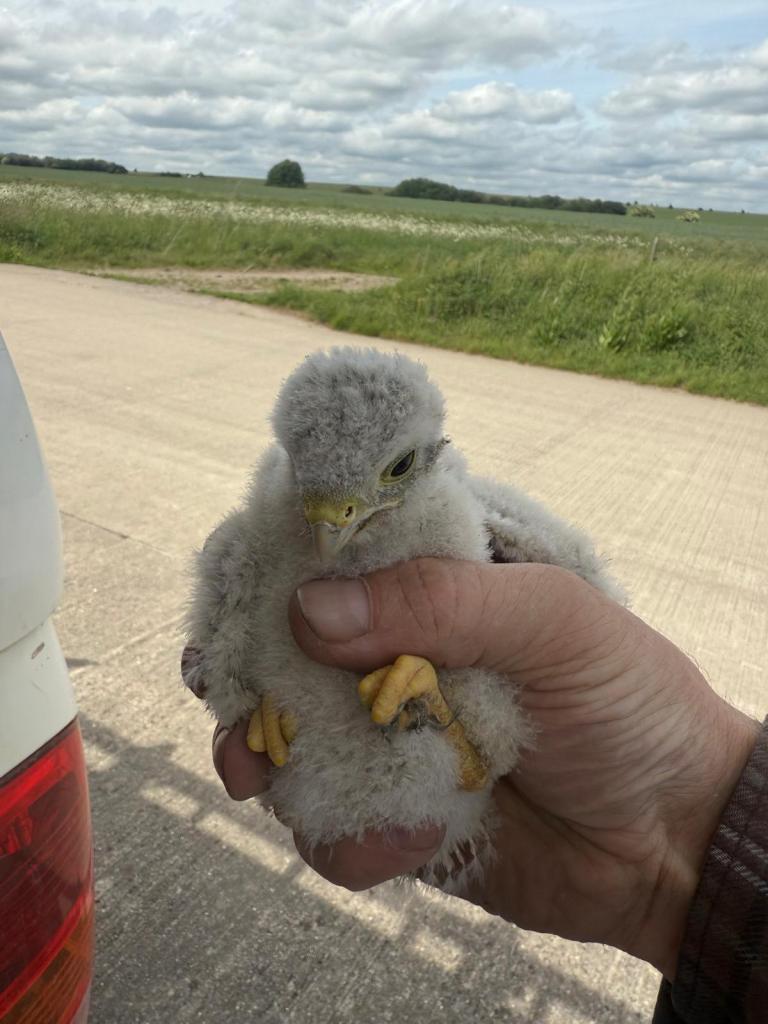
We also checked 13 Kestrel boxes: three with Kestrel pairs, one with three chicks that we ringed. Again, Ellie got her first experience of handling and ringing Kestrel chicks. Jon helped her with how to hold and manage the birds for ringing. She was rather lucky in that they were at the stage where they are easy to handle. Give it another week or so and they will be all beak and claws!
One of the Kestrel boxes was quite unusual. Kestrels usually create a scrape into which they lay their eggs. In one of the boxes Jon found this:

Jon and Dick tell me, as they have so much more experience of nesting Kestrel than I do, that this is unusual, to find something as well defined as this.
In terms of the struggle to find food, we did find the remains of birds in the nest and a number of Kestrel pellets. This first set of feathers is pretty obvious, the second, not quite so:


I got the latter identification from the excellent book “Raptor Prey Remains” by the renowned Peregrine expert: Ed Drewitt, published by Pelagic Publishing in 2020 (no, I am not being paid for this advert).
The pellets were also pretty interesting. Primarily consisting of fur from multiple sources, they also contained a number of beetle elytra, mainly Violet Ground-Beetle, Carabus vilolaceus, as far as I could tell.
One Kestrel box had Jackdaw sticks in it but no sign of a breeding attempt. Another one had a Stock Dove inside, with no evidence of breeding.
We covered a lot of ground during the day, met up with Justine and Mark, who I am out with on Tuesday to check the Lower Wylye Valley boxes, who were parked up photographing House Martins collecting mud for their nests, from the only puddle we saw all day on the Plain. Apparently it is normally a pond!
We packed up and were back to Westdown Camp by 15:30, back to mine by 16:15. I am looking forward to the next session: I will be out with the SPRRG again on the 14th June.
 Ringing In The Braydon Forest & Beyond