I spent Tuesday with Justine and Mark driving around the villages of the Lower Wylye Valley. We were checking boxes to the east of Warminster, taking in farms and areas around the villages of Sherrington, the Codfords and the Langfords.
The primary objective was to carry out a recheck of several Barn Owl boxes done at the start of the season. Unfortunately, we only found one Barn Owl on eggs: just two eggs so far. That will be rechecked in about 10 weeks, as there should hopefully be at least two more eggs to be laid and they will have hatched and be ready for ringing.
Overall, though, it is still very poor on the Barn Owl front. With the recent change in the weather we are hoping that there will be a run of later broods, in effect their first brood, when they would usually be thinking about their second. The cold dry spring affected the grass growth, which was negligible. That had the effect of slowing the availability of key prey species, particularly the breeding of the various species of vole and mouse. This meant that there has not been enough prey for the Barn Owls to get into breeding condition.
It doesn’t help that several boxes contain nesting Jackdaws or squirrel dreys. One regular and productive site for Barn Owls that we checked had been taken over by honey bees. The box itself was full of honeycomb with absolutely no chance of owls taking over, so a visit in winter will be needed to clear that out ready for the spring.
Seven more Barn Owl boxes had either roosting pairs or were empty. One such, the most difficult to access, with the long ladder extended to its fullest extent, held one roosting adult male. Mark climbed the ladder and Justine and I held it firm to ensure no mishaps. Only, we hadn’t reckoned on the owl disgorging a considerable amount of guano as it left. Everyone got some but me, being directly under it as it left, caught it in my hair, down my arm and neck and down the back of my T-shirt. Nicely wet and smelly!
One other box we checked was empty. Mark had mentioned that both Kestrel and Barn Owl had taken advantage of the support girders to nest in last year. Sure enough, he had a look to see and a pair of Barn Owls flew out of the end of the girder and headed across the field. There was no sign of a nest or eggs. It is fortunate that Barn Owls are multi-brooded. Another positive point: Jackdaw young will have fledged within the next week or so, those boxes can be cleaned out, giving more opportunities for Barn Owls to select for breeding.
There is much better news on the Kestrel front. When checking their boxes we found one with a clutch of eggs, which will be checked in a few weeks time to see what has hatched and how they are progressing. Another with small chicks and an unhatched egg:
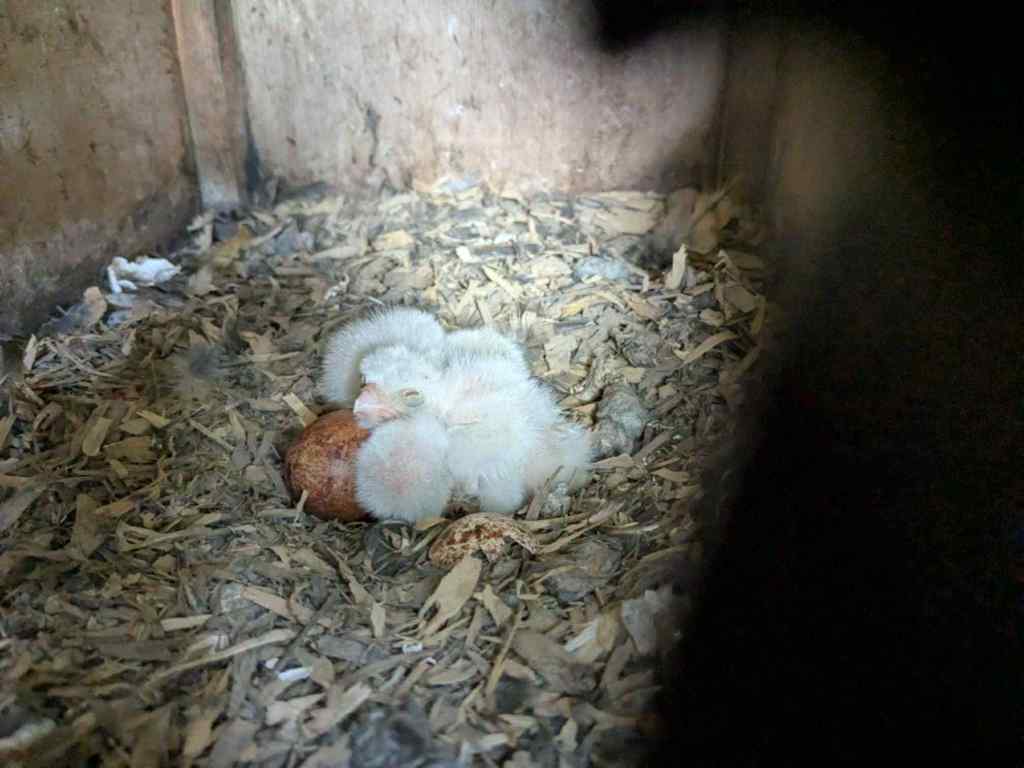
We had three boxes with young in that were too small to ring:

There was one brood of five, of which we ringed four. One was much smaller than its siblings and we are all rather of the opinion that it was unlikely to survive, unless the parents could provide a decent amount of food.

As with my post about the box checking on Salisbury Plain, I think that the Kestrels greater flexibility in taking prey species is probably why they are having more success than Barn Owls. This time we found the remains of a juvenile Robin in one box and these outside another box:

We went to check on a few Little Owl boxes as well. As we approached the last one we saw an adult sitting on the gate post at the entrance to the site. It flew off and disappeared around the back of the barn as we got closer. However, it was a prelude to the highlight of the day:

We found this lovely little owl. It was so cute that three grown adults went totally soppy over it. It was lovely and docile – and I got to ring it, only my second ever. There were originally 4 eggs in the box, so it was either the only one to survive, or the last to fledge. I hope it is the latter. It is close to fledging. Little Owls are disappearing fast from Wiltshire, for whatever reason.
We were out from 9:00 until 4:00: a long day, a lot of driving and stopping and taking ladders on and off the vehicle, climbing the ladder, checking the boxes, bringing down the chicks to check and ring and health check, do the biometrics etc. Should I put that another way: that’s what Mark did, Justine and I gave moral support and ringed a couple of birds! Good job he is fit!
Anyway, it was a satisfactory day for Kestrel, and a somewhat more hopeful day for Barn Owls, we shall see how it goes.
A big thanks to Justine for sending the details through of what we covered in the period and for allowing me to use it for the blog.
 Ringing In The Braydon Forest & Beyond