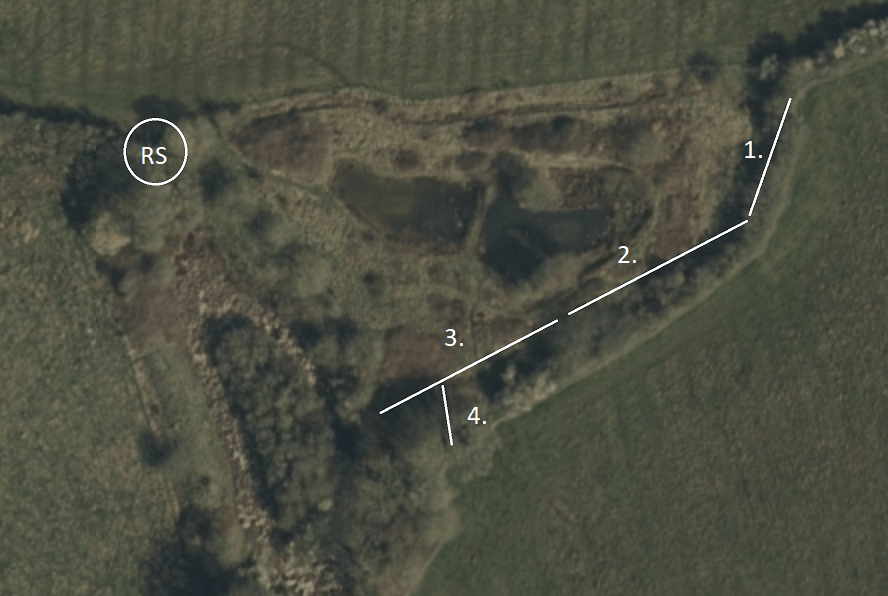
This my first visit to Ravensroost Meadows this year. Funnily, our first visit last year was on the 12th of this month. I am not sure why we didn’t do a May session, as that is often pretty good at this site as well. Anyway, because we hadn’t been there since last Autumn, I told the team to have a lie-in and join me at 6:30, whilst I got up considerably earlier and went strimmed out the rides. After the long, dry May, followed by some considerable rainfall, and back to sun, needless to say that the vegetation has grown considerably. The weather is still a bit of an issue, with sun all day, but an Easterly / East-South-East wind gusting to over 20mph mid-morning and 30mph by lunchtime. The good thing about this site is that there are very good, thick hedgerows that block winds coming from that direction. I was joined by Laura and Ellie and we set the following nets:

Mariana, from the Zoological Society of London joined us again to take samples from migratory birds. The study is looking at whether migratory birds arriving in the UK are carrying mosquito-borne exotic diseases, particularly West Nile Fever, as it is spreading across Europe and is likely to be arriving here soon, if it hasn’t already. There are no known cases of home-caught illness, and just seven travel-related cases recorded in the UK but climate change could make that more likely.
It was a nice start to the session, with three birds caught before the nets were open: juvenile Robin and Chiffchaff and adult Wren. In our first round proper we had an excellent drop of 18 birds: nine Chiffchaff, one poor worn-out female Willow Warbler and our first five of these for the year:
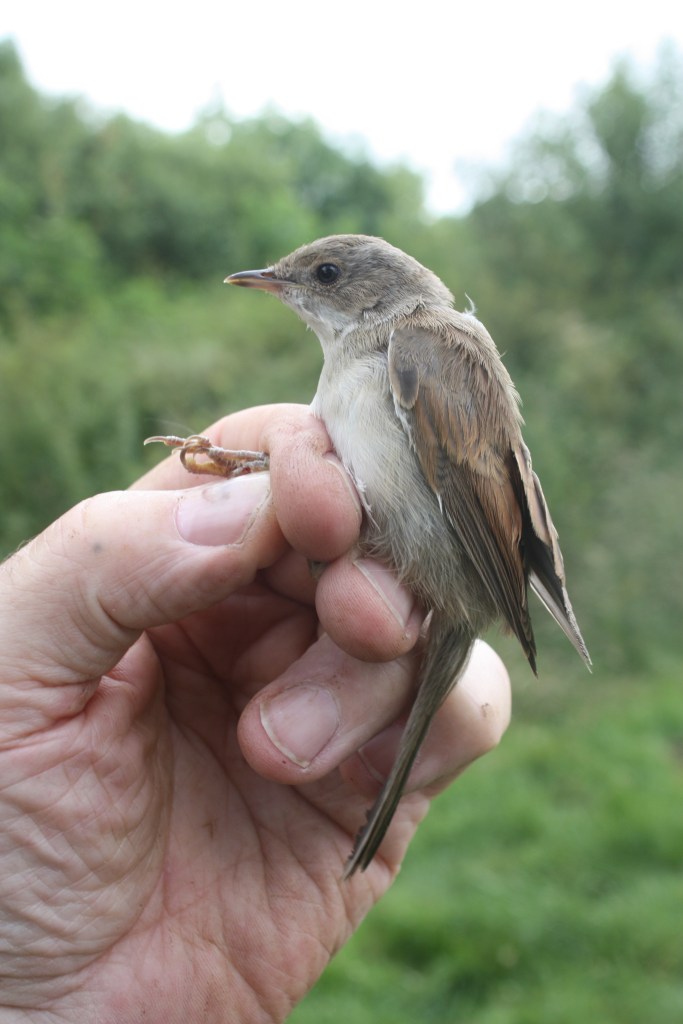
One of the four was a retrapped female. She was ringed as a juvenile at this same site in July of last year. The youngsters were all caught together, all at the same juvenile moult stage, possibly along with Mum, as she was in the same group. Possibly just recently fledged as a group. Two rounds later we caught an adult male in the same net, was it the whole family?
Anyway, it was a good session. We had birds in every round, and a nice variety. We could have added another species but the rather beautifully plumaged male Chaffinch had a mite infection on its legs: it looked like it was wearing white socks!
The list for the day was Adult [Juvenile](Retraps): Blue Tit [5]; Great Tit [4]; Wren 2; Dunnock 1[1]; Robin [2]; Blackcap 1; Garden Warbler [1]; Chiffchaff 2[14](1); Willow Warbler 1; Whitethroat 1[4](1). Totals: 8 adults ringed from 6 species, 31 juveniles ringed from 7 species and 2 birds retrapped from 2 species, making 41 birds processed from 10 species.
The breeze started having an impact on ride 4 at about 10:30, and more generally by 11:00 so I declared that the 11:20 round would be our last and we would close up as we were checking for birds. It was clear that the birds had also decided it was time for us to pack up as there were none in the nets. So we closed up and took down. I introduced Ellie to how I like my nets to be taken down and packed away. She took to it like a duck to water and we had the nets down and were away from site before midday! Most unusual but, then, unlike a lot of ringers, I don’t set lots of nets. I like my team to enjoy themselves and not feel pressured by numbers. We do get the odd 100+ catch, but always by accident, not design. Mariana remarked upon how relaxed and pleasant our sessions are. She got a lot of samples today for the research project, which is being carried out on behalf of an absolute alphabet soup of government departments, ZSL Institute of Zoology and the BTO. We hope to see her again soon.
 Ringing In The Braydon Forest & Beyond