With temperatures forecast to be rather high, I wanted to go somewhere a bit sheltered from the sun and the forecast breeze and Somerford Common seemed like the best bet. Laura joined me at 6:30 to help set up and, hopefully, ring some birds before she had to leave at 9:00.
I chose not to set a lot of net as I knew that I would be taking them down on my own and that it would be hot by then (and I am lazy). We had the first nets (white) set up by just gone 7:00, as follows:

All nets were 5-Shelf. Rides 1 and 2 comprised 1 x 18m + 1 x 12m each. Ride 3 was 2 x 18m + 1 x 9m, ride 4 was 1 x 18m and ride 5 was 1 x 9m. I will explain the colour difference in a short while.
Whilst Laura was pushing up ride 2 and then 1, I went to get another furling stick to push up ride 3. Only, as I was walking past the ride, I noticed our first bird of the morning. I was pleased it was another juvenile Garden Warbler. It seems to be turning into a good year for them in the Braydon Forest. We have only ever ringed 21 juveniles in the forest since January 2013, 10 in Ravensroost Wood and 8 at Somerford Common. When I whittle it down to those not yet undergoing post-fledging moult (moult code J) we have only ever had six, three of them this year.
We did our first round proper at 7:30 and, delightfully, extracted 11 birds out of rides 1,2 and 3. Ride 2 produced the one bird: our first juvenile Wren of 2025:
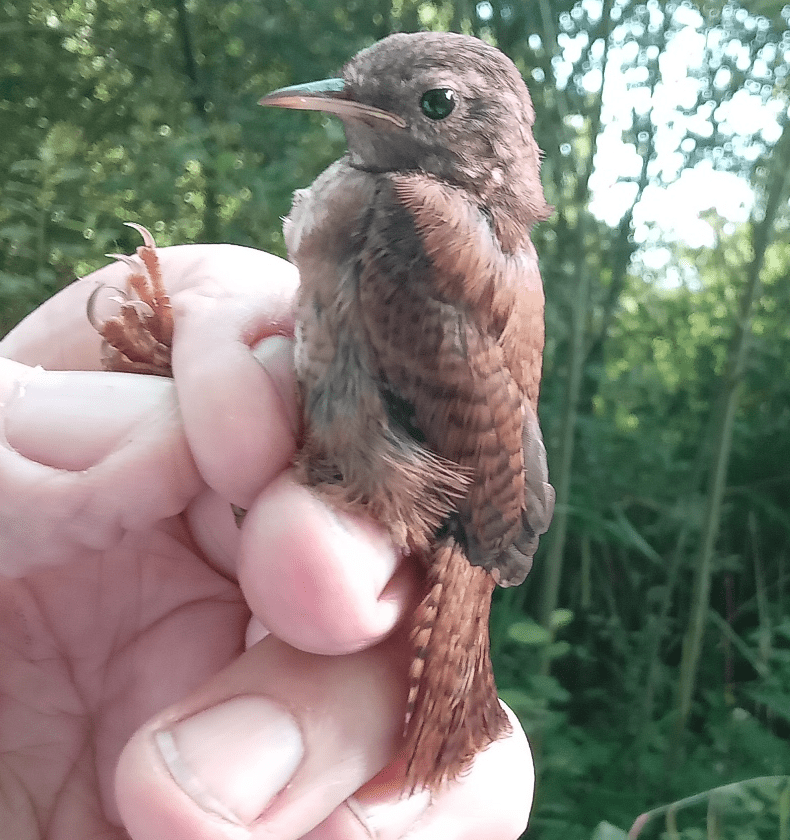
This one still has a little bit of gape on show. Not really surprising as it hadn’t started its post-fledging moult yet. There are lots of ways of ageing Wrens but, at this time of year and this level of development, the easiest way is to look at the undersides:

Nice, warm brown tones. As they get older the undersides acquire white spotting but at this stage there is none. All 11 of the birds we extracted in this round were juveniles.
A good start we thought, only then it stopped! By 8:30 we hadn’t caught another bird, which is when I decided to set up rides 4 and 5. Unfortunately, we still didn’t catch any other birds until after Laura left at 9:15. Hanging on in hope!
By 10:00 I had had enough, it was getting very hot, and I decided to start packing up. Ride 2, the furthest away, was where I was going to start. I thought I would do a check on rides 4 and 5 before closing it down. Rides 1 and 3 were always visible from the ringing station, so I knew they were empty. Imagine my surprise when I found three of these all together in ride 4:

Another species with our first juveniles of the year in the Braydon Forest! (Laura has just reminded me that we caught one in her garden last Sunday – but that’s in Gloucestershire!) They were accompanied by another juvenile, a Robin. That was it for another 30 minutes, so I started the take down: ride 2 first. As luck would have it, I had the first net just about down when a Robin flew into the second net. I extracted it and finished taking the ride down. I processed it, our only retrap of the morning, and released it.
Next I took down ride 1 and, as I was carrying the equipment back to the car another bird flew into ride 3. That was the final bird of the session: an adult male Chiffchaff. The list for the session was: Blue Tit [5]; Coal Tit [3]; Long-tailed Tit [2]; Wren [1]; Robin [1](1); Garden Warbler [1]; Chiffchaff 1[3]. Totals: 1 adult ringed, 16 juveniles ringed from 7 species and 1 bird retrapped, making 18 birds processed from 7 species.
Both of the Long-tailed Tits were still very definitely in juvenile plumage, lots of brown where one would expect black in an adult or a fully moulted juvenile and lots of body moult going on. However, one of them was undergoing a moult of its secondary flight feathers already: one feather at stage 1 (just the tiniest tip of the feather emerging from the pin) and another at stage 2 (up to one-third emerged from pin), the rest were all what they came out of the nest with.
I would have liked a bigger catch but was happy to get the juvenile Wren and, even happier, to get the juvenile Coal Tits. Whilst we have caught juvenile Coal Tits in May in 2015 and 2019 in the Forest, it is still uncommon to catch any number in June at my sites. As for the juvenile Wren, there have been none in May and only three caught earlier in the month of June – all in 2014. In 12 years we have actually only caught 17 juveniles in June prior to this one. So this is quite a nice find.
I had everything packed away by 12:20 and was home at a decent time for lunch.
 Ringing In The Braydon Forest & Beyond